
Birds

CITE
We have made every effort to follow citation style rules, but there may be some minor differences. If in doubt, please refer to the appropriate citation style manual.
Sea birds. (2026). In Q-files Encyclopedia, Life, Birds. Retrieved from
https://www.q-files.com/life/birds/sea-birds
"Sea birds." Life, Birds, Q-files Encyclopedia, 23 Mar. 2026.
https://www.q-files.com/life/birds/sea-birds.
Accessed 13 Sep. 2026.
Sea birds 2026. Life, Birds. Retrieved 13 September 2026, from
https://www.q-files.com/life/birds/sea-birds
Life, Birds, s.v. "Sea birds," accessed September 13, 2026.
https://www.q-files.com/life/birds/sea-birds


Sea birds
About 300 species of birds live on or near the ocean, feeding on fish and other marine life. They include penguins, skuas, gulls, guillemots, terns, puffins, auks, skimmers, albatrosses, petrels, shearwaters, fulmars, frigatebirds, gannets, boobies, cormorants, shags, tropicbirds and pelicans. Some kinds dive into the water from the air, or from high rocks. Others skim over the surface, scooping up food. Some, such as penguins, can pursue their prey by swimming through the water. Most sea birds have waterproof feathers and rough, webbed feet to help them paddle or snatch up slippery fish. Many sea birds gather in large colonies to breed, often laying just one egg.

Colonies


The vast majority of sea birds gather in huge colonies, often returning to the same place every year to nest. Some species nest on the ground, while others nest on cliffsides or in burrows. Seaside cliffs are ideal nesting sites as they are out of reach of most predators while still being close to the sea, the birds’ main food source.
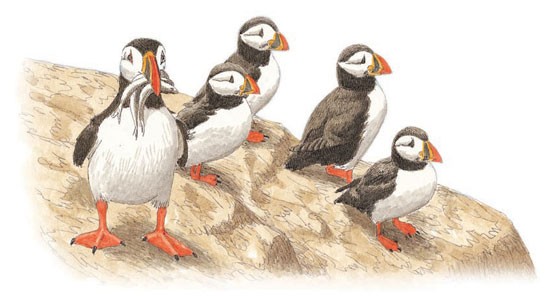
When their chicks hatch, parents catch fish to bring back for them. A puffin may carry about 10 fish in its beak at a time. Birds that feed further out to sea, such as guillemots, swallow their catch, then, on returning to their nest, regurgitate it into their infants' beaks.
Divers
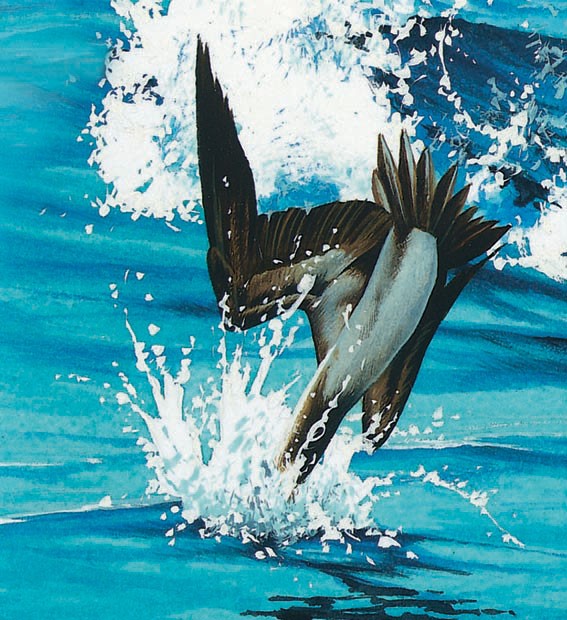
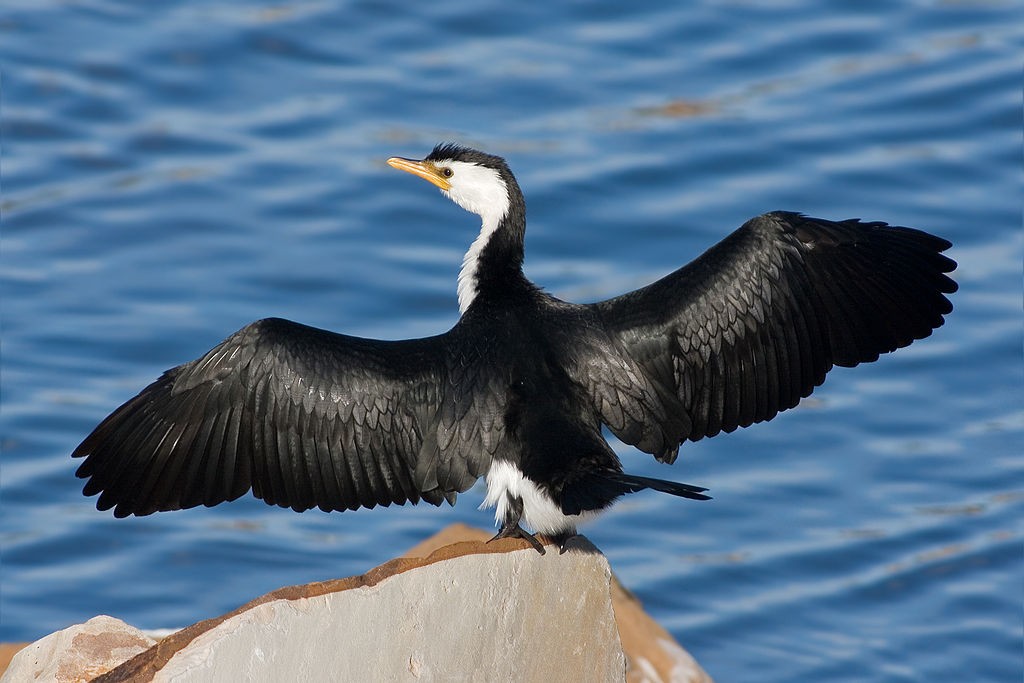
Some sea birds, such as gannets and boobies, plunge dive, using their airborne momentum to power through the water after their prey just beneath the surface. Others pursuit dive, swimming after their prey underwater. Some pursuit divers, such as auks, use their wings to push themselves through the water, while others, such as cormorants, use their feet as paddles.

Arctic tern
The Arctic tern spends the summer months in the Arctic, raising its young. Then it flies all the way to Antarctica, a distance of some 13,000 kilometres (8000 miles), where it spends a second summer fishing off the coast. It then returns north. This bird makes the longest migration journey of any animal. Over the course of its life, it may fly more than 1 million kilometres (600,000 miles).
Blue-footed booby
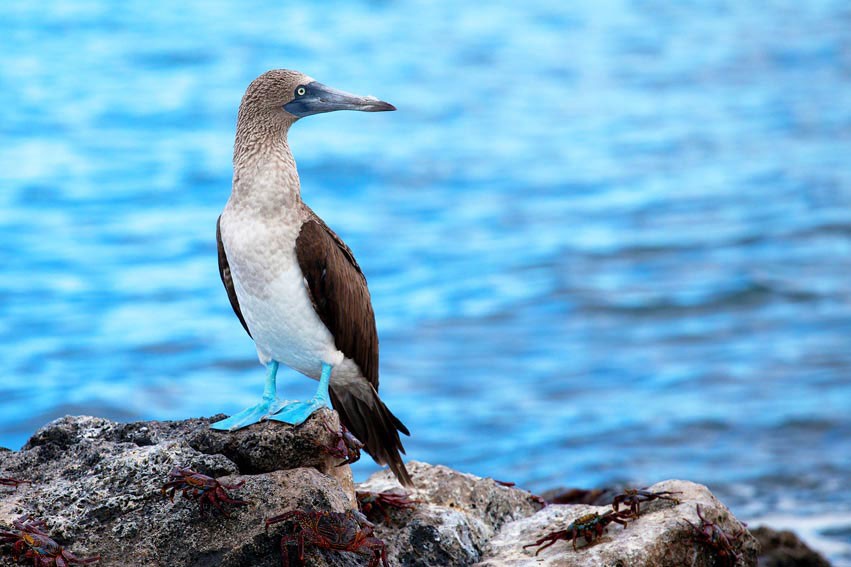
Blue-footed boobies are large sea birds, related to gannets. They nest on the steep cliff faces of the Galapagos Islands, off the west coast of South America on the Equator. They dive into the sea from high in the air to catch fish. Their tapered bodies cut easily through the water as they power beneath the surface. Their bills are long and sharply pointed, with serrated edges for gripping on to fish. Both male and female boobies have bright blue feet. Males display their feet during courtship to help them attract a mate.
Gulls
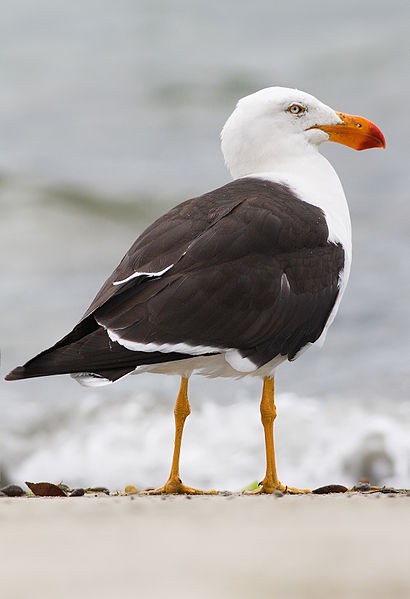
Gulls are large white or grey birds. Apart from the kittiwakes, gulls usually live near coasts or inland areas, rarely venturing far out to sea. They have a very varied diet, catching crabs and fish in shallow waters, but also insects, worms, eggs, small mammals, seeds, fruit and human waste. Gulls scavenge and steal food from other birds. They are able to unhinge their jaws, allowing them to eat large food items.
There are more than 50 types of gull, including the herring gull and the black-headed gull. Gulls gather together in large colonies to nest. They often display what is called "mobbing behaviour"—attacking potential predators and other intruders.
Magnificent frigatebird
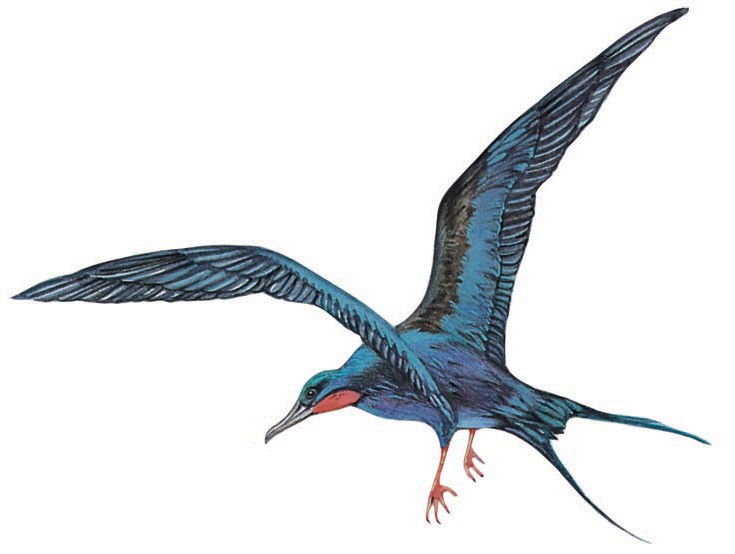
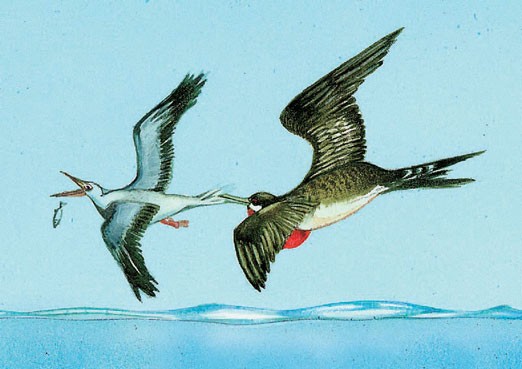
The magnificent frigatebird lives in Central and South American waters. It uses thermals, warm upcurrents of air, to soar to altitudes of up to 2500 metres (8000 feet). It catches fish and squid by swooping down to the water’s surface. But it also steals from other sea birds by biting their tails, forcing them to release their catch.

During the mating season, the male’s throat pouch becomes red and inflates. The bigger and redder the pouch, the more likely he is to attract a mate.

Tropicbird
The red-tailed tropicbird is a sea bird that nests in colonies on oceanic islands across the Indian and Pacific oceans. It is also known by its Maori name, amokura. Having small, feeble legs, it walks only with difficulty on land. In the air however, tropicbirds are agile flyers, often hovering before plunge-diving into surface waters to grab their prey. They may even swoop to catch flying fish in mid-air.
Pelicans
Pelicans are large sea birds with large throat pouches. Their long bills have a downwards-curving hook at the end of the upper jaw. This is used to catch large fish, which the pelican then tosses into the air so that it slides down its gullet head-first. The throat pouch is used to scoop up smaller fish from the water like a fishing net—and not to store food for digesting later, as is sometimes believed. Once a pelican has drained the water from its pouch, it swallows its prey whole. All pelicans fish from the water's surface, with the exception of the brown pelican, which usually plunge dives for its prey.


Puffins
Puffins are small black and white sea birds with orange feet and orange and blue striped beaks. They use their wings to push them through the water in pursuit of fish. Puffins can hold more than 80 small fish in their beaks, which they carry back to feed their chicks. Puffins nest underground, sometimes in abandoned rabbit burrows.
Shearwaters
Shearwaters are so-called after the way they skim, or shear, the water’s surface in flight. The short-tailed shearwater, or mutton bird, has long and narrow wings for high-speed gliding. It spends its summer breeding on the Australian coast. In April it flies north across the western Pacific to the Bering Sea. It returns over the middle of the ocean in September. It travels about 15,000 kilometres (9000 miles) in each direction every year.


Consultant: Chris Jarvis
pics



Without in any way limiting Q-files Ltd’s exclusive rights under copyright, any use of this publication to “train” generative artificial intelligence (AI) technologies to generate text is expressly prohibited. Q-files Ltd reserves all rights to license use of this work for generative AI training and development of machine learning language models.