
Birds

CITE
We have made every effort to follow citation style rules, but there may be some minor differences. If in doubt, please refer to the appropriate citation style manual.
Owls. (2026). In Q-files Encyclopedia, Life, Birds. Retrieved from
https://www.q-files.com/life/birds/owls
"Owls." Life, Birds, Q-files Encyclopedia, 23 Mar. 2026.
https://www.q-files.com/life/birds/owls.
Accessed 13 Sep. 2026.
Owls 2026. Life, Birds. Retrieved 13 September 2026, from
https://www.q-files.com/life/birds/owls
Life, Birds, s.v. "Owls," accessed September 13, 2026.
https://www.q-files.com/life/birds/owls


Owls
Though they are also hunting birds with strong beaks and talons, owls are a completely separate group to the birds of prey. Owls have flat faces with forward-facing eyes. There are 260 different species of owl. Most, but not all, are nocturnal, flying and hunting during the night while resting during the day. Unlike birds of prey, owls have forward-facing eyes. This gives them binocular vision, like humans, enabling them to have a good perception of depth. Their disc-like faces “collect” sound and direct it towards the ears, giving them exceptional hearing to locate their prey. Their feathers are soft, allowing them to fly almost completely silently, taking their prey by surprise. Using their superb eyesight and hearing, owls swoop down on their victims, seizing them in their razor-sharp talons.


Talons
An owl’s talons (claws) are needle-sharp—perfect for grabbing and killing its prey. A mouse or vole can be plucked from the ground and carried away easily. Owls have four toes. When they are flying, three of the toes face forwards, and one faces backwards. When they are clutching prey, and sometimes while they are perching, one toe swivels round to the back to improve grip. Owls have very rough feet, which helps them grip their prey or a perch.


Feeding
Owls are perfectly adapted to prey on small animals from different habitats all over the world. After catching its prey, the owl carries it away to eat in a safe place. After crushing it in its talons, it can swallow small prey in a single gulp. It eats larger prey by holding it in its talons and tearing it into bite-sized chunks with its sharp, curved beak. Owls mostly eat small mammals, such as voles and rabbits, but will also catch frogs, birds, worms and insects. Some owls specialize in catching fish, plucking them from the water's surface.
Pellets
Owls have no teeth and cannot chew their food, so they tend to swallow things whole. This means that they eat things like fur, feathers, teeth and bone, which they cannot digest. Instead, they cough up these remains in a small, neat ball. All owls cough up these soft pellets, usually about 15 hours after eating. They cannot eat again until they have got rid of the pellet from their last meal.


Owlets
Owls mate and lay their eggs—usually between two and four—in early spring. The female stays with the eggs to keep them warm, while the male brings her food. After a month, the first eggs hatch. The young owls are covered in fluffy grey feathers, called down. As an owlet grows, its down will be replaced with stronger feathers, better equipped for flight, and it will get its adult colouring. Tawny owlets usually leave the nest after about 10 days and hide on nearby branches before fledging, the time when their feathers and wing muscles are ready for flight.
Tawny owl
Found in woodlands all over Europe and Asia, the tawny owl eats voles, mice and small birds, as well as frogs, worms and insects. Its night vision is, in fact, only slightly better than humans': its exceptional hearing is what allows it to hunt effectively in the dark. Sometimes it even pulls fish out of ponds or streams. During the day, the owl's colouring acts as excellent camouflage. As the owl rests, it can barely be seen against the browns and blacks of a tree trunk. Pairs usually mate for life. Their nest is usually a tree hole where they can protect their eggs and young from predators.
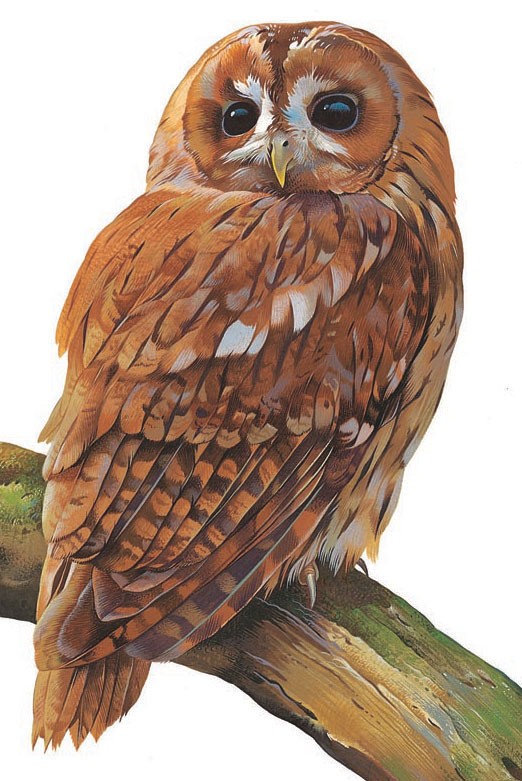


Barn owl
The barn owl is found all over the world, and is one of the most widespread of all birds. It is also one of the commonest owl species. Known by many different names, including death owl, golden owl or screech owl (after its call—not a hoot, but an ear-piercing scream), it has a white face or chest and golden brown plumage on its back. Barn owls usually nest in woodland but are also well known for nesting in farm buildings. They are well liked by farmers because they will kill pests, such as mice.
Eagle owl
The eagle owl lives in mountainous and other remote habitats all over Europe and Asia. A large and powerful bird, it has long, ear-like tufts of feathers on top of its head. These are not actually used for hearing, but may just be a way of helping the owls to recognize each other. Eagle owls feed mostly on mammals, including foxes, small deer, voles, rabbits and hedgehogs, but will also attack and eat reptiles and—especially—other birds.


Elf owl
The swollen stems of the saguaro cactus of the chaparral country (dry scrublands) of the southwestern United States and Mexico make perfect homes for the tiny elf owl. It uses the hollows made—and later abandoned—by Gila woodpeckers to make its own nest. Inside the cactus, the bird can also hide from the hot desert sun. The smallest owl, 13.5 centimetres (5 inches) long and weighing just 30 g (1 oz), the elf owl feeds mostly on flying insects. If captured, it lies still, pretending to be dead.
Snowy owl
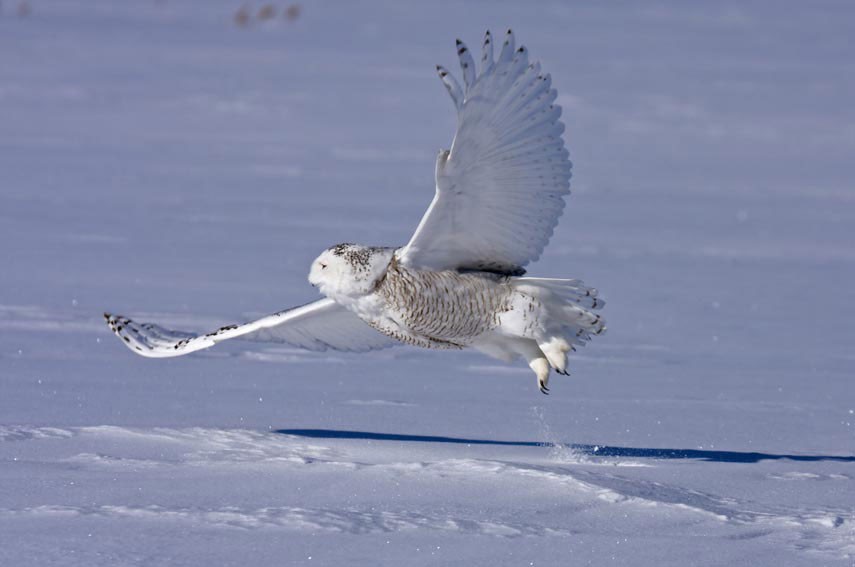
The snowy owl has extra thick plumage to keep it warm in the Arctic. It can fluff out its feathers to trap a layer of air which keeps out the cold. Snowy owls prey on small mammals, particularly lemmings. Their excellent hearing allows them to pinpoint prey burrowing under the snow and swoop down, crashing through the snow to grab it.
Burrowing owl
Burrowing owls are so named because they live underground in burrows that have been previously dug out by prairie dogs in the grasslands of North America. They are small, about 25 centimetres (10 inches) long, but have relatively long legs. During the nesting season they collect dung from other mammals—often from grazing cattle—to attract dung beetles, which they prey on.

Consultant: Chris Jarvis
pics

Without in any way limiting Q-files Ltd’s exclusive rights under copyright, any use of this publication to “train” generative artificial intelligence (AI) technologies to generate text is expressly prohibited. Q-files Ltd reserves all rights to license use of this work for generative AI training and development of machine learning language models.