
Birds

CITE
We have made every effort to follow citation style rules, but there may be some minor differences. If in doubt, please refer to the appropriate citation style manual.
Ostriches and other ratites. (2026). In Q-files Encyclopedia, Life, Birds. Retrieved from
https://www.q-files.com/life/birds/ostriches-and-other-ratites
"Ostriches and other ratites." Life, Birds, Q-files Encyclopedia, 23 Mar. 2026.
https://www.q-files.com/life/birds/ostriches-and-other-ratites.
Accessed 13 Sep. 2026.
Ostriches and other ratites 2026. Life, Birds. Retrieved 13 September 2026, from
https://www.q-files.com/life/birds/ostriches-and-other-ratites
Life, Birds, s.v. "Ostriches and other ratites," accessed September 13, 2026.
https://www.q-files.com/life/birds/ostriches-and-other-ratites


Ostriches and other ratites
The ostrich, the world's largest bird, belongs to the ratite group of birds, which also includes rheas, emus, cassowaries and kiwis. They are all flightless birds: their tail and flight feathers are plumes—useless for flight. They have no keel on their sternum (breastbone), which flying birds have to anchor their wing muscles. Most ratites are tall, long-necked birds that live in wide open spaces. They use their excellent eyesight to spot predators at a distance, and their long, powerful legs to run away at top speed.

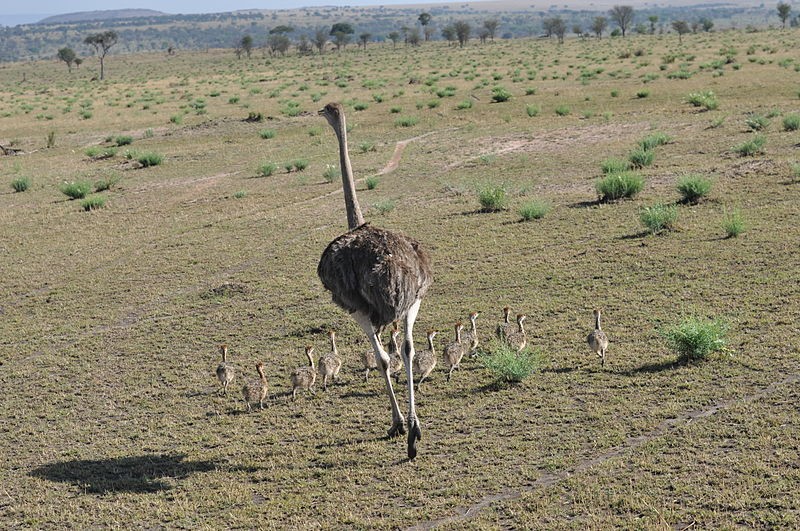
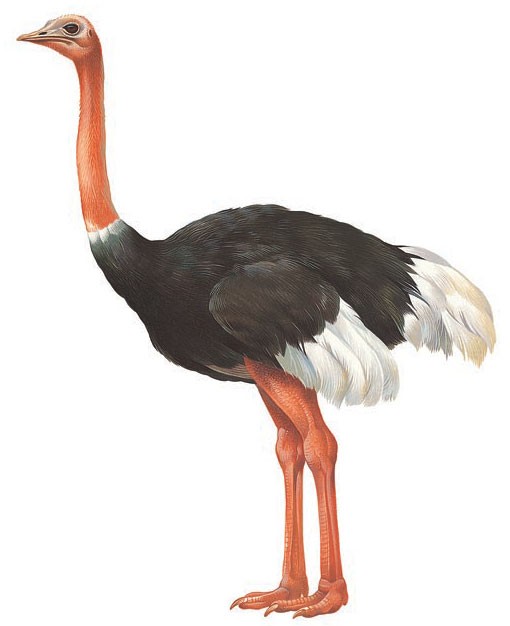
Ostrich
The ostrich lives on Africa’s dry grasslands. Too big to fly, it is the fastest creature on two legs. Its powerful legs and two-toed feet take it across the ground at speeds of up to 70 km/h (more than 40 mph). Ostriches have very long necks and good eyesight, which helps them to spot danger from far off. They run away when threatened, but if attacked they are capable of causing serious injury with kicks from their powerful legs.
Ostriches feed mostly on plant shoots, leaves, flowers and seeds. Females lay their eggs in a shallow pit dug in the sandy soil. Ostrich eggs are the largest laid by any bird—about 40 times the size of a hen’s egg.
Emu

The second largest bird in the world, the emu has a long neck and legs, and dark, shaggy plumage. It runs at speeds of around 50 km/h (30 mph).
Emus have good eyesight and hearing, which gives them early warning of threats from the approach of predators: dingos and birds of prey. They can run away or kick out at their attacker. Their legs are among the most powerful of any animal, capable even of tearing down metal fences. Emus forage for plants, fruits, leaves and insects in the woodlands of Australia.
Cassowary
The cassowary lives in the rainforests of New Guinea and Australia. Unable to fly, it can move speedily through the undergrowth on its long legs. Cassowaries have hollow, horny ridges on their heads. These may be used to amplify the bird's deep calls, or could be used to turn over leaf litter on the ground to find their food of fruit, insects, snails and fungi.

Cassowaries have a razor-sharp claw, about 12.5 centimetres (5 inches) in length, on their middle toe. They use it for defence, and can slice open an attacker's stomach with a single kick. Female cassowaries lay a clutch of eggs in the nests of several different males. The males then incubate the eggs and raise the chicks until they are almost nine months old.

Rhea
The largest of all South American birds, the rhea, like the ostrich, has a long neck and powerful legs. Rheas feed on fruits and seeds but may also eat insects, lizards and other small animals. Greater rheas live on low, open grasslands and woodlands while the lesser rhea prefers harsher habitats: dry scrublands, deserts and mountains.
Kiwi
The kiwi is a small flightless bird from New Zealand with a long, thin bill and shaggy plumage. It is the only bird with its nostrils at the tip of its bill. This helps it to smell insects and worms in the undergrowth. The kiwi can use its sharp claws for defence.
Females lay a single, extremely large, white egg, which the male incubates inside a burrow for up to three months. Young kiwis may take up to three days to break out of their tough-shelled eggs. They then stay with their parents for three weeks.


Extinct ratites
Aepyornis, the "elephant bird" of Madagascar, was the heaviest bird ever known. It weighed over 400 kilogrammes (nearly 900 lb) and stood up to 3 metres (10 feet) tall. Its egg was more than 30 centimetres (12 inches) long. It was hunted to extinction in the 17th century.
The giant moa, Dinornis maximus, lived in New Zealand. With a height of 3.7 metres (12 feet), it was the tallest bird the world has ever seen. It became extinct by 1500, due to hunting by Maori settlers. Emeus crassus, the eastern moa, also from New Zealand, was smaller than its relative (1.8 metres/6 feet tall). It suffered the same fate.
Consultant: Chris Jarvis
pics


Without in any way limiting Q-files Ltd’s exclusive rights under copyright, any use of this publication to “train” generative artificial intelligence (AI) technologies to generate text is expressly prohibited. Q-files Ltd reserves all rights to license use of this work for generative AI training and development of machine learning language models.