
Birds

CITE
We have made every effort to follow citation style rules, but there may be some minor differences. If in doubt, please refer to the appropriate citation style manual.
Eagles. (2026). In Q-files Encyclopedia, Life, Birds. Retrieved from
https://www.q-files.com/life/birds/eagles
"Eagles." Life, Birds, Q-files Encyclopedia, 23 Mar. 2026.
https://www.q-files.com/life/birds/eagles.
Accessed 13 Sep. 2026.
Eagles 2026. Life, Birds. Retrieved 13 September 2026, from
https://www.q-files.com/life/birds/eagles
Life, Birds, s.v. "Eagles," accessed September 13, 2026.
https://www.q-files.com/life/birds/eagles


Eagles
Eagles are large birds of prey. There are 33 species of eagle, living in mountains, tundra, woodlands, forests or on coasts. They build their nests, called eyries, in trees or up cliffs, returning to the same nest each year. Most eagles feed on mammals or other birds, except for the fish-eating sea eagles, which eat fish, and the snake eagles which feed on reptiles. They usually grab their prey without landing, then, if its not too heavy, carry it to a perch where they tear it apart. All eagles have excellent eyesight and can spot their prey from a great distance.


Golden eagle
The most widespread of all eagles, the golden eagle lives in mountains and wildernesses all over the northern hemisphere. It has dark brown plumage and strong wings that allow it to fly even in high winds. Like all eagles, it can spot its prey—small mammals such as rabbits, hares, marmots and squirrels—from a great distance.
When hunting, the golden eagle can glide at speeds of up to 190 km/h (120 mph). Diving (or stooping) towards its prey, it holds its wings close to its body and its feet against its tail. It may reach 300 km/h (200 mph). Once the prey has been snatched in its massively powerful talons, there is little chance of escape.
Golden eagles build their eyries in high places, usually cliffs. Mating pairs may remain together for several years, sometimes for life. Females lay up to four eggs. One or two of the young will usually survive to fledge (grow flight feathers) in about three months after hatching.
Harpy eagle
The harpy eagle, from the Central and South American rainforest, is one of the largest birds of prey in the world. It is strong enough to carry away large prey, such as sloths and monkeys, gripping them in its extremely large talons. Compared to other eagles, the harpy eagle's wingspan is quite small, because it needs to manoeuvre its way through the trunks and branches of the forest trees.
Pairs build large nests high in the rainforest canopy. Both parents tend to the eggs, but after the first chick has hatched, all other eggs are abandoned. Chicks stay in the nest for about six months, dependent on food from their parents until they are forced to fend for themselves.

Steller's sea eagle
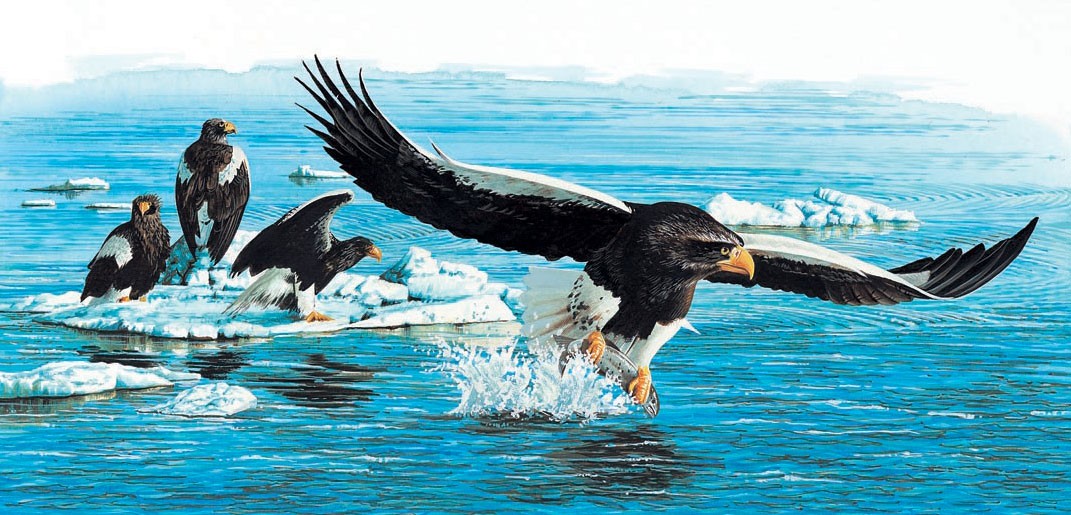
The largest of all eagles, Steller's sea eagles spend the summer breeding in Russia. In winter, the rivers and estuaries where they usually hunt freeze over so the eagles head south towards Japan to fish offshore in open waters.
Each morning the eagles gather and head out to sea. Some perch on ice floes as they search the water for fish, while others patrol from the air. When an eagle spots a fish, it swoops down with its wings raised high and its razor-sharp talons reaching forwards. It snatches the fish from the water’s surface, then settles back on the ice to enjoy its meal.

Bald eagle
The bald eagle's head is actually covered in white feathers, but “white” is an old meaning of the word “bald”. The bald eagle keeps a look out for prey while soaring high in the air. It can spot fish more than a kilometre away. It swoops down at great speed, glides above the water before grabbing its victim in its feet and flying off to eat it.
Courtship

Bald eagles have the most acrobatic of all courtship dances. In a breathtaking display, they tumble and dive through the air, sometimes locking talons as they whirl and somersault high above the ground. Couples plummet headlong towards the ground, often pulling out of the fall with only seconds to spare. Bald eagles mate for life and will repeat this display each breeding season.
Nest-building
Bald eagles return to the same nest year after year. Each year, the eagles bring fresh nesting material to repair and enlarge their nests. Their enormous nests, made from twigs and branches, are usually located on treetops near rivers or coasts. The largest ones can measure up to 6 metres (20 feet) across. The eagles pick the highest spot available for the best views of the land all around them.
The female lays between one and three eggs and the parents take turns to incubate them. While one parent sits on the eggs, the other searches for food or more nesting materials. Chicks hatch out about five weeks later.


Chicks
Newly hatched eagles are covered in soft, fluffy feathers known as down. The hatchlings are fed on scraps brought by their parents. Sometimes the larger chick may kill its smaller sibling, in order to secure more food for itself. After a month, the chicks grow their adult feathers.
Consultant: Chris Jarvis
pics


Without in any way limiting Q-files Ltd’s exclusive rights under copyright, any use of this publication to “train” generative artificial intelligence (AI) technologies to generate text is expressly prohibited. Q-files Ltd reserves all rights to license use of this work for generative AI training and development of machine learning language models.