
Ecosystems

CITE
We have made every effort to follow citation style rules, but there may be some minor differences. If in doubt, please refer to the appropriate citation style manual.
Boreal forest. (2026). In Q-files Encyclopedia, Life, Ecosystems. Retrieved from
https://www.q-files.com/life/ecosystems/boreal-forest
"Boreal forest." Life, Ecosystems, Q-files Encyclopedia, 18 May. 2026.
https://www.q-files.com/life/ecosystems/boreal-forest.
Accessed 27 Jul. 2026.
Boreal forest 2026. Life, Ecosystems. Retrieved 27 July 2026, from
https://www.q-files.com/life/ecosystems/boreal-forest
Life, Ecosystems, s.v. "Boreal forest," accessed July 27, 2026.
https://www.q-files.com/life/ecosystems/boreal-forest


Boreal forest
The vast coniferous forests of northern Canada, Alaska, Scandinavia and Russia are known as boreal forests, or the taiga. It is the world's largest land biome. The winters here are long and cold. Coniferous trees can survive in lower temperatures than deciduous trees, so coniferous woodlands are often found in northerly or mountainous regions. Forest berries and fungi provide food for birds and mammals. Crossbills, for example, use their specially adapted beaks to prise open pine cones and reach the nutritious seeds inside.


Conifers
The forests of the taiga are dominated by fir, pine, spruce and larch trees. They have needle-like leaves and a conical shape, to shed heavy snow that could break their branches. Conifers constantly lose and replace their leaves throughout the year. The dead leaves are not broken down into the soil because worms and other soil-enriching invertebrates find them distasteful. Instead, they remain as a thick layer of leaf litter, making the soil acidic and poor.

Food web
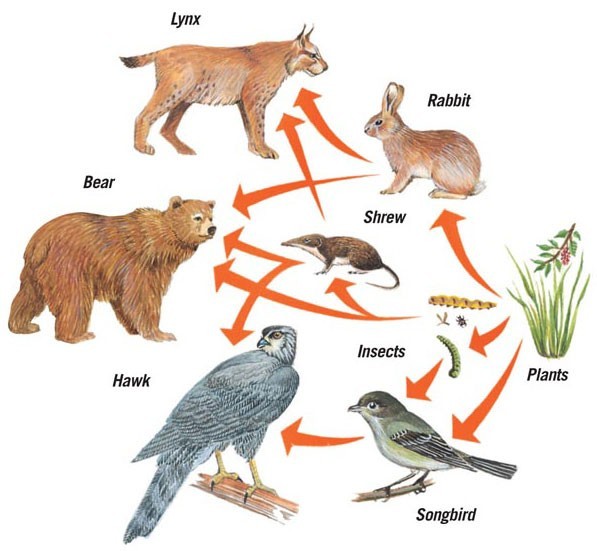
In every ecosystem, its community of living things depend on one another for survival. The taiga is no exception. Plants provide food for plant-eating animals and insects for insect-eaters. Both become prey for flesh-eaters. The pattern of who eats who in any ecosystem is called a food web. In the taiga, plant-eating animals such as rabbits are prey for lynx and bears. Shrews are insect-eaters and they are hunted by these same predators. Bears also feed directly on plants and insects.
Winter in the taiga


Conifer trees provide animals with shelter and some warmth during the winter. Animals that feed on the northern tundra during the short summer, such as elk and reindeer, migrate south to shelter in the forest, scraping away the snow to feed on mosses. The lynx and goshawk prey on small mammals as they search for nuts and berries. The brown bear hibernates until spring.
Consultant: Chris Jarvis
pics

Without in any way limiting Q-files Ltd’s exclusive rights under copyright, any use of this publication to “train” generative artificial intelligence (AI) technologies to generate text is expressly prohibited. Q-files Ltd reserves all rights to license use of this work for generative AI training and development of machine learning language models.