
Mammals

CITE
We have made every effort to follow citation style rules, but there may be some minor differences. If in doubt, please refer to the appropriate citation style manual.
Rabbits and hares. (2026). In Q-files Encyclopedia, Life, Mammals. Retrieved from
https://www.q-files.com/life/mammals/rabbits-and-hares
"Rabbits and hares." Life, Mammals, Q-files Encyclopedia, 24 Mar. 2026.
https://www.q-files.com/life/mammals/rabbits-and-hares.
Accessed 31 Oct. 2026.
Rabbits and hares 2026. Life, Mammals. Retrieved 31 October 2026, from
https://www.q-files.com/life/mammals/rabbits-and-hares
Life, Mammals, s.v. "Rabbits and hares," accessed October 31, 2026.
https://www.q-files.com/life/mammals/rabbits-and-hares


Rabbits and hares
Rabbits and hares are rodent-like mammals with four pairs of front teeth, one pair behind the other. They belong to a family called the lagomorphs, meaning "hare-shaped", which includes rabbits, hares and pikas. All lagomorphs have long soft fur all over their bodies, even on their feet. They feed mainly on grasses, and also eat leaves, bark, seeds and roots. Hares are larger than rabbits and their young are born fully developed rather than naked and blind.

Avoiding predators
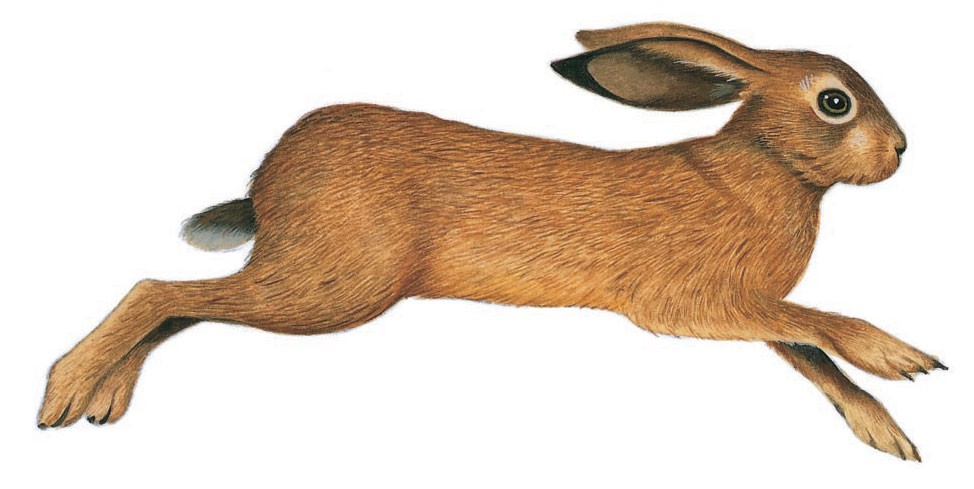
Lagomorphs are prey to many animals, so they have large ears to listen for danger and eyes on the sides of their heads, allowing them to see a wide area around them. If threatened, a rabbit may freeze, then warn other rabbits nearby by thumping on the ground. They may run or hop for their burrows, zigzagging across the ground to make capture as difficult as possible. To escape from predators, hares use their long, strong legs which can carry them at speeds of up to 75 km/h (45 mph).

Burrows
Rabbits dig burrows where they sleep, give birth and hide from predators. Baby rabbits, known as kittens, sleep in fur-lined burrows under the ground. During the day, their mother stays away from the nest. Her constant movement in and out of the burrow would be a clear signal to predators that her young are concealed there. A group of rabbit burrows make up a warren.
Hares and their young rest above ground in small areas of flattened grass, called forms. Their coats act as camouflage when they lie there.
Rabbits in Australia
When European rabbits were introduced to Australia in the 18th century, they rapidly grew in number. They caused much damage, both to farmland and to native wildlife, with which they competed for food and shelter. Rabbits even contributed to soil erosion by removing vegetation cover. The deliberate spread of the disease myxomatosis caused numbers to drop from about 600 million to 100 million. They remain one of Australia's most widespread and destructive pests.

Mad March hares
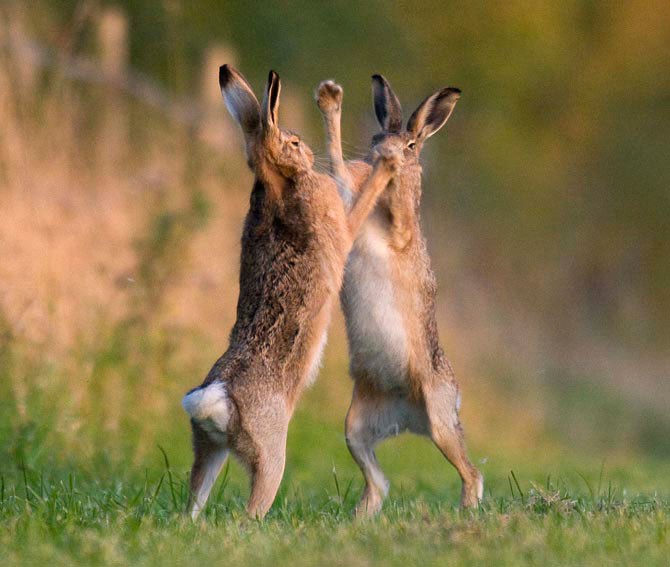
Hares can often be seen "boxing" in March. This occurs throughout the year, but is most common in spring, when the breeding season is at its peak. The contests are between a female and an amorous male. The hares rise up on their back legs and strike one another with their forepaws. The male is smaller and weaker than the female and can be hurt by her claws and teeth. But if he is persistent and shows off his strength, she may choose him as a mate. Five or six weeks after mating, the female gives birth to a litter of baby hares, called leverets.

Snowshoe hare
The snowshoe hare of North America gets its name from its large fur-covered feet. They prevent it from sinking as it hops along across the snow. The fur on the soles also protects the hare from freezing temperatures. It has grey-brown fur in summer. This moults and is replaced by thicker, white fur in the autumn. Its winter coat helps provide camouflage in a snowy landscape as well as providing additional warmth. It normally feeds on grass, leaves, bark and buds, but may also eat any dead rodents it comes across.

Pikas
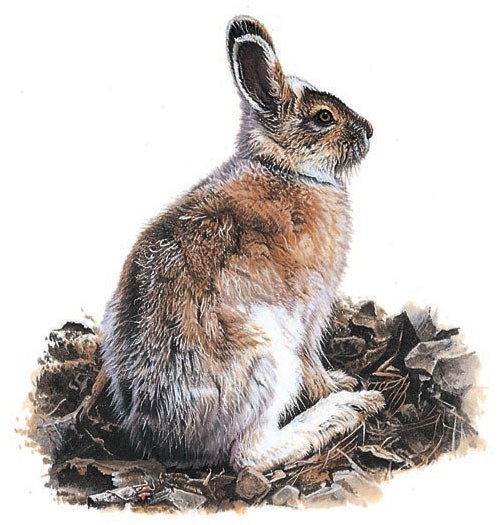
Pikas live in mountainous regions of Europe, Asia and North America, feeding on grass and other plant matter. They shelter in burrows or crevices. Pikas prepare food for the winter by piling up grass, which then dries out in the sun and turns to hay. This can be stored in their burrows over the winter.
Consultant: Chris Jarvis
pics


Without in any way limiting Q-files Ltd’s exclusive rights under copyright, any use of this publication to “train” generative artificial intelligence (AI) technologies to generate text is expressly prohibited. Q-files Ltd reserves all rights to license use of this work for generative AI training and development of machine learning language models.