
Mammals

CITE
We have made every effort to follow citation style rules, but there may be some minor differences. If in doubt, please refer to the appropriate citation style manual.
Gibbons. (2026). In Q-files Encyclopedia, Life, Mammals. Retrieved from
https://www.q-files.com/life/mammals/gibbons
"Gibbons." Life, Mammals, Q-files Encyclopedia, 24 Mar. 2026.
https://www.q-files.com/life/mammals/gibbons.
Accessed 21 Sep. 2026.
Gibbons 2026. Life, Mammals. Retrieved 21 September 2026, from
https://www.q-files.com/life/mammals/gibbons
Life, Mammals, s.v. "Gibbons," accessed September 21, 2026.
https://www.q-files.com/life/mammals/gibbons


Gibbons
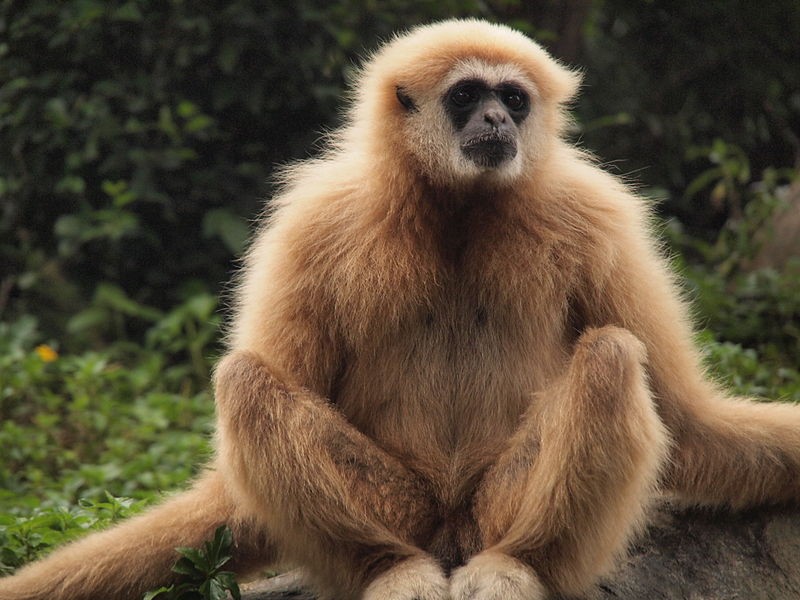
The gibbons are the lesser apes, to distinguish them from the great apes—chimpanzees, orang-utans and gorillas. Gibbons are smaller and less intelligent than the great apes. All species of gibbon, including the siamang, live in the forests of South and Southeast Asia. They hang from the trees, moving each powerful arm in turn to swing their bodies along at high speed, a way of moving called brachiation. Like all apes, gibbons are tail-less, so do not possess the prehensile tail, or "fifth limb" that some monkeys use to get from branch to branch. They feed mostly on fruit, but will also eat leaves, shoots and insects.


Brachiation
Gibbons travel through the trees of their rainforest home by brachiation: swinging from branch to branch sometimes up to 15 metres (50 feet) apart at speeds of up to 55 km/h (about 35 mph). The flexible ball-and-socket joints in their wrists reduces the amount of effort needed by their upper arms, giving them great power and accuracy when swinging through trees. A gibbon's arms are particularly long and they have hooked-shaped hands for grasping branches. Occasionally, though, branches break or hands slip, leading to falls. Most gibbons suffer bone breakages during their lifetimes.
Singing
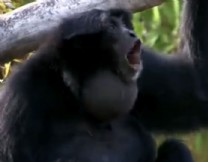
Gibbons defend their territories fiercely. One way is by singing. A duet, known as a "great call" between a mated pair, can often be heard up to a kilometre (0.6 mile) away. In most species of gibbon, males sing solos to attract mates. The song is different from one species to another, and even from one part of the forest to the other. Some gibbons have an enlarged throat sac, which inflates and helps to make their songs even louder.
Consultant: Chris Jarvis
pics
Without in any way limiting Q-files Ltd’s exclusive rights under copyright, any use of this publication to “train” generative artificial intelligence (AI) technologies to generate text is expressly prohibited. Q-files Ltd reserves all rights to license use of this work for generative AI training and development of machine learning language models.