
Mammals

CITE
We have made every effort to follow citation style rules, but there may be some minor differences. If in doubt, please refer to the appropriate citation style manual.
Raccoons. (2026). In Q-files Encyclopedia, Life, Mammals. Retrieved from
https://www.q-files.com/life/mammals/raccoons
"Raccoons." Life, Mammals, Q-files Encyclopedia, 24 Mar. 2026.
https://www.q-files.com/life/mammals/raccoons.
Accessed 21 Sep. 2026.
Raccoons 2026. Life, Mammals. Retrieved 21 September 2026, from
https://www.q-files.com/life/mammals/raccoons
Life, Mammals, s.v. "Raccoons," accessed September 21, 2026.
https://www.q-files.com/life/mammals/raccoons


Raccoons
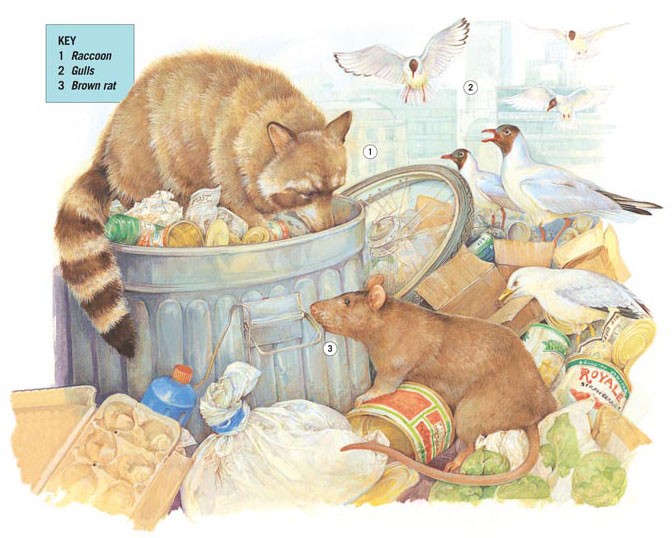
The scientific name for the raccoon family is the procyonids. They include the raccoons, coatis, kinkajous and cacomistles. All are quite small animals with long tails. They are good climbers, and some feed and nest in trees. Most members of the raccoon family live alone and are nocturnal, apart from coatis, which form groups of females and feed during the day. Raccoons and coatis are omnivores: they feed on a wide range of foods including rodents, insects, frogs, eggs, plants, fruits and nuts. Raccoons have adapted to urban environments, where they frequently scavenge from rubbish bins at night.

Coati

Coatis move about the rainforests of Central and South America in noisy bands of up to 20 animals, foraging on the ground or in the trees for insects, tarantulas and fruit. They will also feed on lizards, rodents, birds and eggs. With their sharp teeth and claws, they can defend themselves fiercely from any attack.
Kinkajou
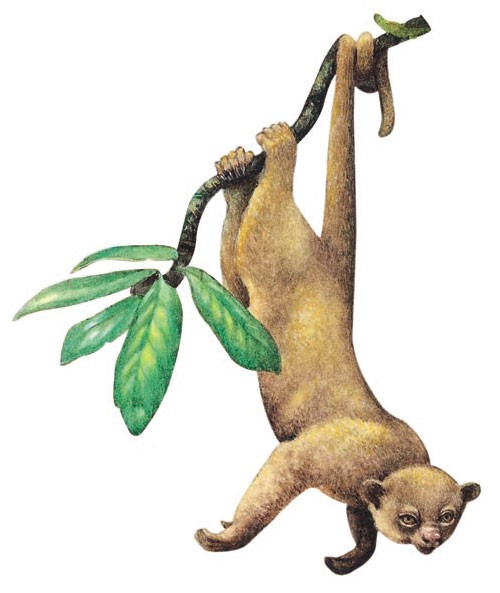
Like many monkeys from Central and South America, the kinkajou has a long, prehensile tail, which it uses as a "fifth limb" for grasping on to branches, enabling it to move more easily through the trees where they spend their lives.
Despite being classified as carnivores, kinkajous feed almost exclusively on fruit (especially figs) and other sweet foods. They also sometimes feed on insects. Nocturnal creatures, they probe flowers with their 13-centimetre (5-inch) tongues to reach the nectar inside. For this reason the kinkajou is also known as the honey bear.
Red panda

Despite its name, the red panda has its own family, which is more closely related to raccoons than to the giant panda. A solitary animal, it lives in the forests of the Himalayas and China feeding on fruit, bamboo and other plant material. It has long, curved claws for grasping branches and fruit. Although it is not related to the giant panda, like the larger animal it also has a "false thumb", actually a lengthened wrist bone. It helps the red panda to grip bamboo stems.
Consultant: Chris Jarvis
pics



Without in any way limiting Q-files Ltd’s exclusive rights under copyright, any use of this publication to “train” generative artificial intelligence (AI) technologies to generate text is expressly prohibited. Q-files Ltd reserves all rights to license use of this work for generative AI training and development of machine learning language models.