
Ecosystems

CITE
We have made every effort to follow citation style rules, but there may be some minor differences. If in doubt, please refer to the appropriate citation style manual.
Cities and farmland. (2026). In Q-files Encyclopedia, Life, Ecosystems. Retrieved from
https://www.q-files.com/life/ecosystems/cities-and-farmland
"Cities and farmland." Life, Ecosystems, Q-files Encyclopedia, 23 Mar. 2026.
https://www.q-files.com/life/ecosystems/cities-and-farmland.
Accessed 13 Sep. 2026.
Cities and farmland 2026. Life, Ecosystems. Retrieved 13 September 2026, from
https://www.q-files.com/life/ecosystems/cities-and-farmland
Life, Ecosystems, s.v. "Cities and farmland," accessed September 13, 2026.
https://www.q-files.com/life/ecosystems/cities-and-farmland


Cities and farmland
All animals share the planet with human beings, many suffering the consequences. Some, however, have learned to live in habitats that humans have created, such as cities, suburban gardens or farmland. They have adapted their lifestyles to suit this new environment, and, in many cases, have thrived in them. Not all these animals are welcome, however. Some have become pests and are responsible for spreading diseases or the destruction of crops. Animals that have been deliberately introduced by humans to new environments have sometimes created problems.


Animal life in the city
Birds use roofs, gutters and chimney pots as roosting and nesting sites, instead of cliffs and trees. Bats gather in warm attics or empty buildings instead of caves and holes. The warm air given off from houses, offices and factories draws flocks of birds into towns and cities on winter evenings. Many people enjoy seeing birds, and some put out food to help them through the coldest periods. However, birds and people also come into conflict. Flocks of birds are a hazard at airports, where they can be sucked into aircraft engines, causing damage.
Feral pigeons, so familiar in many major towns and cities, are descended from escaped domestic pigeons. These in turn evolved from the rock dove. Pigeons roost on rooftops, and have adapted their diet to include scraps and pieces of bread thrown to them by people.
Rubbish and diseases

The vast quantities of rubbish produced in a town or city also attracts less welcome animals. Rats, foxes, gulls, vultures and even larger animals such as jackals, baboons or polar bears, all scavenge from rubbish dumps in various parts of the world. Raccoons rummage through dustbins in North America to get at the food inside. Rats, along with mice, are found wherever people live. These adaptable animals have become pests, eating our food and spreading diseases. Flies, fleas, lice and cockroaches live close to humans as well, some also spreading disease. Mosquito bites are a constant danger in tropical countries.

Farmland
Farming has made a huge impact on the environment, replacing woodland, wetland and grasslands with cropfields and grazing land. Some animals have adapted to take advantage of these new habitats. Rabbits, mice and many kinds of bird feed and nest among the crops and in the hedgerows of agricultural land.
Pests
Other insect pests attack crops, or cause damage to homes and other buildings. Buprestid beetles feed on house timbers, while clothes moths make holes in our clothing. However, some insects also have a beneficial effect on our lives. Bees are vital for the pollination of plants—in fact, much of the world’s crop yield comes from plants pollinated by wild bees.
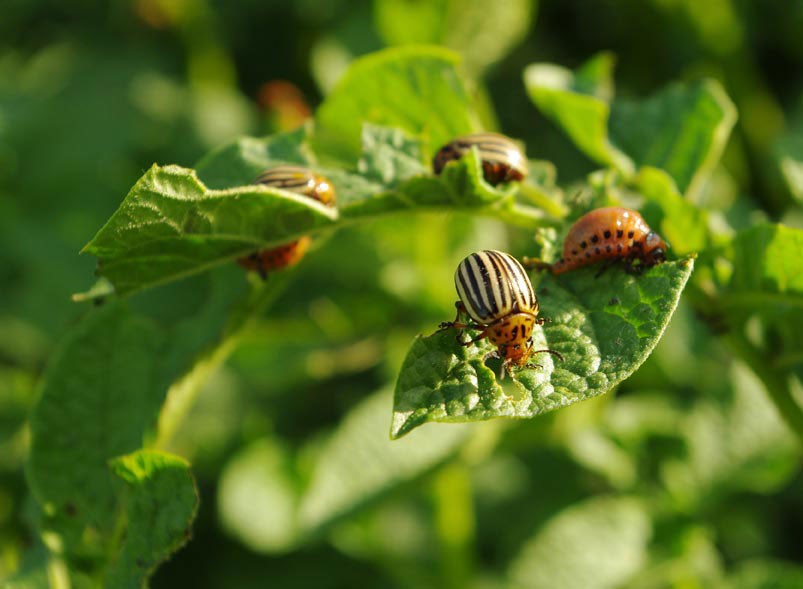
Other insects feed on pests which attack crops. Without the right balance of natural pest-controlling agents, however, pests can increase in number and destroy entire crop harvests. The use of chemical pesticides can upset this balance even further, as well as harming other animals.

Introduced species
Humans have often created further problems by introducing species from one country into another. Rats arrived on islands in Oceania with the early European settlers, and became invasive pests. To control them, the settlers brought in cats or mongooses, which quickly destroyed many of the native birds, small reptiles and mammals. Rats, themselves, have killed whole populations of birds on small islands that had previously had no native predators.
Other introduced animals have competed with native species for food and habitat. The grey squirrel, introduced to Great Britain from the United States, has out-competed the native red squirrel, which is now found only in a few areas. Red deer imported into New Zealand compete with other grazing animals and destroy woodland.
Consultant: Chris Jarvis
pics


Without in any way limiting Q-files Ltd’s exclusive rights under copyright, any use of this publication to “train” generative artificial intelligence (AI) technologies to generate text is expressly prohibited. Q-files Ltd reserves all rights to license use of this work for generative AI training and development of machine learning language models.