
Insects

CITE
We have made every effort to follow citation style rules, but there may be some minor differences. If in doubt, please refer to the appropriate citation style manual.
Beetles. (2026). In Q-files Encyclopedia, Life, Insects. Retrieved from
https://www.q-files.com/life/insects/beetles
"Beetles." Life, Insects, Q-files Encyclopedia, 24 Mar. 2026.
https://www.q-files.com/life/insects/beetles.
Accessed 13 Sep. 2026.
Beetles 2026. Life, Insects. Retrieved 13 September 2026, from
https://www.q-files.com/life/insects/beetles
Life, Insects, s.v. "Beetles," accessed September 13, 2026.
https://www.q-files.com/life/insects/beetles


Beetles
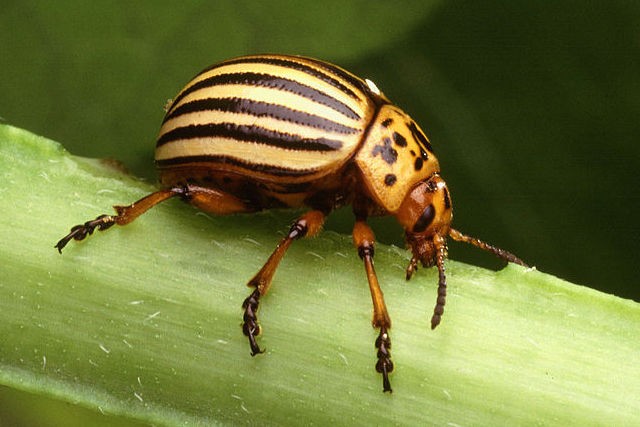
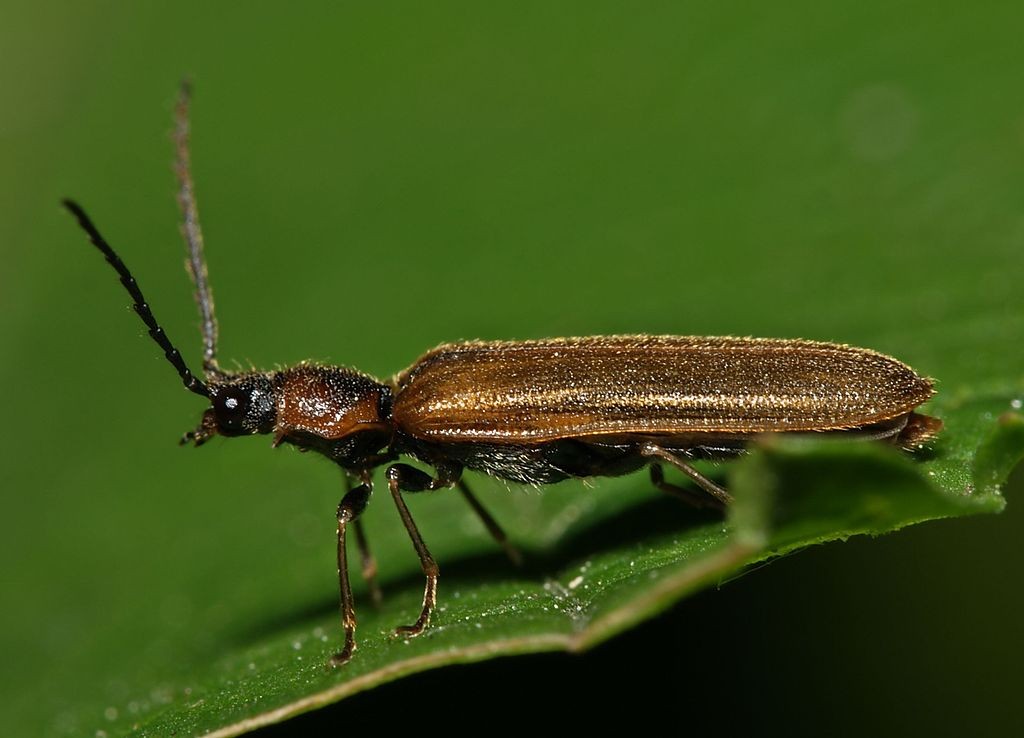
Beetles are the largest order of insects, with at least 400,000 known species. They include weevils (the largest family), ladybirds, fireflies, scarabs and chafers. All beetles have two pairs of wings, but only the back pair are used for flying. The front wings form a hard, protective case that folds over the flying wings, opening just before the beetle takes to the air. The beetle's exoskeleton is made up of a number of separate plates, called sclerites. Adults have a range of diets: some feed on plants, some scavenge and some are predators. Many beetles have methods of defence, such as squirting poisonous chemicals at their attackers, or startling them with loud noises.

Head
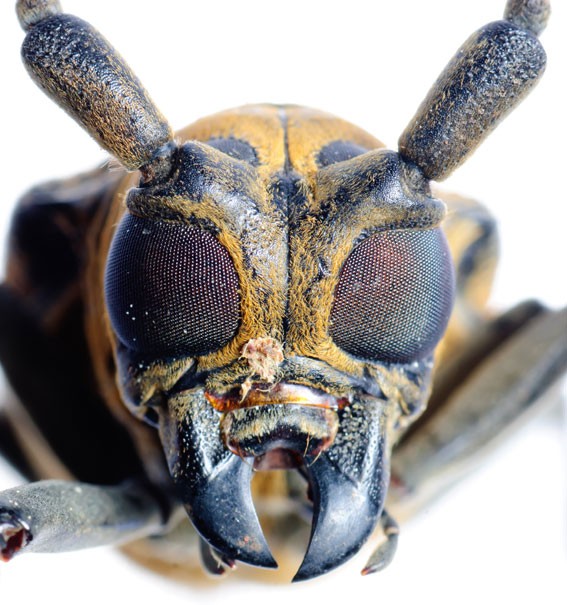
Like other insects, beetles have compound eyes, made up of thousands of tiny lenses. Their visual capability is not strong; they rely more on their antennae, which are chiefly organs of smell, but which can also be used to sense the beetle's immediate surroundings. Beetles communicate through emitting chemical substances called pheromones. The beetles' mouthparts include prominent mandibles: jaws that move from side to side to grasp their prey or cut up their food. Two, finger-like organs close to the mouth help move food into the mouth.
Flying
Beetles all have two pairs of wings. The front pair form a hard, protective case, called the elytra. This folds over the fragile back wings when the beetle is on the ground. The hard elytra are good protection against predators. As a beetle takes off, its elytra open. Some beetles do not fly, so their elytra are fused together.

Life cycle
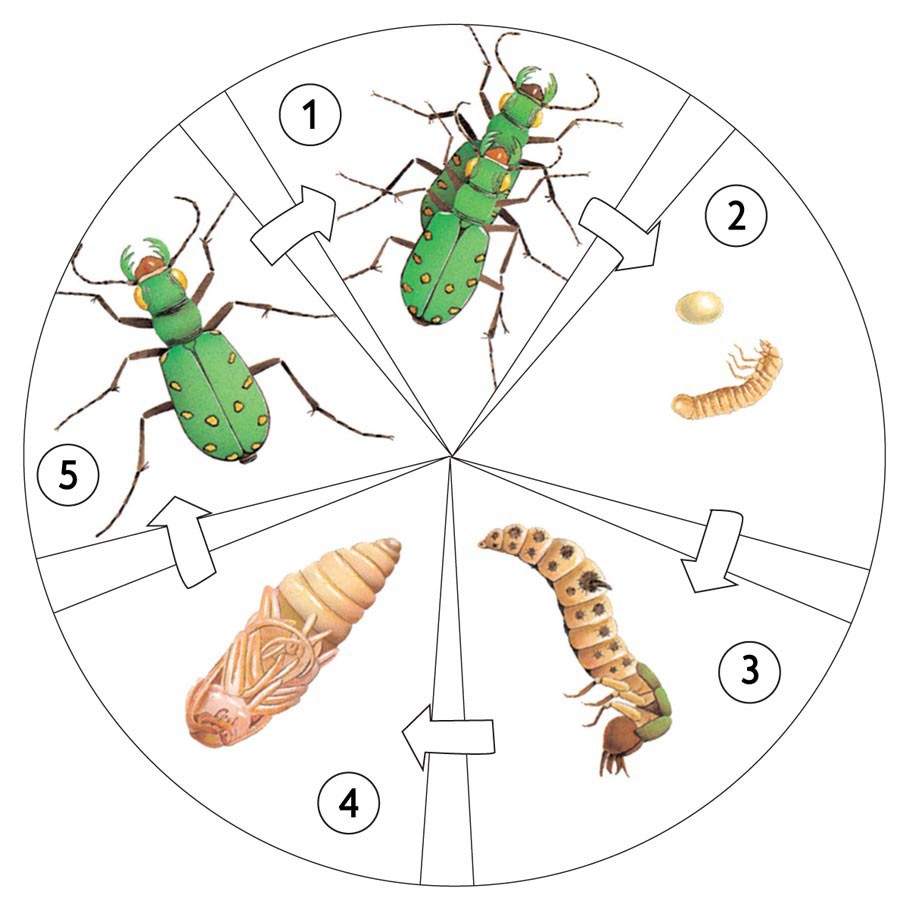
Beetles undergo complete metamorphosis. They hatch from their eggs as larvae, usually known as grubs. The larvae eat voraciously and, as they increase in size, they shed, or moult, their old skins. Each stage in the larvae's growth is called an instar. Finally the larvae pupate, emerging as fully-grown adults. Some plant-eating beetle larvae are legless grubs, while predatory beetle larvae have legs and large jaws for catching their prey.

Scarab beetles
Scarab beetles are broad, oval-shaped beetles with thick front legs adapted for digging. They have clubbed antennae that can be squashed into a ball, or fanned out like leaves to detect smells. Many species have bright, metallic colouring. Scarab beetles include the rhinoceros, dung, goliath, stag and chafer beetles.

Dung beetle
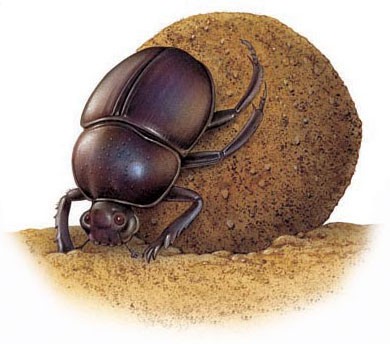
The dung beetle is a type of scarab beetle. There are about 5000 species of dung beetle, found in many different types of habitats. All dung beetles feed on dung. Many kinds mould animal dung into a ball, rolling it away—usually travelling backwards—to a safe place for burial. They will then use it as a food store or lay their eggs inside it. When the larvae hatch they will be protected inside the ball and feed on the dung and the bacteria that thrives there.
Rhinoceros beetle

The rhinoceros beetle is a large, tropical scarab beetle. Typically, they measure 15 centimetres (6 inches) long, but are still able to fly. If disturbed, some make loud, hissing squeaks, a noise produced by rubbing their abdomens against their wing covers. Males have a large, horn-like structure at the front of their heads, used to fight off rivals or for digging. They eat only nectar and fruit.
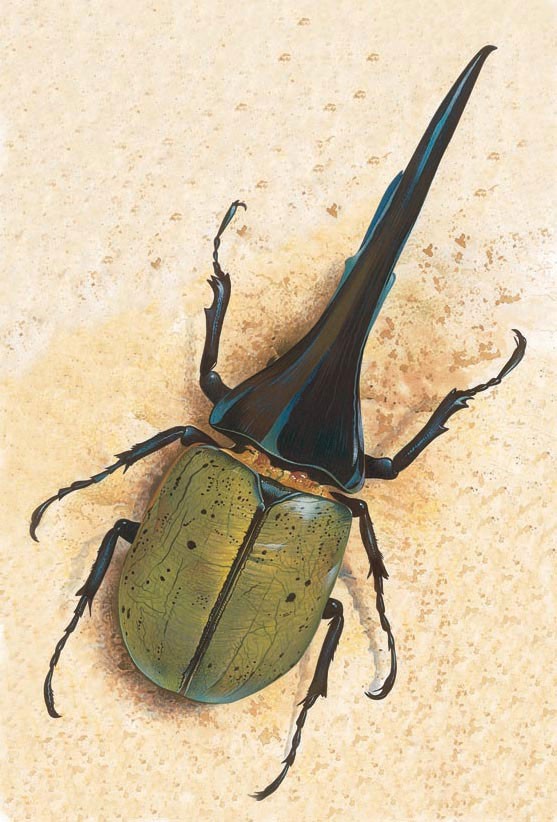
Hercules beetle
The male hercules beetle, a kind of rhinoceros beetle, grows up to 17 centimetres (7 inches) long—one of the longest of all beetles. The female beetle has no horn, but has a longer body. About half the length of the male is made up of its huge horns, which are used to fight other males over mates. The fight ends when one beetle throws the other on to its back. The hercules beetle is immensely strong: it is able to lift up to 850 times its own weight. If anything dares to attack it, the beetle will release a foul smell to deter them.
Cockchafer
The cockchafer, or may bug, can often be seen airborne on warm evenings in early summer. As it flies, it spreads its feathery antennae into a fan. This helps it to detect the scent of food or a mate. Both the larvae, or grubs, which feed on plant roots such as potatoes, and the adults, which eat tree leaves, have voracious appetites. They have long been considered pests by farmers.


Stag beetle
The stag beetle is a large, dark beetle. Males have massive, horn-like jaws, used to fight over territory or mates. Some species grow up to 12 centimetres (4.7 inches) long. Stag beetles' impressive “antlers” are actually powerful jaws. Despite their appearance, stag beetles are not predators. They feed mainly on tree sap and honeydew.
Firefly
The firefly is a beetle that can produce light, generated by chemical reactions inside its abdomen. This is known as bioluminescence. The flashes of light are used to attract mates. Most species of firefly live in warm, wet regions. Their larvae, commonly called glow worms, also give off light. This has a different purpose: to warn predators that they are poisonous. The name glow worm is also given to both adults and larvae of a particular species: the common European glow worm. The wingless adult females, which look quite similar to larvae, glow brightly, while the flying males glow only weakly.


Rove beetles
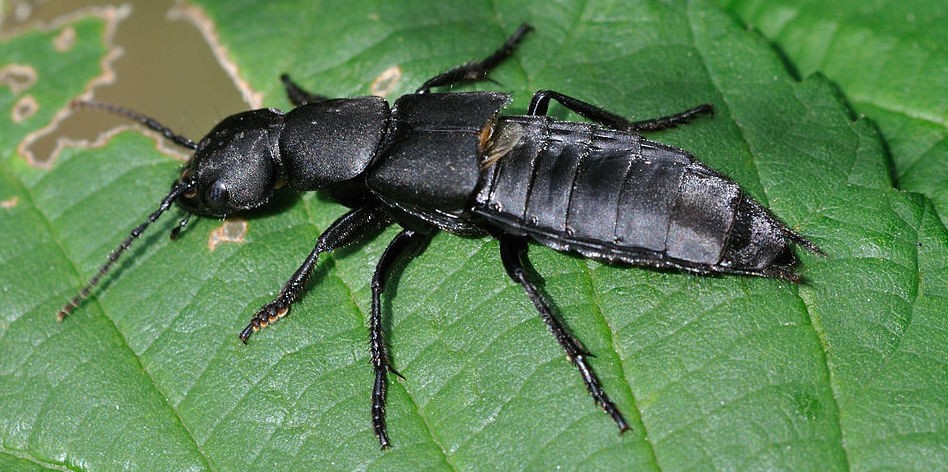
With around 63,000 species, rove beetles make up the second largest family (after the weevils) of beetles. Rove beetles are masters of disguise. Some, for instance, resemble army ants. This enables them to move among the ants undetected—while eating their eggs and young. Another rove beetle, the devil's coach horse beetle, can, when threatened, raise its abdomen to make it look like a scorpion. A recently discovered rove beetle found in Australia has an abdomen shaped like a termite—realistic enough to deceive real termites, which are blind. Thus disguised, it lives in a termite nest where it is unwittingly fed by worker termites.
Tiger beetle
Like its namesake, the tiger beetle is a ferocious predator. There are about 2300 species. The tiger beetle is one of the fastest insects, both running and in flight. Adults chase and catch their prey in the open, devouring them with their powerful, curved mandibles (jaws). Tiger beetle larvae hide in burrows, seizing passing insects to eat. Some tropical kinds are tree-dwellers, but most live on the ground. Many species are found on sea and lake shores, particularly on sand or dry mud.

Water beetles
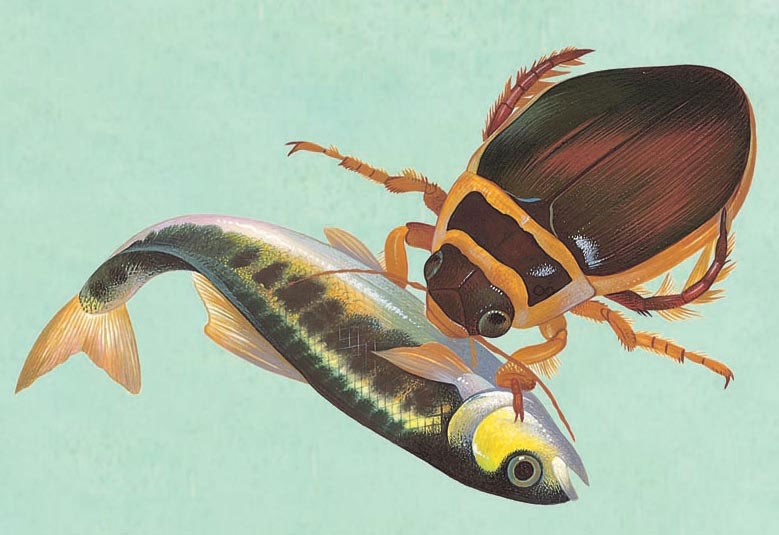
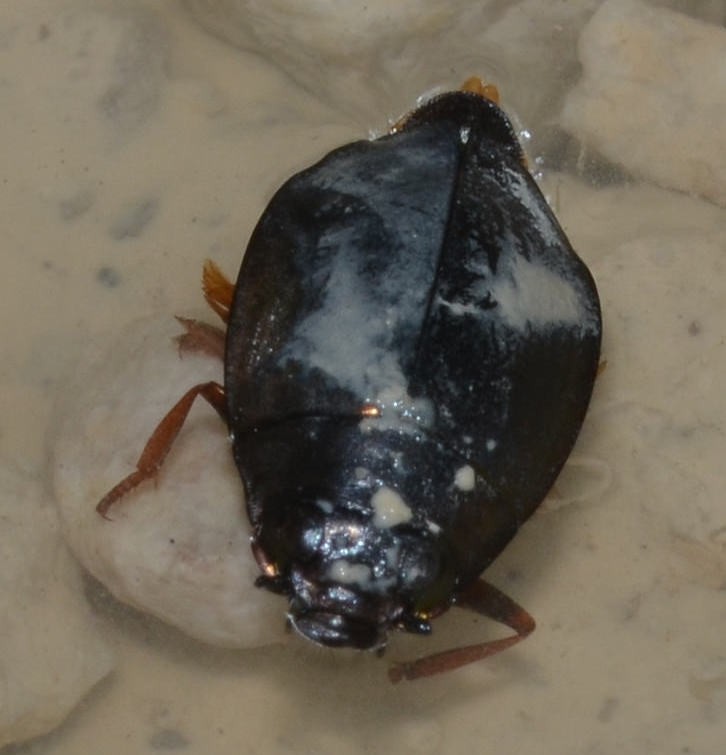
Water beetles live in freshwater ponds or rivers. When they dive, they carry a bubble of air under their elytra to breathe underwater. Water beetles feed on insects, tadpoles and small fish. Species include the water scavengers and diving beetles. Their fierce, predatory larvae are known as water tigers.
The whirligig beetle normally swims near the water's surface. It gets its name from its habit of swimming rapidly in circles when alarmed. It has divided eyes, which enable it to see both above and below water.
Smallest beetle
Feather-winged beetles are the smallest beetles. All the features that they share with their larger relatives—including compound eyes, mouthparts, wings, antennae and so on—are packed into a creature a fraction of a millimetre long.

They are named after their feather-tipped wings, which they use for flying as well as to help them float on water. Feather-winged beetles live under dead leaves or bark, decaying logs, compost heaps, treeholes, under seaweed on seashores, or in animal dung. They will live anywhere suitable for growth of the moulds and fungi upon which they feed.
Consultant: Chris Jarvis
pics


Without in any way limiting Q-files Ltd’s exclusive rights under copyright, any use of this publication to “train” generative artificial intelligence (AI) technologies to generate text is expressly prohibited. Q-files Ltd reserves all rights to license use of this work for generative AI training and development of machine learning language models.