
Natural history of the British Isles

CITE
We have made every effort to follow citation style rules, but there may be some minor differences. If in doubt, please refer to the appropriate citation style manual.
Insects of the British Isles A-Z. (2026). In Q-files Encyclopedia, Life, Natural history of the British Isles. Retrieved from
https://www.q-files.com/life/natural-history-of-the-british-isles/insects-of-the-british-isles-a-z
"Insects of the British Isles A-Z." Life, Natural history of the British Isles, Q-files Encyclopedia, 24 Apr. 2026.
https://www.q-files.com/life/natural-history-of-the-british-isles/insects-of-the-british-isles-a-z.
Accessed 21 Sep. 2026.
Insects of the British Isles A-Z 2026. Life, Natural history of the British Isles. Retrieved 21 September 2026, from
https://www.q-files.com/life/natural-history-of-the-british-isles/insects-of-the-british-isles-a-z
Life, Natural history of the British Isles, s.v. "Insects of the British Isles A-Z," accessed September 21, 2026.
https://www.q-files.com/life/natural-history-of-the-british-isles/insects-of-the-british-isles-a-z


Insects of the British Isles A-Z
Ants
Lasius niger (black garden ant), Myrmica ruginodis (common red ant)
More than 50 species of ant live in the British Isles. The most common is the black garden ant, a harmless ant which makes its nest (colony) in soil and under stones and lawns. Black ants scavenge and predate on small invertebrates. They tend aphids and “milk” them for honeydew. Early in the season, when outdoor food sources are scarce, they often enter houses where they are attracted to sweet substances, and can become a nuisance.
Length: 0.4–0.6 cm (0.15–0.2 inches). Eats: honeydew, small insects, fruit, food scraps.
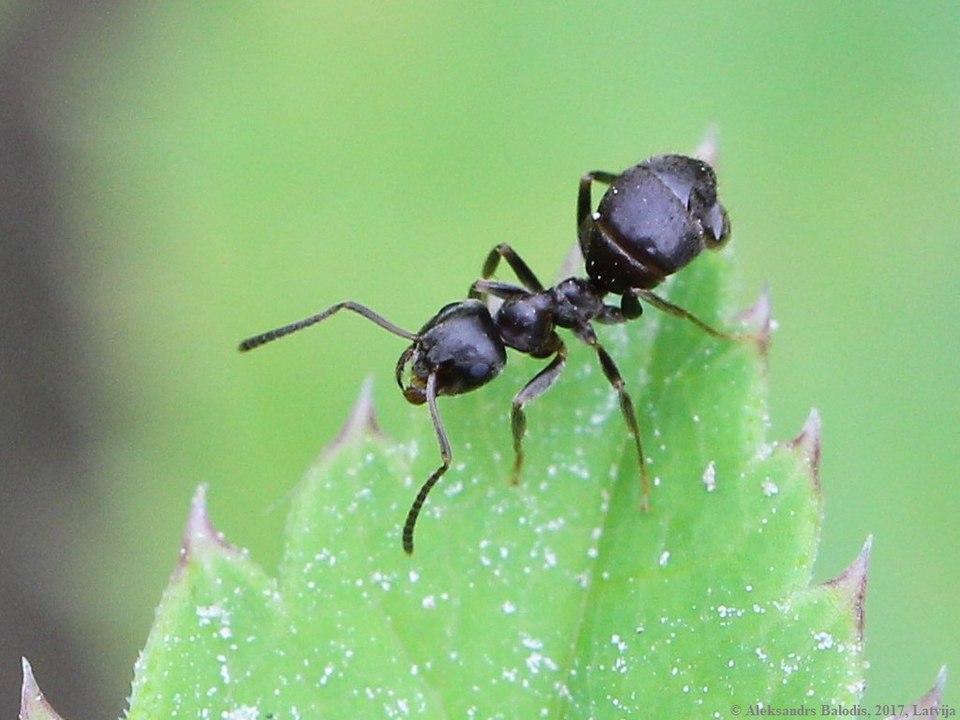
Red ants live in woodland habitats, where they nest in rotting tree trunks. They are found in many other habitats, too: moorland, grassland, open urban and agricultural areas, parks and gardens. Like black ants, they feed on honeydew from aphids and other scale insects. Red ants can deliver a mild sting if they are disturbed. Length: 0.4–0.6 cm (0.15–0.2 inches) Eats: honeydew.
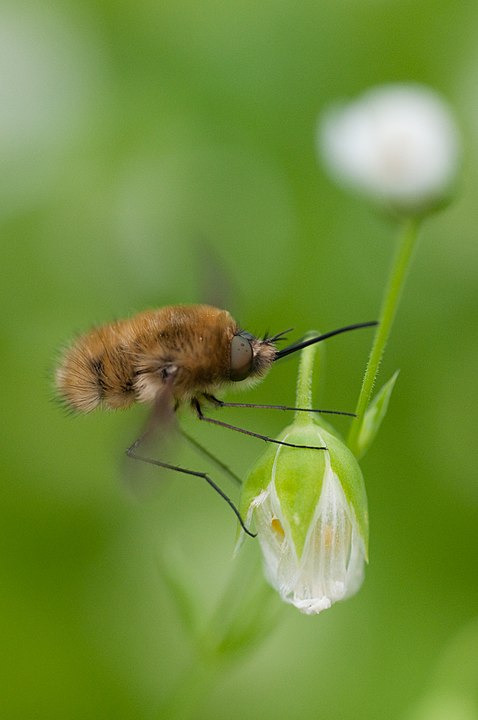
Bee-fly
Bombylius major
These yellow-striped, fluffy flies look like bees to deter predators, but do not have a sting. They have a pouch which they fill with small stones to coat their stick-shaped eggs. This gives them the weight needed to hurl them down the nest tunnels of solitary bees where the larvae eat the young bee larvae. The dark-edged bee-fly is most commonly seen in the British Isles in spring. It feeds on nectar from flowers, using its long proboscis to reach inside them. Length: up to 1.8 cm (0.7 inches). Eats: nectar.
Bees
Bombus pascuorum (Common carder bee) Apis mellifera (Honey bee), Osmia bicornis (Red mason bee), Bombus hypnorum (Tree bumblebee)
The British Isles are home to more than 250 species of bee, including 24 species of bumblebee. Tree bumblebees are common in woodlands and gardens. These furry bees have golden-yellow backs, black bodies and white tails. Length: 1.1–1.3 cm (0.4–0.5 inches). Eats: nectar and pollen.
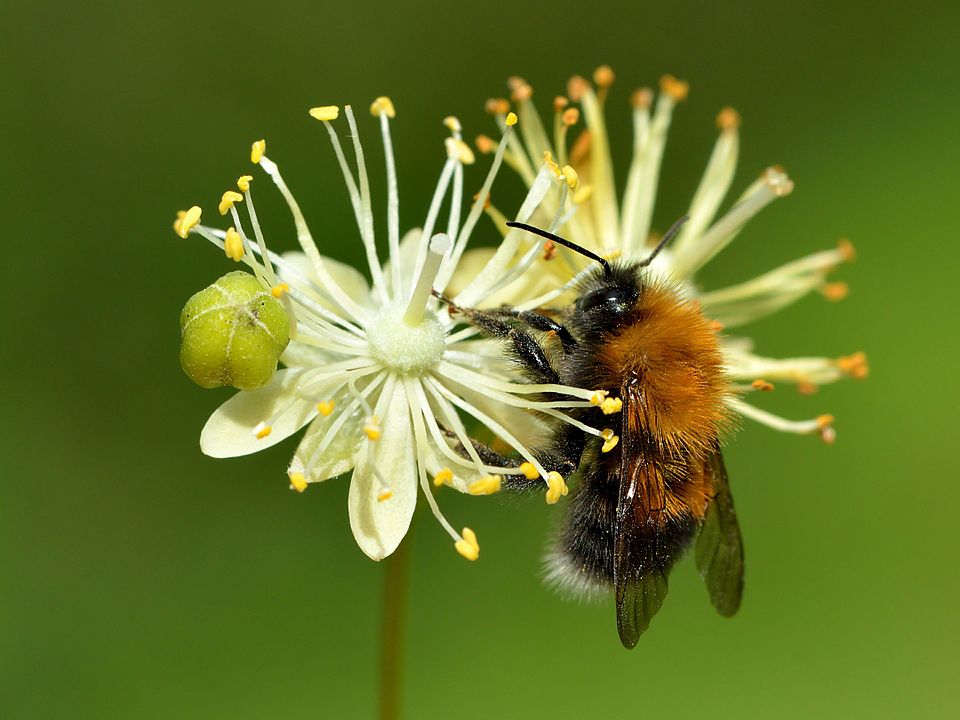

The fluffy common carder bee can be spotted almost everywhere in the British Isles, and is becoming the most widespread bumblebee in northern areas. It has golden-brown fur all over. Its long proboscis enables it reach deeper into flowers than other bees as it searches for nectar. It is often found feeding on heather and lavender. Length: 1.3 cm (0.5 inches). Eats: nectar and pollen.
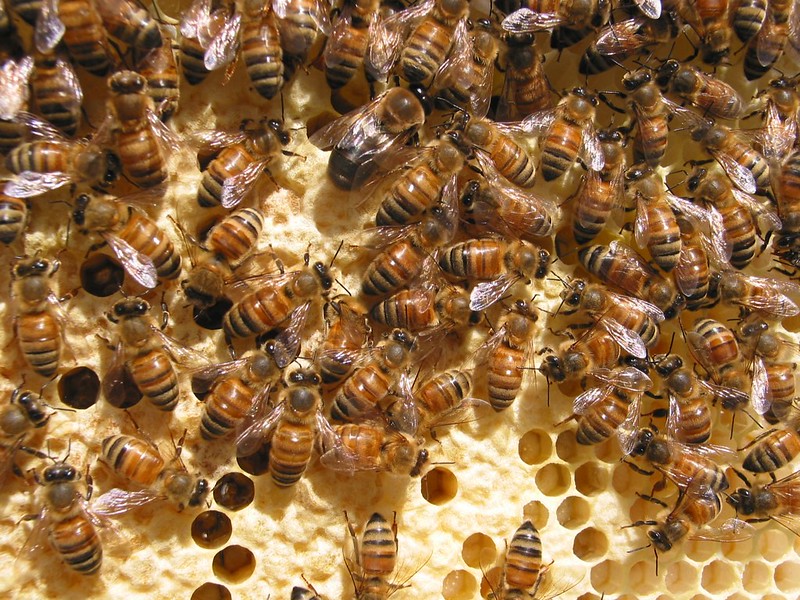
Honeybees are much slimmer than bumblebees, and have thinner stripes. Nearly all the British Isles’ honeybees are domesticated (looked after by beekeepers). Length: 1.2 cm (0.5 inches). Eats: nectar and pollen.
Mason bees are solitary bees that make their nests in the cracks of brick and stone walls. They use mud to seal up their nests in winter and keep them warm. Length: 0.6–1.1 cm (0.2–0.4 inches). Eats: nectar and pollen.
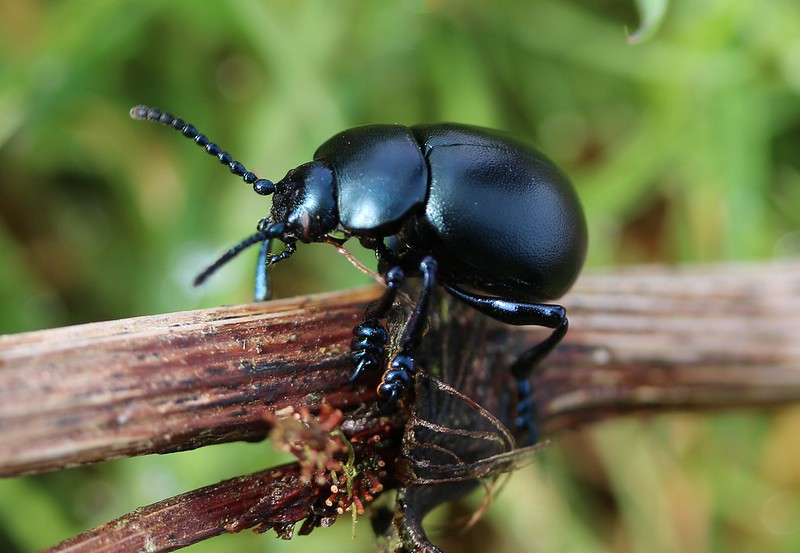
Bloody-nosed beetle
Timarcha tenebricosa
This large black beetle lives in grassy heathlands and hedgerows. It cannot fly—instead it walks slowly along the ground on its long legs. When in danger of being eaten, it oozes a drop of red liquid from its mouth. The foul taste causes predators to spit the beetle out and avoid it in future. Length: 2–2.3 cm (0.8–0.9 inches). Eats: leaves.

Bluebottle
Protophormia terraenovae
This fly has a metallic-blue body and large, red eyes. Bluebottles are a type of blowfly. Like other blowflies, they lay their eggs in meat or rotting flesh, and the eggs hatch out into maggots within 48 hours. They are considered pests because they can spread diseases—they carry dangerous bacteria on their legs and bodies. Length: 0.7–1.2 cm (0.3–0.5 inches). Eats: rotting flesh.
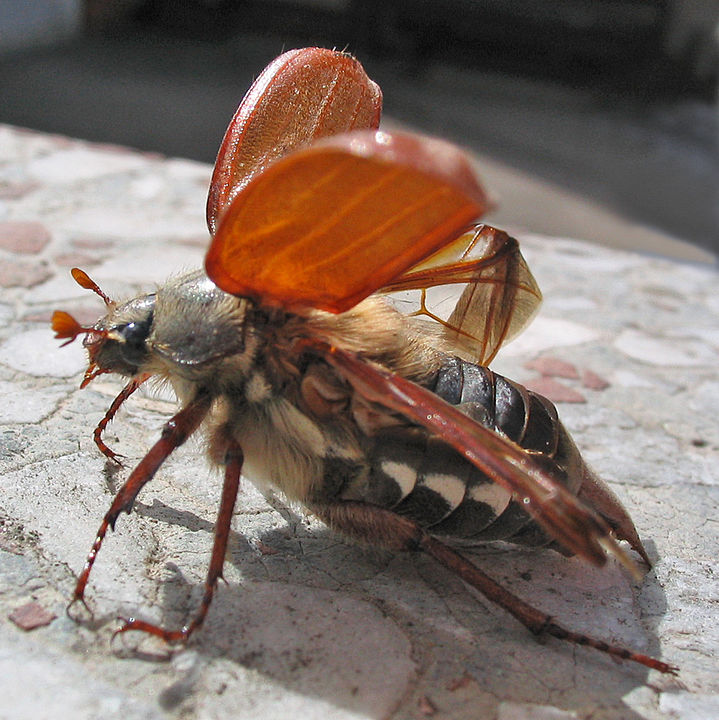
Cockchafer
Melolontha melolontha
Cockchafers are huge, rusty-brown beetles. Also known as maybugs, they are a common sight—and sound—in gardens on warm late spring evenings. As they fly, their wings make a loud buzzing sound. Cockchafers can cause damage to crops: adults eat the plants’ leaves and flowers while the larvae live in the soil, where they eat the roots. Length: up to 3 cm (1.2 inches). Eats: leaves, flowers.
Crickets
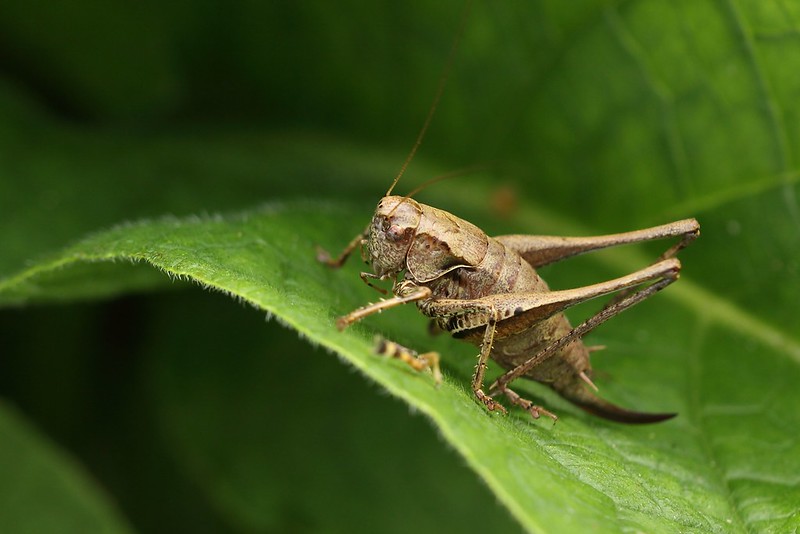
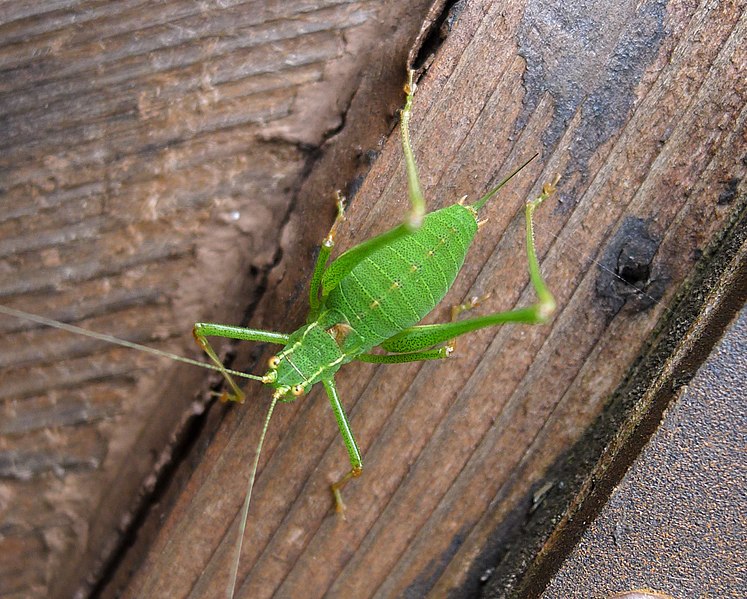
Pholidoptera griseoaptera (dark bush-cricket), Tettigonia viridissima (great green bush-cricket), Leptophyes punctatissima (speckled bush-cricket)
Crickets can be told apart from grasshoppers by their antennae (feelers), which are longer than their bodies. Their long hind legs help them to jump great distances into the air to escape danger. There are more than 20 species of cricket in the British Isles, and nearly all of them live in southern England. The chirping song of the dark bush-cricket is a common sound in summer. This small cricket has reddish-brown colouring. It lives in hedgerows, especially bramble bushes. Length: 1–2 cm (0.4–0.8 inches). Eats: leaves, grass, flowers.
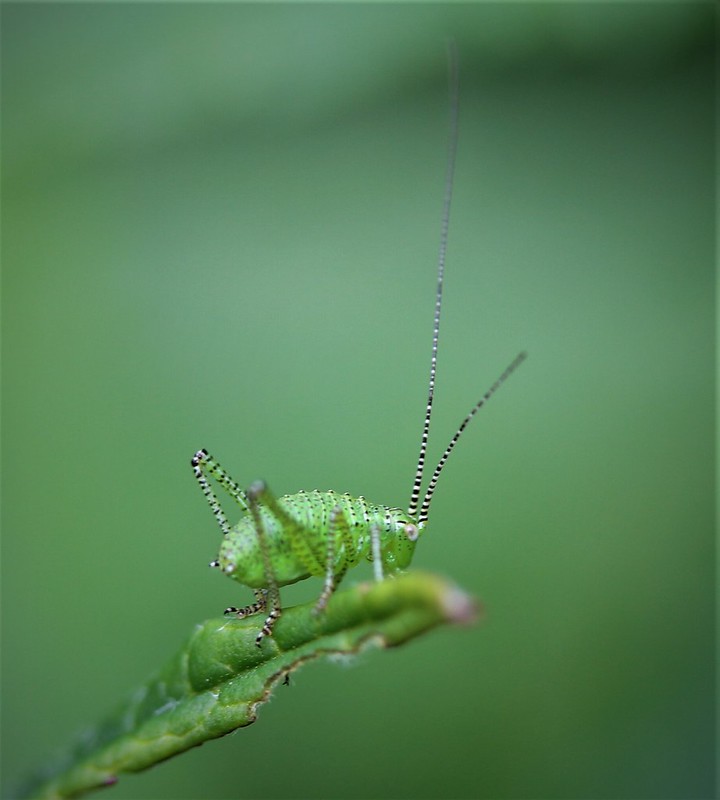
Speckled bush-crickets are also common across southern England in summer. They live in areas with lots of vegetation, such as the edges of woodlands and hedgerows. Like most crickets (and unlike grasshoppers) they become active in the evening, when their “singing” sound can be heard. Their chirping song, barely audible to humans, is made by rubbing their wings together. Length: 1–2 cm (0.4–0.8 inches). Eats: leaves, grass, flowers.
The enormous great green bush-cricket is bright green all over. Its body is almost the length of a human finger. Length: up to 7 cm (2.8 inches). Eats: leaves, grass, flowers.
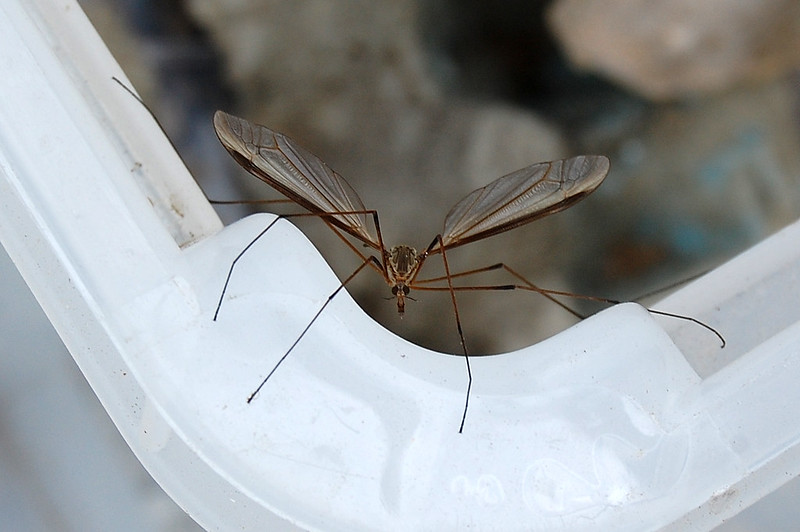
Daddy longlegs
Tipulidae
Daddy longlegs, or crane flys (there are 290 species), are types of fly with long bodies and long papery wings. Their spindly legs can measure up to 5 centimetres (2 inches) long. They often fly into houses in summer. Females have a pointed tip called an ovipositor at the tips of their bodies which they use to lay their eggs carefully in the ground. Length: 1.6 cm (0.6 inches). Eats: grass (larvae eat roots).
Damselfly
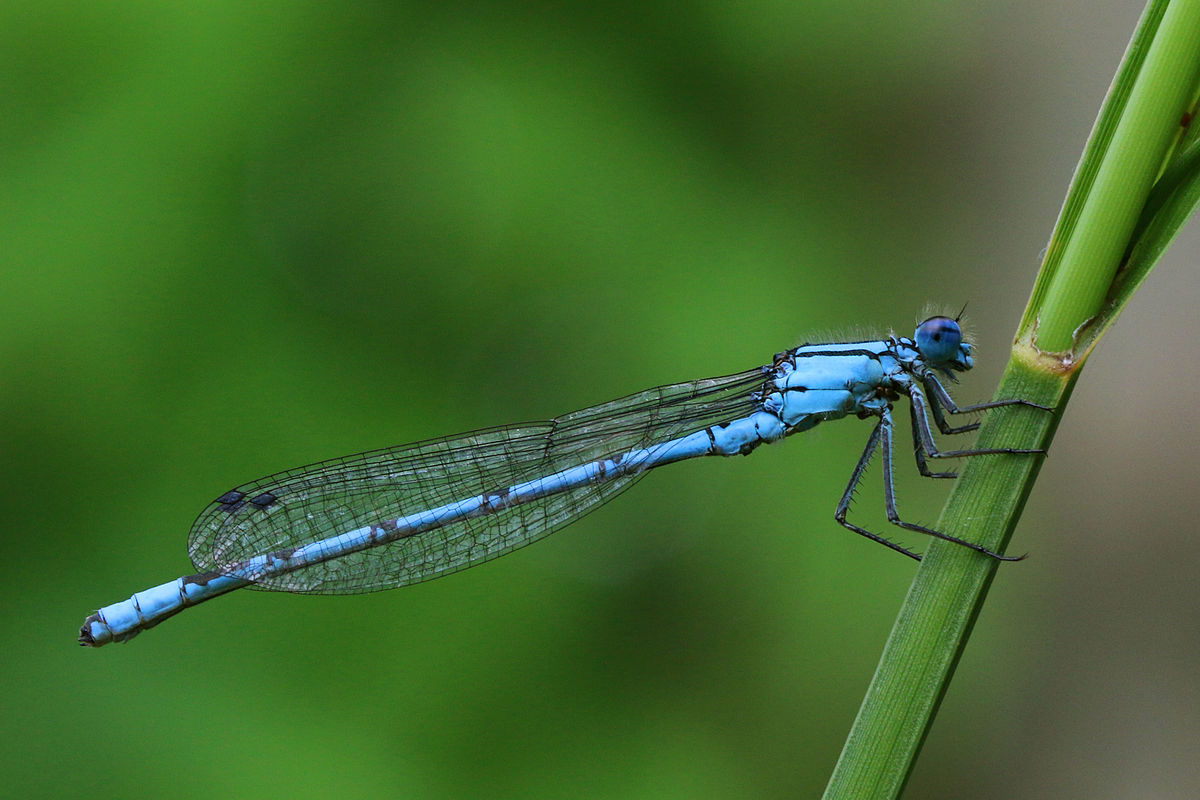
Enallagma cyathigerum (common blue damselfly)
Damselflies live on rivers, ponds and lakes, flitting over the water in search of tiny insects to eat. They look similar to dragonflies but can be told apart by the way they rest with their wings closed against their bodies when they land. There are 21 species of damselfly in the British Isles, and the common blue damselfly is the commonest. The male is electric blue with black bands along its body, while the female's body is not as brightly coloured. Length: 3.2 cm (1.3 inches). Eats: smaller insects such as gnats and aphids.
Devil's coach-horse
Staphylinus olens
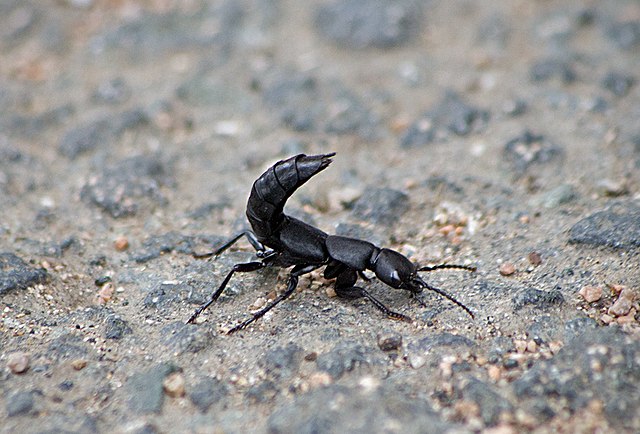
This fierce-looking black beetle lives in gardens and hedgerows, where it hides under rocks and in piles of rotting leaves. It emerges at dusk to run along the ground hunting for invertebrates, using its large jaws as pincers to crush them. When threatened, it curls up its tail like a scorpion. Length: 2.8 cm (1.1 inches). Eats: small invertebrates (woodlice, worms, slugs).

Dragonflies
Sympetrum striolatum (common darter), Anax imperator (Emperor dragonfly), Cordulegaster boltonii (golden-ringed dragonfly), Aeshna cyanea (southern hawker)
More than 30 species of dragonfly live in the British Isles. They are found in wetland areas such as rivers, lakes and marshes, as well as woodlands and hedgerows. Dragonflies spend most of their lives living underwater as juveniles, called nymphs, feeding on passing beetles and tiny fish. As adults, they fly powerfully above the water, or hunt in hedgerows, catching other insects in mid-flight. With two pairs of wings (which cannot be folded away), they can hover and turn quickly in mid-air.
Most dragonflies mate and lay eggs between June and September. As the weather turns colder, the adults die and their eggs hatch out underwater, where they can survive the lower temperatures. Dragonflies are some of the British Isles' fastest insects: they can fly at speeds of up to 48 km/h (30 mph).
The British Isles' largest dragonfly is the emperor dragonfly, which has a wingspan of just over 10 centimetres (4 inches). Females have green bodies, while males' bodies are blue. Length: 7.5–8 cm (3–3.1 inches). Eats: insects.
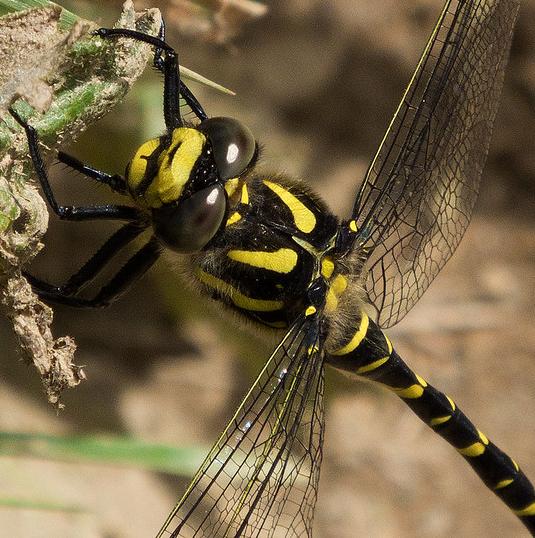
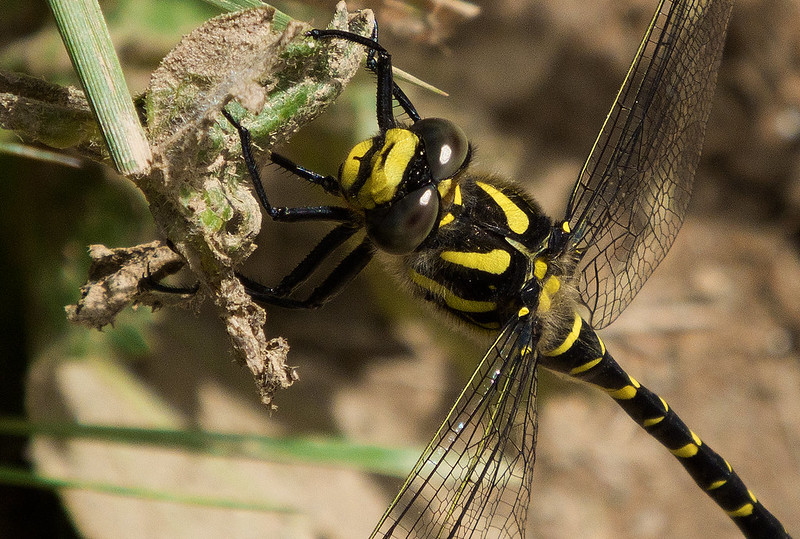
The golden-ringed dragonfly has the longest body of all, with bright yellow and black stripes. It lives in streams on moorland and heathland, and will attempt to catch large prey: bumblebees, beetles and even other dragonflies and damselflies. Length: 7.5–8.5 cm (3–3.3 inches). Eats: insects.
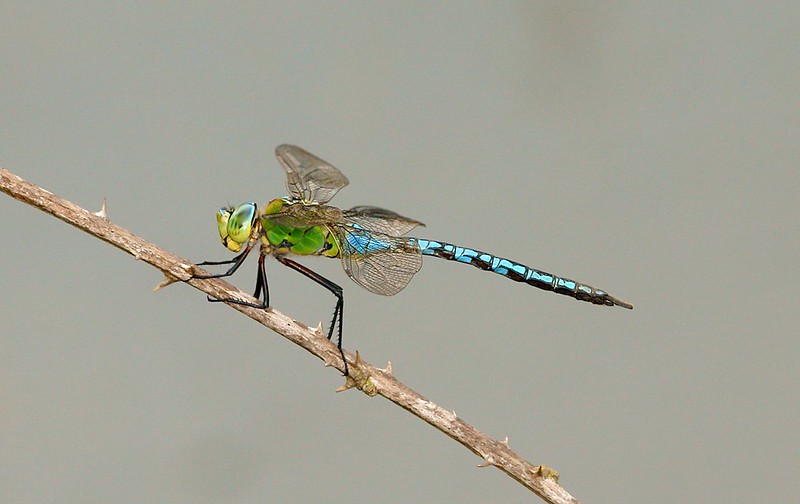

Adult common darters can be spotted flying over rivers and ponds in late October, well after other adult dragonflies have mated. Males have reddish-orange bodies, while females are yellow or pale brown. Length: 3.5–4 cm (1.4–1.6 inches). Eats: insects.
The southern hawker is easy to spot in woodland streams and ponds. The male's narrow black body is spotted with lime green markings and flashes of electric-blue. Females are brown with green markings. Length: 7 cm (2.7 inches). Eats: insects.
Dung beetles
Typhaeus typhoeus (Minotaur beetle), Geotrupes stercorarius (Dor beetle)
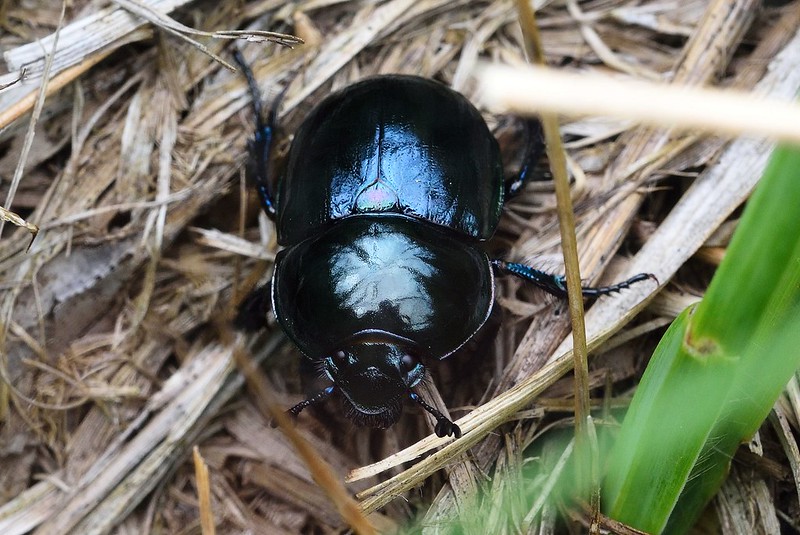
Around 60 species of dung beetle live in the British Isles. One of the most common is the dor beetle, a large, rounded beetle with shiny blue-black colouring. Dor beetles live in piles of dung and are commonly found in fields alongside cattle and horses. They dig out tunnels to make nests for their larvae, which live there for up to a year, feeding on dung. Both adults and larvae may eat their own weight in dung every day. Length: 1.2 cm (0.4 inches). Eats: mites, parasites, dung.
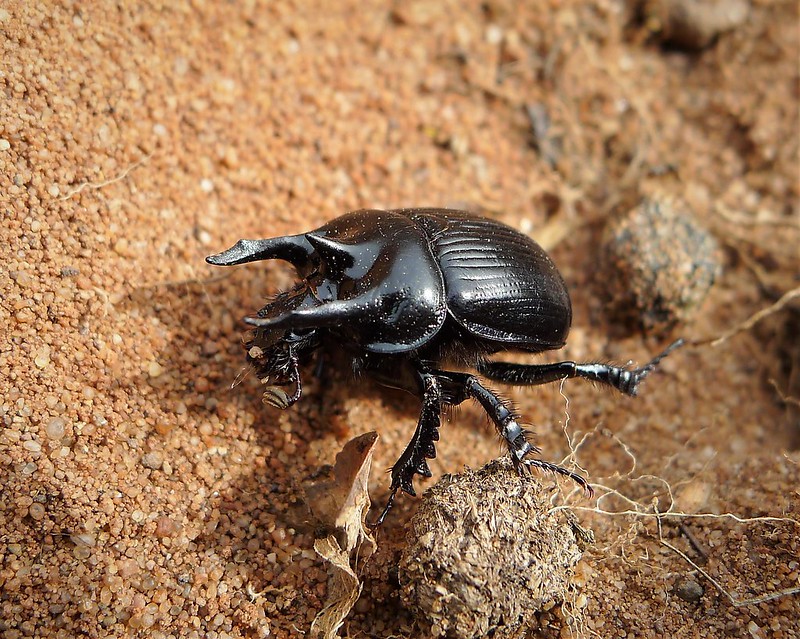
The large, black minotaur beetle is named after the Minotaur, a Greek mythical beast, because of the three, bull-like horns on the male’s head. It can be seen on sandy heathlands in autumn, where it feeds on rabbit droppings, collecting them and rolling them back to an underground nest where it feeds them to its larvae. The minotaur beetle's nesting tunnels can be as deep as 1.5 metres (5 feet). Length: up to 2 cm (0.8 inches). Eats: dung.
Earwig
Forficula auricularia
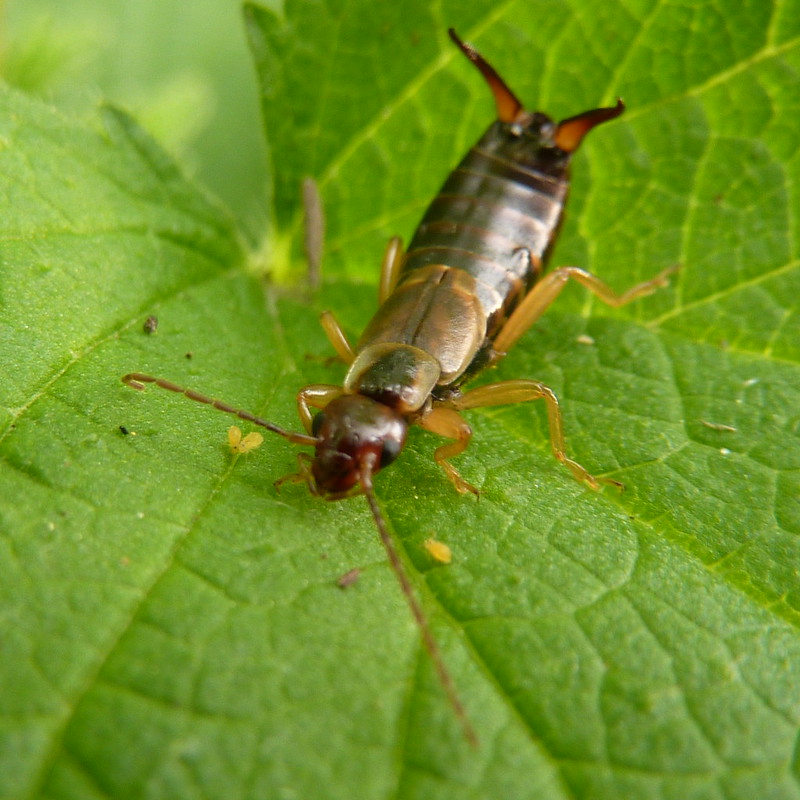
The common European earwig lives everywhere in the British Isles, making its home under piles of rotting leaves, damp logs or stones. Earwigs have long, shiny brown bodies with pincers at the end. Males’ pincers are curved while females’ are smaller and straighter. They use them to scare off predators, but if they are disturbed they can sometimes nip humans too. Length: 1.3–1.8 cm (0.5–0.7 inches). Eats: small invertebrates, leaves.

Glow worm
Lampyris noctiluca
Despite its name, the glow worm is a type of beetle which lives in chalky grasslands. Glow worms are commonest in the south of England. Adult males are plain-looking beetles with brown wings. Adult females look like larvae, with segmented bodies and no wings. They emit a bright light—called bioluminescence—from the tips of their bodies at night to attract males. Glow worm larvae and eggs may also glow. Length: 1.5–2.5 cm (0.6–1 inches). Eats: slugs (larvae also eat snails).
Grasshoppers
Chorthippus brunneus (Common field grasshopper), Omocestus viridulus (Common green grasshopper), Chorthippus parallelus (Meadow grasshopper)
Grasshoppers are plant-eating insects that live close to the ground in grassy areas. Their strong back legs enable them to spring great distances to escape danger or launch into flight. Grasshoppers' chirping song is made by the males, who rub their legs against their wings to make a song that attracts females. This is called stridulation.
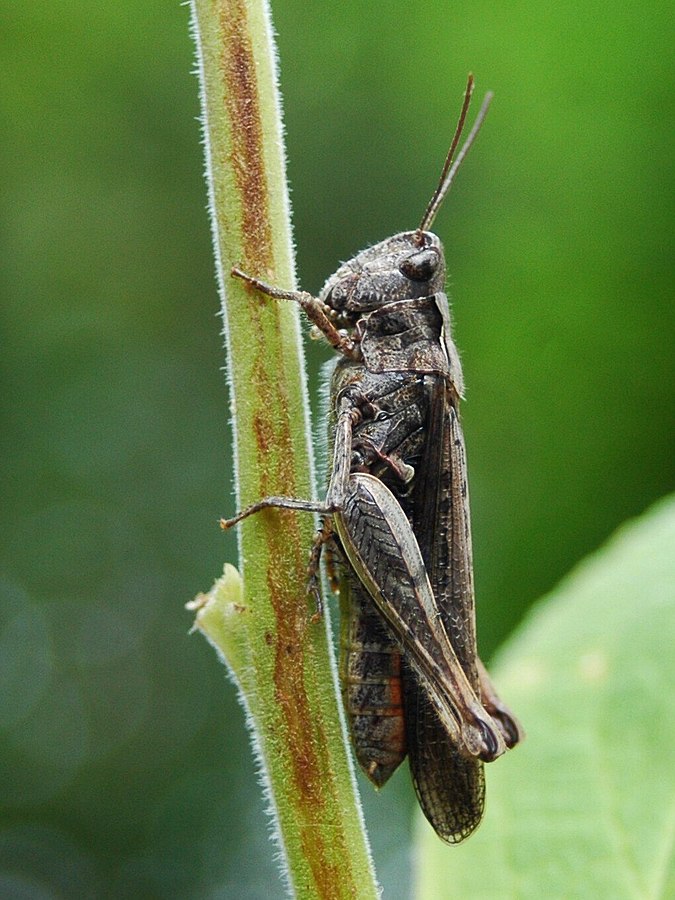
The British Isles are home to 11 species of native grasshopper. Common field grasshoppers are found everywhere in grassy areas of the British Isles including parks and gardens. They are brown with fluffy undersides, and make a song with single, short repeated chirps. Length: 1.8–2.5 cm (0.7–1 inch). Eats: grass, plant stems, leaves, flowers.

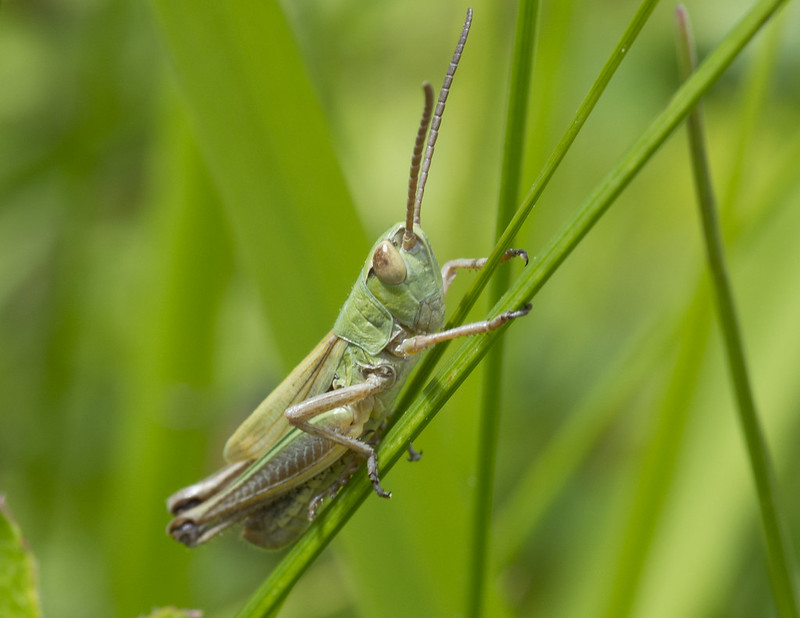
Meadow grasshoppers prefer to live in areas with long grass that are undisturbed by people or grazing animals. With only short forewings, they are, unlike field and green grasshoppers, flightless. Length: 1.7–2 cm (0.6–0.8 inches). Eats: grass, plant stems, leaves, flowers.
Common green grasshoppers live in woodlands and meadows in upland areas. They have greenish-brown colouring and a long, continuous song. Length: 1.5–2 cm (0.6–0.8 inches). Eats: grass, plant stems, leaves, flowers.
Great diving beetle
Dytiscus marginalis
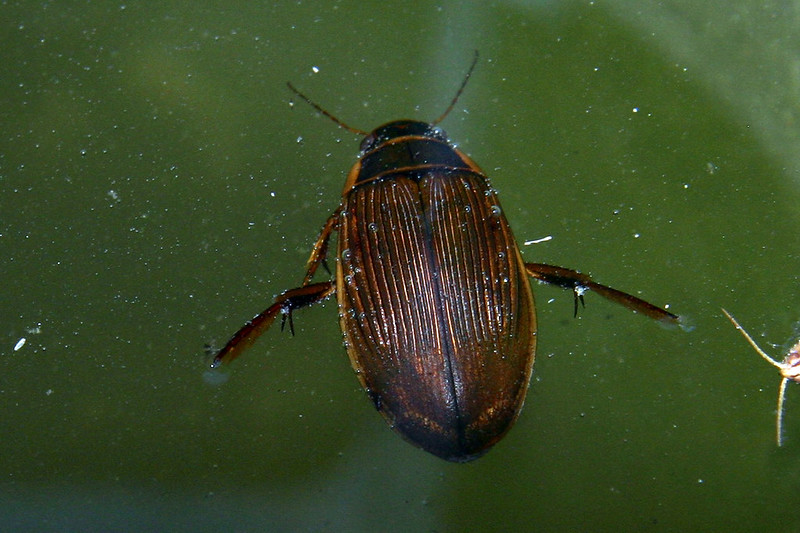
The great diving beetle is one of the British Isles’ largest beetles. It lives in ponds and other slow-moving waters and hunts underwater, where it preys on tadpoles, insect larvae and even small fish. Both larvae and adults have large, strong jaws. Before a dive, adult beetles store air underneath their wing-cases so they can stay underwater for longer. Length: 3 cm (1.1 inches). Eats: tadpoles, insect larvae, fish.
Green tiger beetle
Cicindela campestris
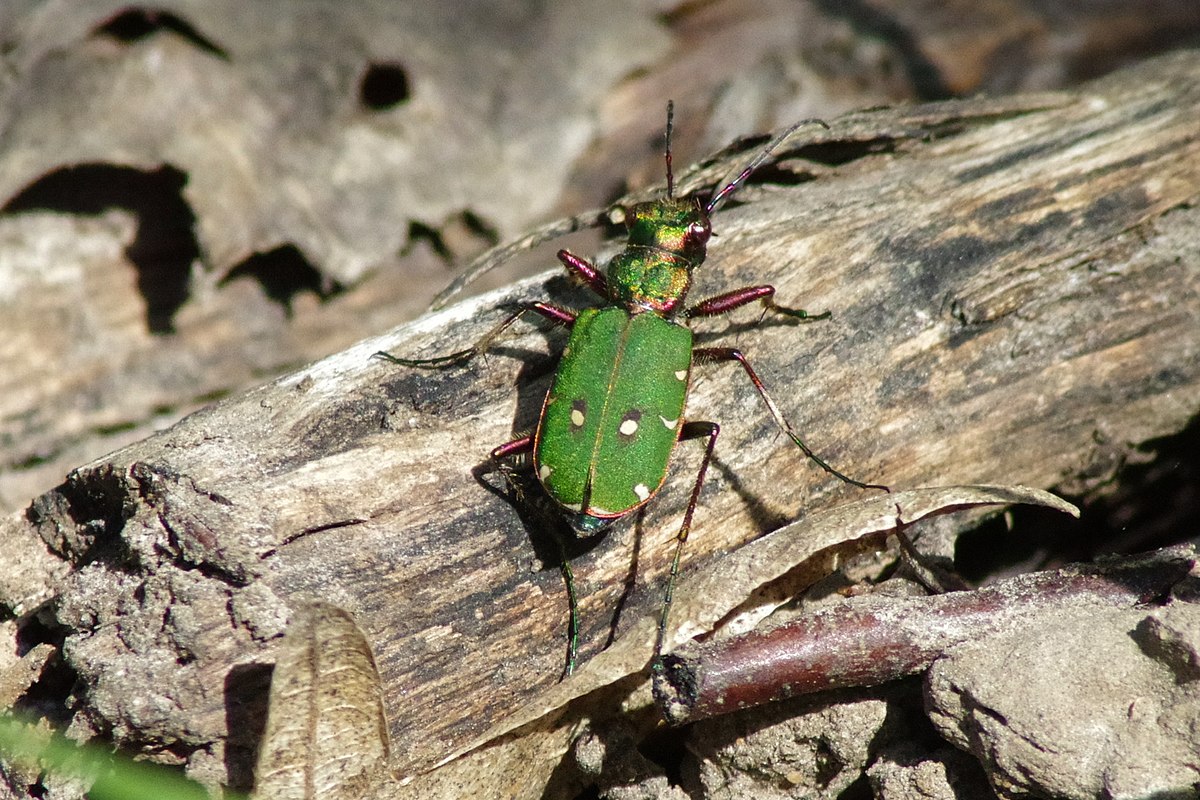
This fast-moving beetle has a bright, metallic green body with large spots on its wing-cases. Its long legs allow it to run at great speeds to catch ants and spiders. Green tiger beetles live in grasslands in areas with sandy soil. They can be easily spotted on the ground during spring and summer. Length: 1–1.5 cm (0.4–0.6 inches). Eats: spiders, ants, caterpillars.
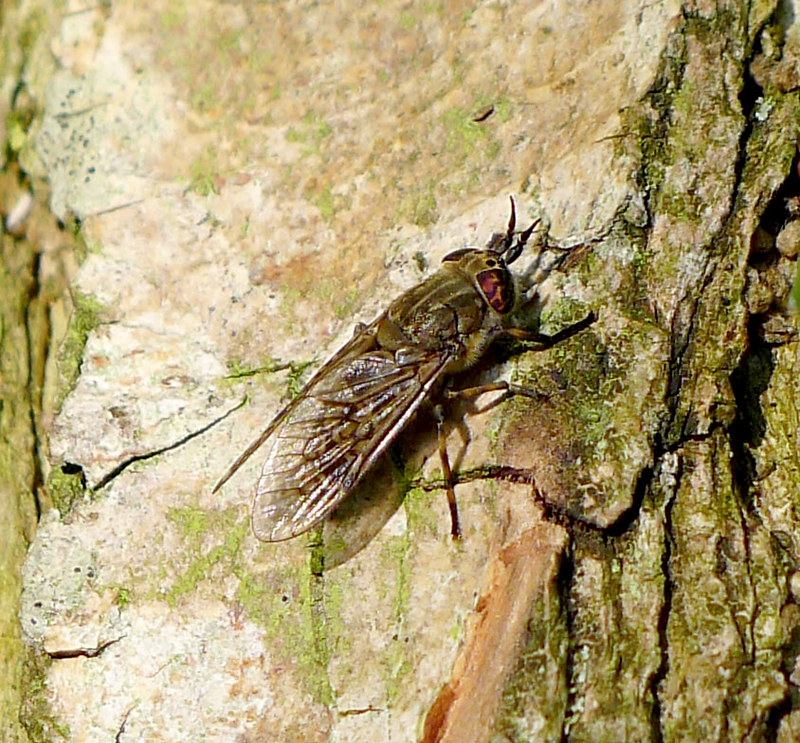
Horsefly
Haematopota pluvialis (Notch-horned cleg fly)
There are 30 species of horsefly in the British Isles. The most common is the notch-horned cleg fly, a dark grey fly with striped eyes. Horseflies are well-known for their bite, which can be painful for humans. They live on grassy farmland, where they feed on the blood of cows and horses. Only the females have the sharp mouthparts that allow them to drink blood; males drink nectar instead. Length: 1 cm (0.4 inches). Eats: blood, nectar.
Hoverflies
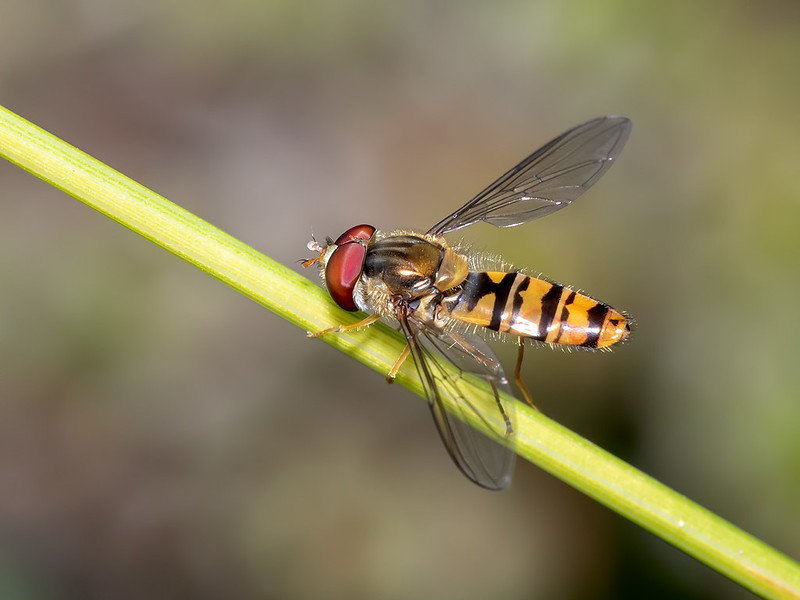
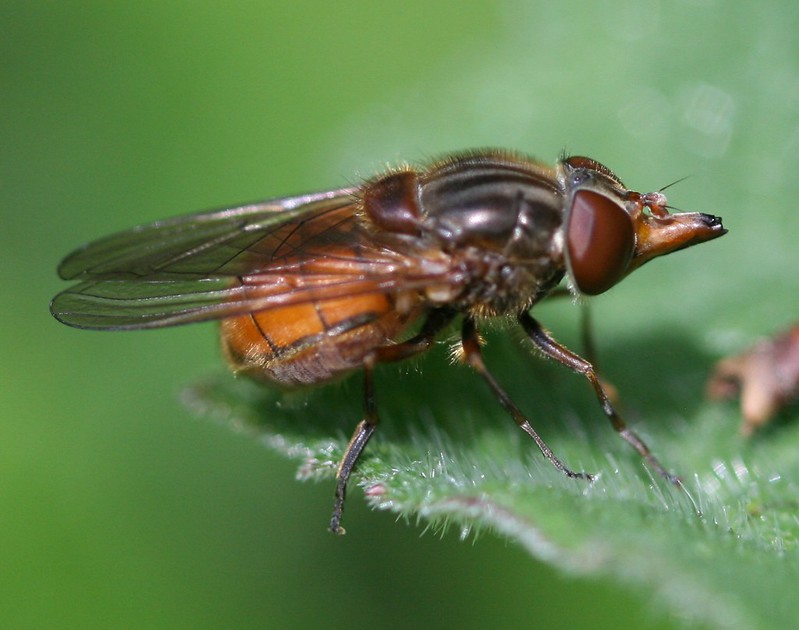
Rhingia campestris (black-rimmed snout hoverfly), Episyrphus balteatus (marmalade fly)
Hoverflies are flies with bee-like markings on their bodies to deter predators. They move their wings in figure-of-eight movements to hover over flowers as they feed. Some hoverfly larvae live in ant nests or tunnel inside plants. The most common hoverfly is the marmalade fly, which is orange with black stripes. It is easy to spot in flowerbeds. Length: 0.9–1.2 cm (0.4–0.5 inches). Eats: nectar.
The black-rimmed snout hoverfly is dark orange with a hairy body, and feeds on flowers in hedgerows and woodlands. It has an especially long snout, which allows it to reach deeper into flowers than other hoverflies. Length: 0.7–1.1 cm (0.3–0.4 inches). Eats: nectar.
Ladybirds
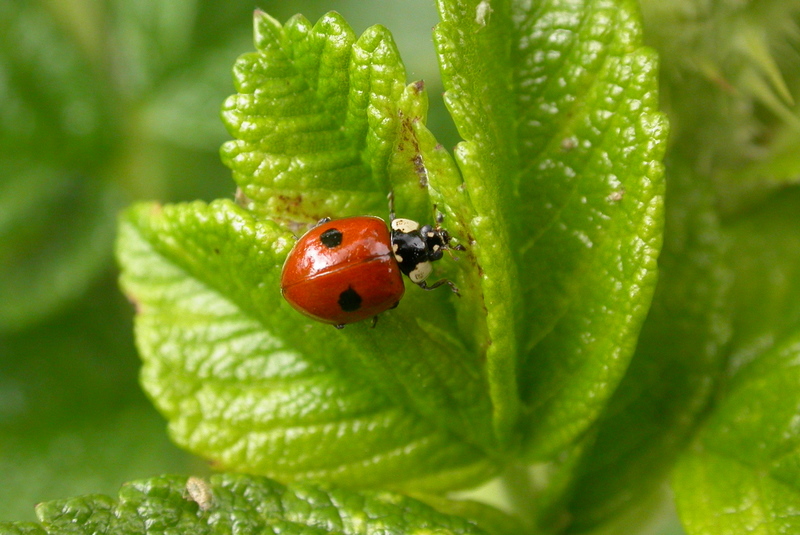
Adalia bipunctata (2-spot ladybird), Psyllobora vigintiduopunctata (22-spot ladybird), Harmonia axyridis (harlequin ladybird)
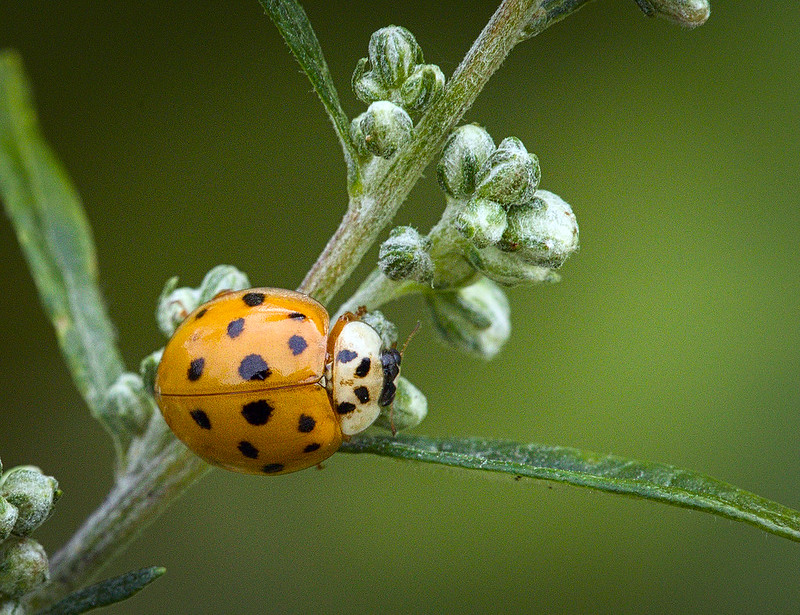
Ladybirds are colourful, spotted beetles. They live in parks, hedgerows and gardens, where they feed on tiny plant-eating insects called aphids. When threatened, ladybirds ooze a smelly liquid from their leg-joints to scare predators away. There are 46 ladybird species in the British Isles. The most common is the red 2-spot ladybird, so-called because some (but not all) individuals have one black spot on each wing-case. (Confusingly, 2-spots with four spots are common, especially in the north. Some have as many as 16 spots.) Length: 0.4–0.6 cm (0.15–0.2 inches). Eats: aphids.
The 14-spot and smaller 22-spot ladybirds (which measure 4 mm long) are yellow with black spots.
Harlequin ladybirds can have any combination of markings in orange, red and black. They were introduced from Asia in 2003 and have quickly spread across England and Wales, threatening the survival of native ladybirds by eating their food and even their larvae. (They can be distinguished by their brown legs; native ladybirds have black legs.) Length (Harlequin): 0.8 cm (0.3 inches). Eats: aphids, other ladybird larvae
Mayfly
Ephemera danica
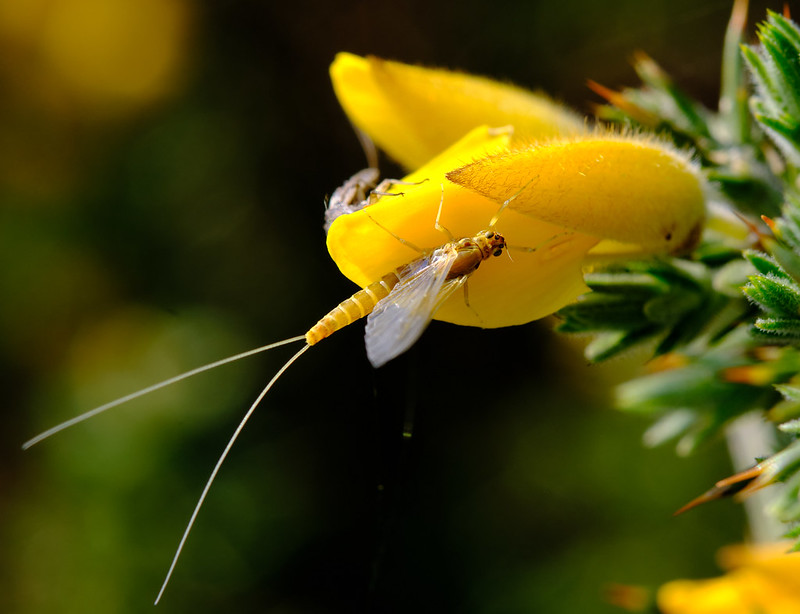
The common mayfly lives near rivers and lakes. Mayfly young, called nymphs, live underwater for several years, feeding on plants and algae. Once they mature into adults, they live for only a few hours, during which they must attract a mate and breed. After successfully mating, they die. Mayflies have long, delicate bodies, long, split tails and translucent wings with lacy patterns. Length: 1.5–3 cm (0.6–1.2 inches) Eats (as larvae only): water plants, algae.
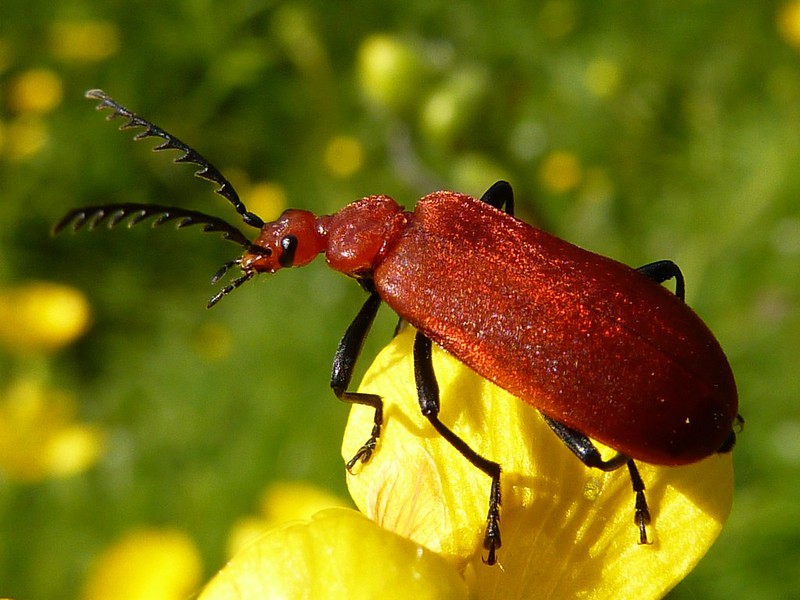
Red-headed cardinal beetle
Pyrochroa serraticornis
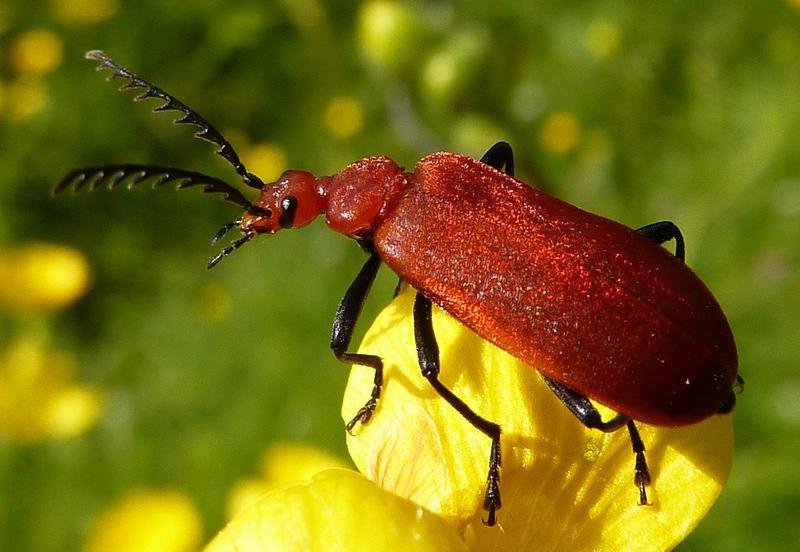
This bright red beetle is easy to spot in woodlands and hedgerows, where it basks on leaves and flowers during the summer. It lies in wait for its prey—small flying insects—to land nearby, then seizes them in its jaws. The cardinal beetle’s red colour tricks predators into thinking it is poisonous, so it does not need to hide and can sunbathe in the open. Length: 2 cm (0.8 inches). Eats: insects.
Rose chafer
Cetonia aurata
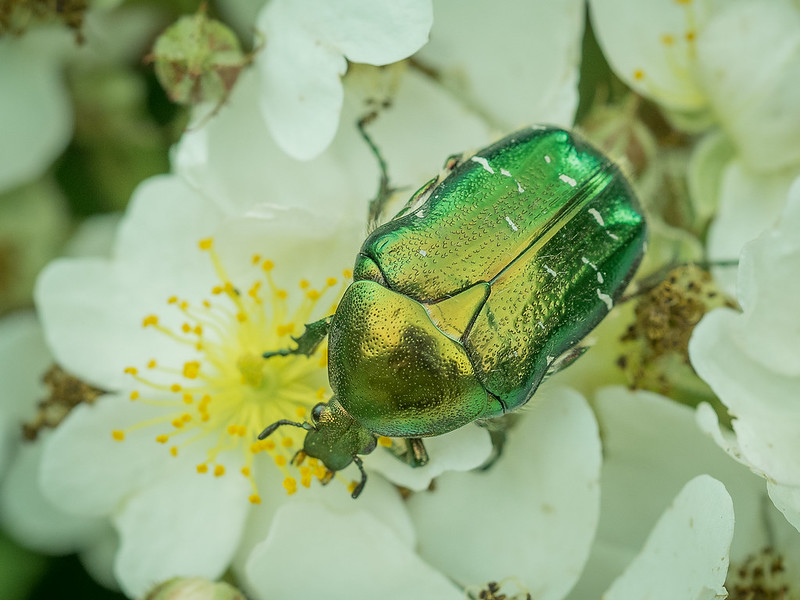
The rose chafer is a large beetle with a bright metallic-green shell. It lives in grassy areas such as gardens and on the edges of woodlands. Rose chafers can be spotted on flowering plants, especially roses, on sunny days in summer and autumn. Their favourite food is a pale pink or white flower called the dog rose. Length: 1.7–2 cm (0.7–0.8 inches). Eats: flowers, nectar, pollen.

Sexton beetle
Nicrophorus vespilloides
The common sexton beetle is a type of burying beetle that lives on the decaying bodies of dead birds and small mammals (a sexton is a church official in charge of the graveyard). The female lays her eggs on the corpse, and then works with the male to bury it in the soil. After the larvae hatch, they feed on the flesh. The sexton is one of the few beetles to actively care for its young. Since the larvae's mouthparts are not strong enough to begin with, the adult beetles feed them mouth to mouth. They also coat the carrion with anti-bacterial chemicals in order to stop the food rotting and to disguise the smell from other scavengers. Sexton beetles can smell a dead animal kilometres away. Length: up to 3 cm (1.2 inches). Eats: carrion.
Shield bugs
Pentatoma rufipes (forest bug), Palomena prasina (green shield bug), Acanthosoma haemorrhoidale (hawthorn shield bug)
These flat-bodied, shield-shaped bugs are also known as stink bugs, because of the strong smell they give off when they are disturbed. The largest and commonest of them is the hawthorn shield bug, which lives in shrubs and hedgerows all over the British Isles. Its distinctive red-and-green markings help it to camouflage. Length: 1.3–1.7 cm (0.5–0.7 inches). Eats: haws (hawthorn berries).

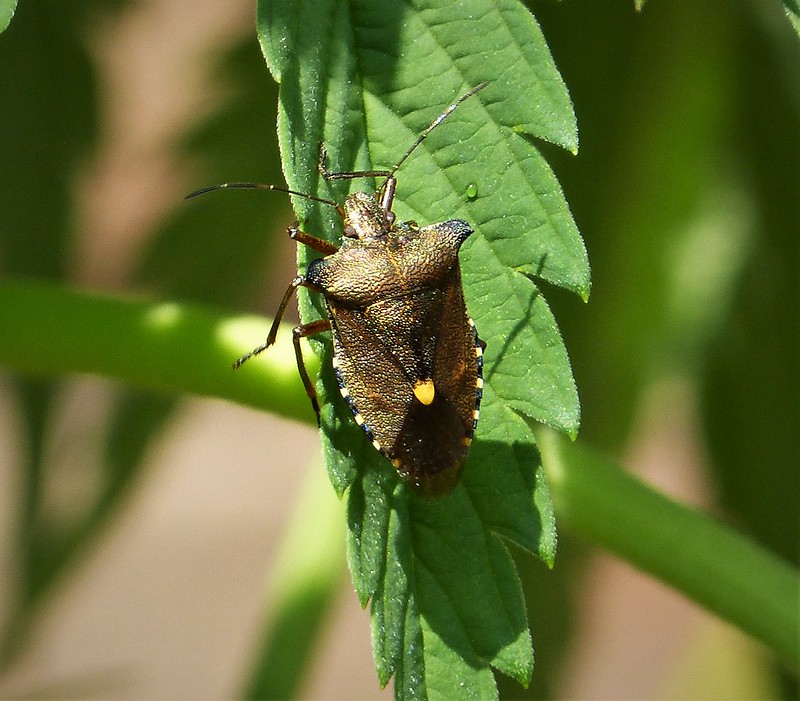
Green shield bugs are leaf-green in summer and brown in autumn. They are found throughout England and Wales. Adults hibernate through the winter, hiding in piles of leaves. Length: 1–1.5 cm (0.4–0.6 inches). Eats: plant sap.
The forest bug's shell looks most like a shield, with its squared-off corners. Forest bugs are dark brown with reddish-orange legs. They live in woodlands, where they feed on oak tree sap. They also eat fruit and caterpillars, which they pierce with their tube-like mouthparts and suck the juices out of. Length: 1.1–1.4 cm (0.4–0.6 inches) Eats: tree sap, fruit, caterpillars.
Soldier flies
Chloromyia formosa (broad centurion)
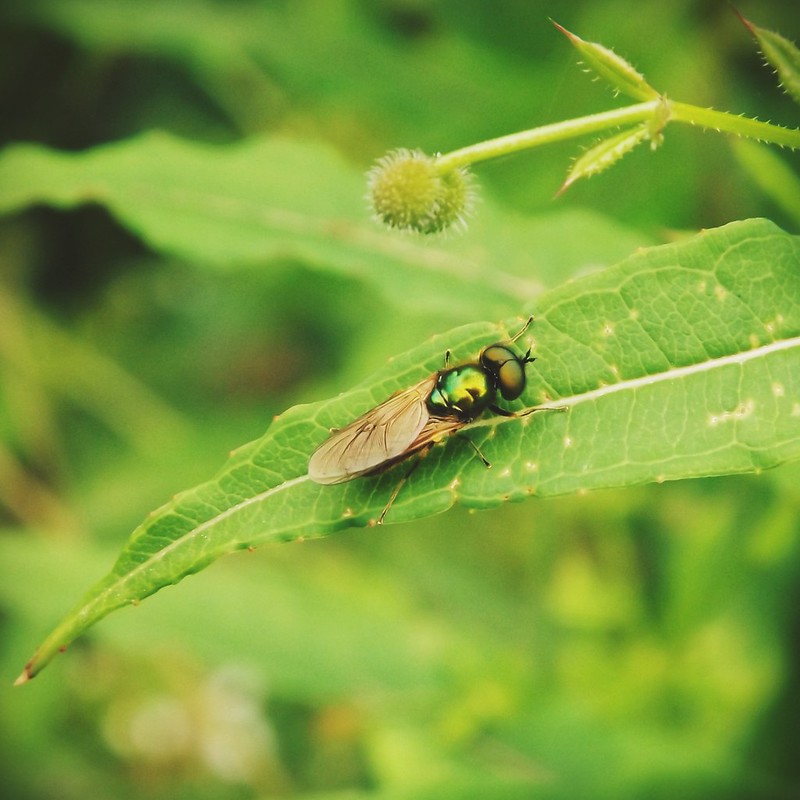
Nearly 50 species of soldier fly live in the British Isles. This family of flies are so-called because of their brightly-coloured or patterned bodies, which look like soldiers' uniforms (in the historical past). The most commonly-seen is the broad centurion, also known as the green soldier fly. Females have a metallic blue body, while males’ are green. Like other soldier flies, they have hairy eyes. They are easy to spot in gardens, where they lay eggs in piles of rotting leaves. Length: 1 cm (0.4 inches). Eats: rotting leaves (larvae), nectar (adults).
Stag beetle
Lucanus cervus
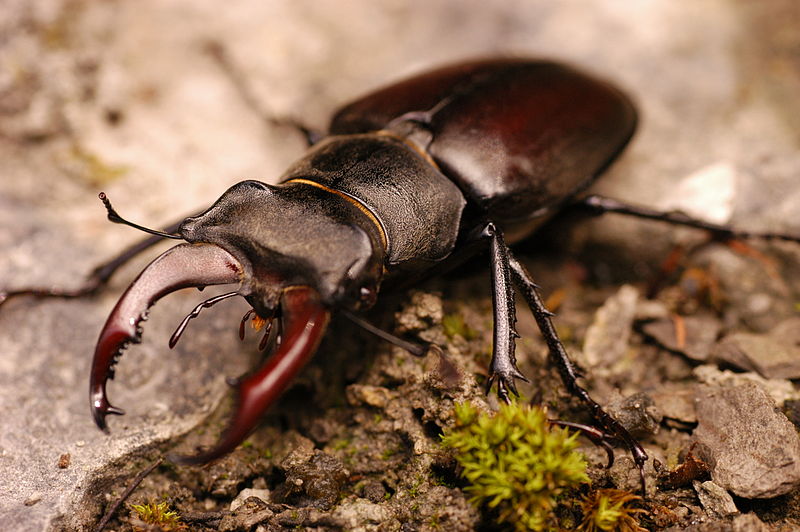
The British Isles’ largest beetle is the magnificent European stag beetle, which lives in southeast England. Males have huge jaws like antlers, which they use to attract females and fight with other males. Although they look vicious, they are harmless to humans. Stag beetles spend most of their lives—five to six years—underground as larvae. Once they become mature adults, they emerge in summer to find a mate and breed. Length: 3.5–7.5 cm (1.4–3 inches). Eats: rotting wood (larvae), tree sap (adults).
Thick-headed fly
Conops quadrifasciatus
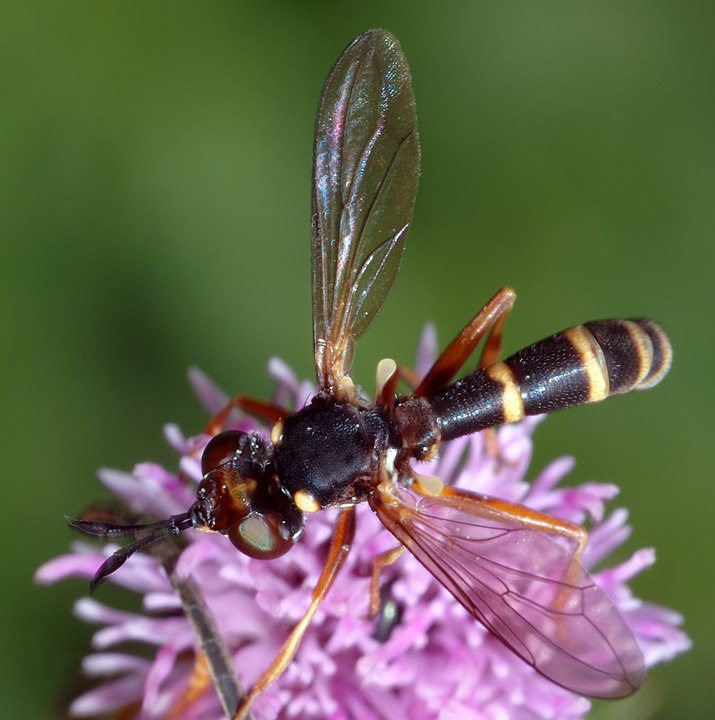
Thick-headed flies look like wasps with their black and yellow stripes, but they are a type of conopid fly, harmless to humans but deadly to bumblebees. They live on flowers, where they lie in wait for bumblebees. The female then pierces the bee’s body and inserts one of her eggs. When the larvae hatch out, they slowly devour the bee from the inside out. Length: 1 cm (0.4 inches). Eats: other insects (larvae), nectar (adults).
Wasps
Vespula vulgaris (common wasp), Vespa crabro (European hornet)
Around 9000 species of wasp live in the British Isles. They are found in all habitats, making their homes in any hole or gap suitable for building a nest, such as roofs or rock crevices. If disturbed or threatened, they can deliver a painful sting. The common wasp (also called a yellow-jacket) is one of the easiest to spot in summer and autumn, when the adults fly into gardens and picnics in search of flowers and sugary foods. The sugar gives them energy to build and maintain their nests, which are made from chewed-up wood pulp. Length: up to 2 cm (0.8 inches). Eats: small insects (larvae), nectar, rotting fruit, sugary scraps (adults).
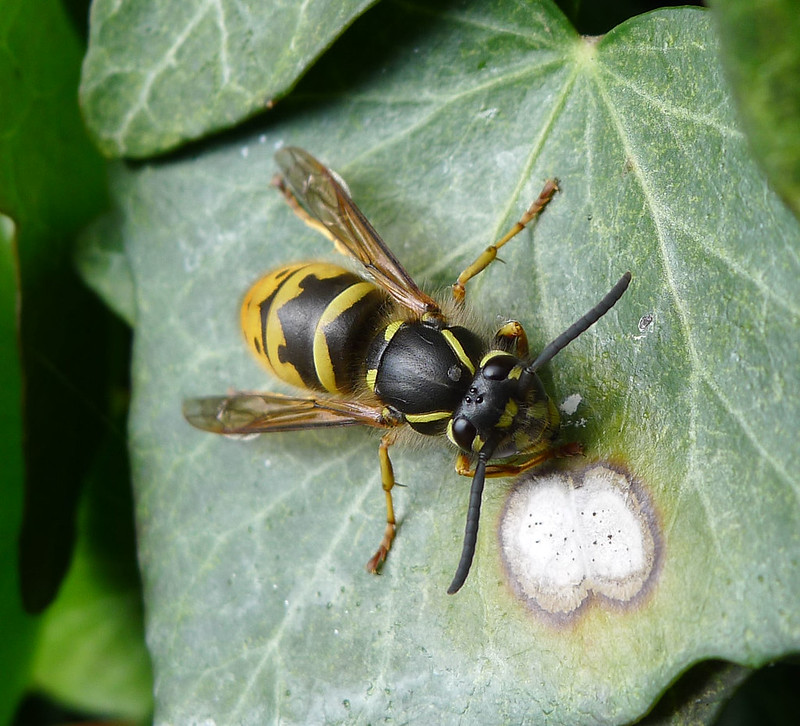
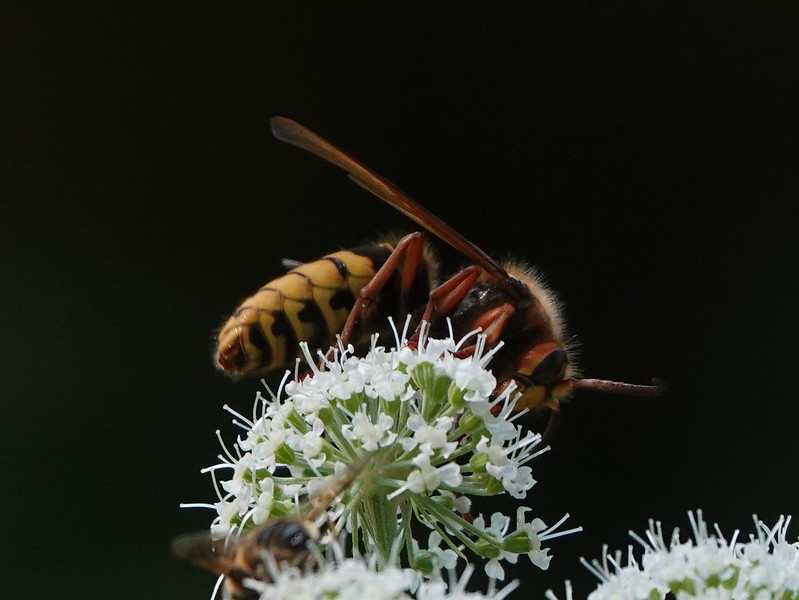
European hornets are much larger than common wasps. They have pale yellow bodies with thin black stripes, and red legs. Despite their large size, they are no more likely to sting humans than common wasps, especially if they are left undisturbed. Length: up to 3.5 cm (1.4 inches) Eats: nectar, insects
Water boatman
Corixa punctata
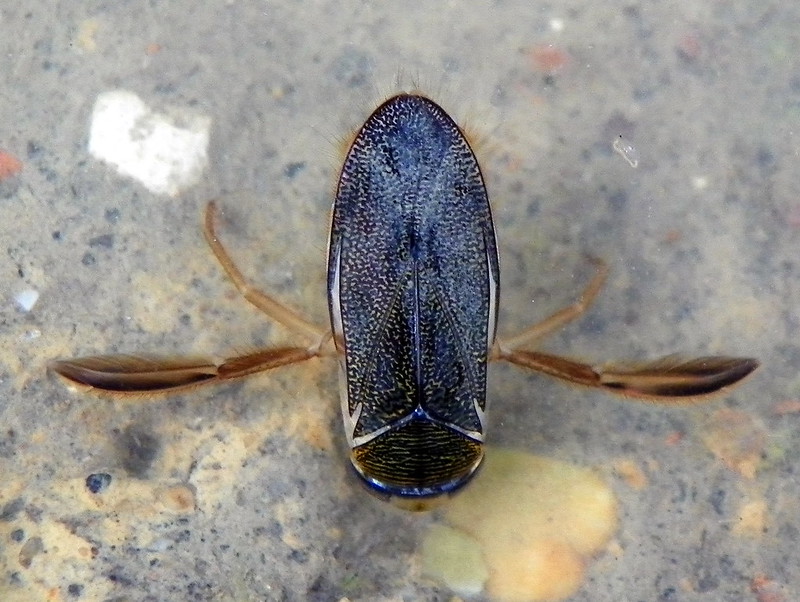
These brown bugs live on ponds and other slow-moving waters all over the British Isles. Their large hind legs are shaped like oars to help power them through the water. Water boatmen dive under the water to feed on algae and underwater plants, surfacing to take in air. Length: up to 1.5 cm (0.6 inches). Eats: algae, water plants.

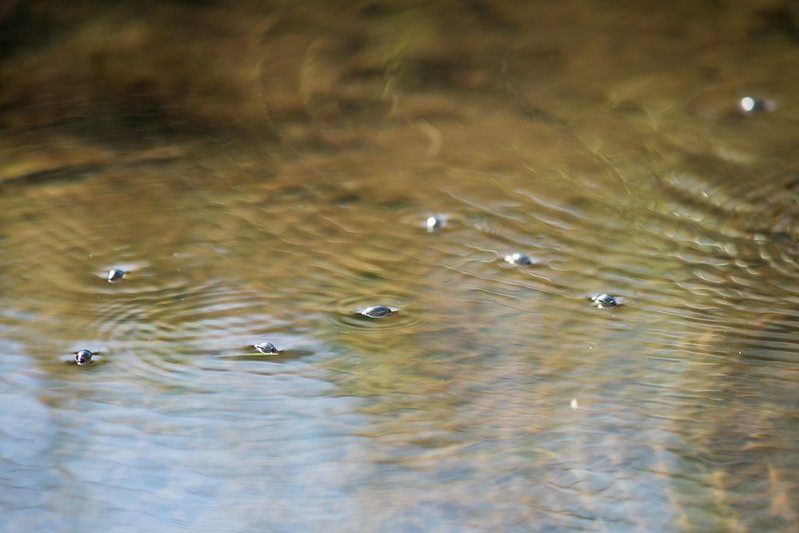
Whirligig beetle
Gyrinus substriatus
Whirligig beetles can be seen in large groups on the surface of ponds and slow-moving waters, swimming in a circling (“whirligig”) way. Their short back legs are shaped like oars to paddle themselves through the water. They catch insects that fall on to the water’s surface, or dive to catch underwater prey. Whirligig beetles have two pairs of eyes: one pair looks upwards while the other keeps a lookout for predators underwater. Length: 0.5–0.7 cm (0.2–0.3 inches) Eats: small insects and invertebrates.
Consultant:Chris Jarvis
pics

Without in any way limiting Q-files Ltd’s exclusive rights under copyright, any use of this publication to “train” generative artificial intelligence (AI) technologies to generate text is expressly prohibited. Q-files Ltd reserves all rights to license use of this work for generative AI training and development of machine learning language models.