
Mammals

CITE
We have made every effort to follow citation style rules, but there may be some minor differences. If in doubt, please refer to the appropriate citation style manual.
Hedgehogs, moles and shrews. (2026). In Q-files Encyclopedia, Life, Mammals. Retrieved from
https://www.q-files.com/life/mammals/hedgehogs-moles-and-shrews
"Hedgehogs, moles and shrews." Life, Mammals, Q-files Encyclopedia, 24 Mar. 2026.
https://www.q-files.com/life/mammals/hedgehogs-moles-and-shrews.
Accessed 13 Sep. 2026.
Hedgehogs, moles and shrews 2026. Life, Mammals. Retrieved 13 September 2026, from
https://www.q-files.com/life/mammals/hedgehogs-moles-and-shrews
Life, Mammals, s.v. "Hedgehogs, moles and shrews," accessed September 13, 2026.
https://www.q-files.com/life/mammals/hedgehogs-moles-and-shrews


Hedgehogs, moles and shrews
Hedgehogs, moles and shrews are a loosely related group of small animals. They have long snouts and very keen senses of smell that they use to find their prey. Most eat insects, worms and other tiny creatures, but some shrews are able to kill quite large prey, such as frogs. Many of these animals are nocturnal, emerging only at night to feed.


Moles
Moles are small, burrowing animals with clawed, shovel-like paws and small eyes. There are 46 species of mole and their relatives, the desmans and shrew moles. Moles rely mostly on their sense of touch to get around and detect prey. Their flexible snouts are particularly sensitive.
Moles tunnel underground in search of worms and other invertebrates to eat. They build underground "larders" for storing earthworms for later consumption. As a mole digs, it pushes the waste soil up to the surface to form a mole hill. Some species may forage for food on the forest floor at night, but most moles feed on invertebrates that fall into their network of tunnels.


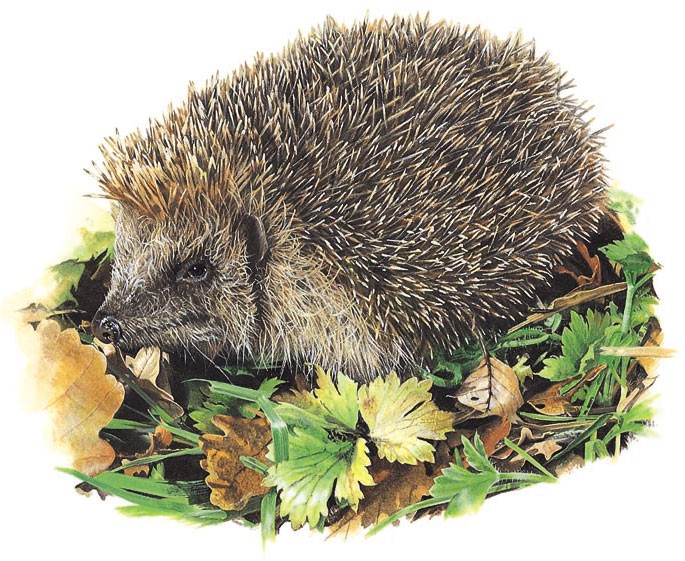
Hedgehogs
Different species of hedgehog are found all over Europe, Asia and Africa: 16 in all. They eat a wide range of foods, chiefly earthworms, but also insects, slugs, birds' eggs, bird chicks and fruit. They also scavenge on the carcasses of dead animals. A European hedgehog goes in search of food at night, often wandering into gardens or rubbish dumps. If threatened, it erects the 5000–6000 spines on its back, rolls into a tight ball and freezes until the danger has gone away.
Shrews

Shrews are small, mice-like animals with long tails, pointed snouts and short, spiky teeth. There are 385 species, forming the most diverse group of mammals after the rodents and bats. Shrews forage for seeds, insects, worms and a variety of other foods. Different species inhabit a wide range of habitats, including under the ground, in trees or in the water. Shrews have small eyes and poor eyesight, but have excellent senses of hearing and smell. They have large appetites, eating nearly the equivalent of their own body weight in food each day. Some shrews are venomous, using their bite to stun large prey, such as frogs.
Tree shrews
Despite their name, tree shrews are not related to "true" shrews. In fact, they are more closely related to primates: lemurs, monkeys, apes and humans. They are slender animals, averaging about 20 centimetres (8 inches) long, with pointed snouts and long tails. There are 20 species, all living in the Southeast Asian rainforest. They use their keen eyesight to search for and find insects, small vertebrates, fruit and seeds to eat.
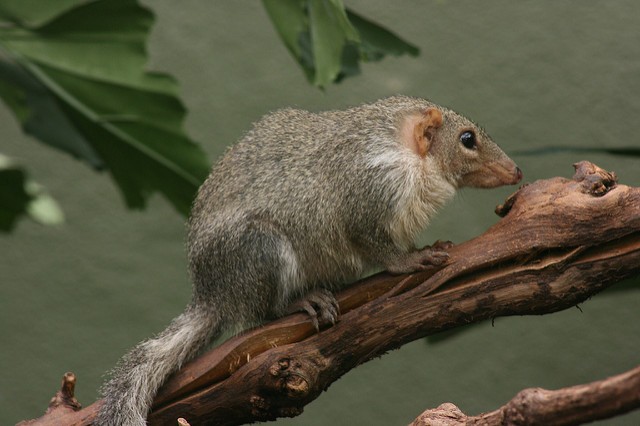

Elephant shrews
Elephant shrews are not related to true shrews either, despite their tiny size and shrew-like appearance. They get their name from their elongated, trunk-like snouts, but many biologists now think they are actually also distantly related to elephants, along with the manatees, hyraxes and the aardvark.
Elephant shrews eat mainly invertebrates: insects, spiders, centipedes, millipedes and earthworms. They use their "trunks" to sniff out their prey, their cheek teeth to chop it up and their tongues to flick it into their mouths.
Consultant: Chris Jarvis
pics


Without in any way limiting Q-files Ltd’s exclusive rights under copyright, any use of this publication to “train” generative artificial intelligence (AI) technologies to generate text is expressly prohibited. Q-files Ltd reserves all rights to license use of this work for generative AI training and development of machine learning language models.