
Ocean life

CITE
We have made every effort to follow citation style rules, but there may be some minor differences. If in doubt, please refer to the appropriate citation style manual.
Antarctic life. (2026). In Q-files Encyclopedia, Life, Ocean life. Retrieved from
https://www.q-files.com/life/ocean-life/antarctic-life
"Antarctic life." Life, Ocean life, Q-files Encyclopedia, 24 Mar. 2026.
https://www.q-files.com/life/ocean-life/antarctic-life.
Accessed 29 Oct. 2026.
Antarctic life 2026. Life, Ocean life. Retrieved 29 October 2026, from
https://www.q-files.com/life/ocean-life/antarctic-life
Life, Ocean life, s.v. "Antarctic life," accessed October 29, 2026.
https://www.q-files.com/life/ocean-life/antarctic-life


Antarctic life
Lying at the southern end of the Earth, the continent of Antarctica is a huge, mountainous landmass, much of it covered by a permanent ice sheet on average about 1.8 kilometres (more than one mile) deep. It is the coldest place in the world. Bitter winds sweep up snow from the ground into fierce blizzards. The only places where plants can grow on this barren land are along the coasts and around the Antarctic Peninsula. Even then they are mostly tiny mosses and lichens growing on the rocks. There is not enough food on the land to feed anything larger than small insects, so the animals of Antarctica are clustered around the coasts and islands, where the ocean waters provide them with plenty of food.


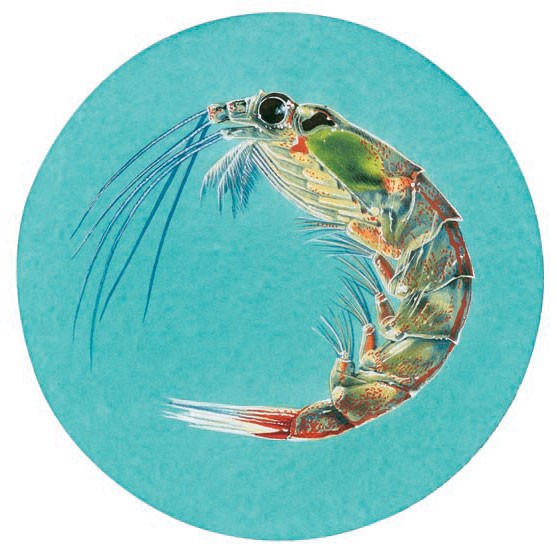
Krill
The main source of food for many Antarctic animals is plankton. Phytoplankton and zooplankton thrive in the surrounding waters, thanks to nutrient-rich currents and upwellings that swirl through the cold waters. Fish throng the waters, feeding on the zooplankton, including krill, a shrimp-like crustacean, which is a staple food for many other animals. Krill, themselves, feed on phytoplankton, especially diatoms, types of algae.
Blue, fin, humpback, right, minke, sei and sperm whales migrate long distances to Antarctic waters in summer to feed on the vast quantities of krill. Despite its name, the crabeater seal also feeds almost entirely on krill—the only seal to do so. Other seals and penguins dive after fish, while sea birds such as albatrosses and terns pluck fish from the surface.

Penguins

Antarctica is home to several kinds of penguins, sea birds that live only in the Southern Hemisphere. Penguins spend most of their lives at sea, coming ashore to breed in large colonies on the ice. The emperor, Adélie, macaroni and gentoo and chinstrap penguins live in Antarctic waters. On the ice, they waddle around clumsily, or toboggan on their bellies. In the water, they are graceful swimmers, using their wings as flippers to propel themselves through the water.
Emperor penguins are the largest species of penguin. After their eggs are laid, the females return to the sea to feed. The males look after the eggs, carrying them on their feet to keep them off the ice. In the coldest weather, they huddle together in groups. Six weeks later, the chicks hatch, the mothers return and the fathers can finally feed.

Antarctic adaptations
Antarctic animals are specially adapted to survive the cold, icy conditions and winds of up to 200 km/h (125 mph). They have thick fur or feathers, and many also have a layer of fat, called blubber, to keep them warm. Some insects can survive being frozen during winter and defrosted in summer, while some kinds of fish have a natural “anti-freeze” in their blood to stop them icing up in temperatures close to zero.

Underwater killers
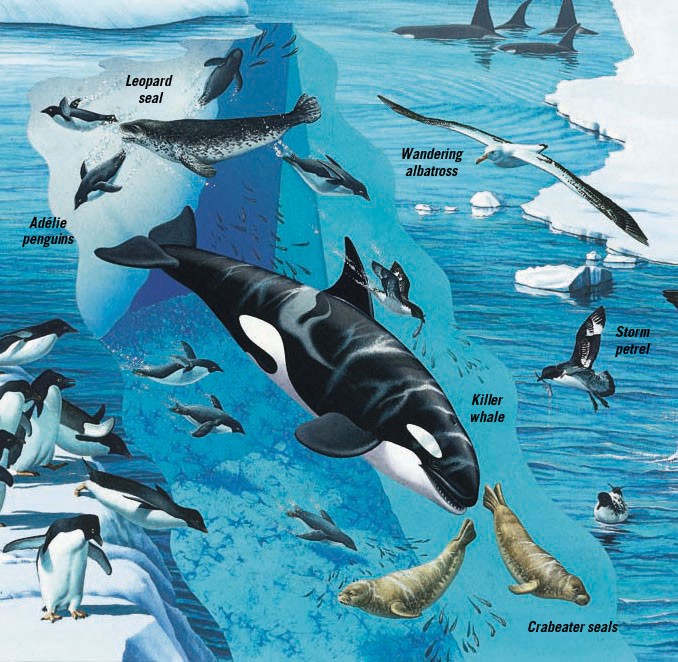
Just beneath the water’s surface, the hunters of Antarctica lie in wait. Orcas (killer whales) are fearsome predators. Fast and streamlined, these 10-metre (33-foot) giants hunt fish, squid, seals and penguins.
The leopard seal patrols the coastal waters where it preys on Adélie penguins, fish and even other seals. Adélie penguins are so fearful of this hunter that they hesitate at the water’s edge, none daring to be first to take the plunge.
Consultant: Chris Jarvis
pics

Without in any way limiting Q-files Ltd’s exclusive rights under copyright, any use of this publication to “train” generative artificial intelligence (AI) technologies to generate text is expressly prohibited. Q-files Ltd reserves all rights to license use of this work for generative AI training and development of machine learning language models.