
Ocean life

CITE
We have made every effort to follow citation style rules, but there may be some minor differences. If in doubt, please refer to the appropriate citation style manual.
Oceanic islands. (2026). In Q-files Encyclopedia, Life, Ocean life. Retrieved from
https://www.q-files.com/life/ocean-life/oceanic-islands
"Oceanic islands." Life, Ocean life, Q-files Encyclopedia, 24 Mar. 2026.
https://www.q-files.com/life/ocean-life/oceanic-islands.
Accessed 31 Oct. 2026.
Oceanic islands 2026. Life, Ocean life. Retrieved 31 October 2026, from
https://www.q-files.com/life/ocean-life/oceanic-islands
Life, Ocean life, s.v. "Oceanic islands," accessed October 31, 2026.
https://www.q-files.com/life/ocean-life/oceanic-islands


Oceanic islands
Cut off from the continental land masses by stretches of ocean water, islands often have a range of plant and animal life that is uniquely their own. Some islands were once part of a larger land mass, while others are formed by underwater volcanoes rising from the ocean floor. As soon as an island forms, it begins to be colonized by plants and animals. Islands close to the mainland are colonized more quickly than remote ones.


Plants
Plant seeds can travel across the oceans. They rely on the wind or water to carry them to islands. Seeds can also be carried in the fur or feathers of animals, or even in their digestive systems. The light seeds of small plants can travel further on the winds than those of large trees, so there are sometimes few, if any, trees on the most remote islands. But these small plants may, over many years, evolve into larger ones.
Animals
Birds and swimming animals, such as seals, are often the first animals to arrive on a new island. Birds can carry seeds on or inside their bodies, as well as insects and other tiny creatures. Insects are also blown to islands on the winds. As they increase in population, they provide food for more and more animals.

Land animals sometimes find their way to newly formed islands on rafts of vegetation torn from mainland coasts by savage storms. Others are brought to islands by humans. On remote islands, some animal species die out, while others are able to adapt to their new surroundings and build up a breeding population. Over many years, new species that are unique to their island environment evolve.
Adapting to island life
Large predators are often absent from islands, which means that some island animals do not need to be fast-moving. It also means that some birds no longer need their escape mechanism of flight. Their wings become small and useless, since they spend all their time on the ground. This adaptation produces flightless birds like the takahe, a New Zealand species of rail—but they become easy prey when predators are later introduced by humans.


Taking advantage of abundant food supplies, some animals, including insects, can grow to huge sizes in island habitats. The giant weta, a cricket-like insect from New Zealand, is about four times as large as an ordinary cricket. Having no natural predators on its island, it has become flightless, but is now threatened by introduced predators, such as rats.
With a relatively small variety of animal life, competition between island species is reduced. One bird can eat a wide range of foods, which on the mainland would be “reserved” for several different birds.
Galapagos species
There are three species of land iguana living on the Galapagos Islands, two of which are found on just one island apiece, including a pink variety that was discovered only in 1986. The iguanas were once abundant, but their numbers have since been reduced by hunting, and from being preyed on by rats, cats and dogs.

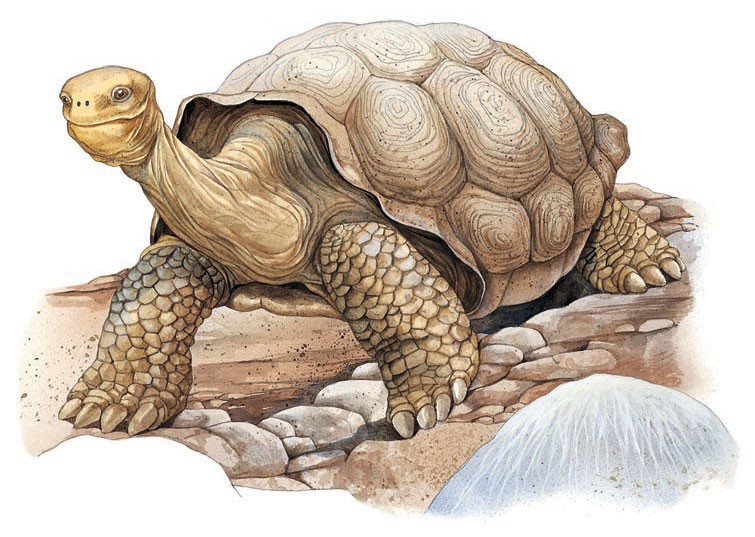
Giant tortoises
Giant tortoises are found in the Galapagos Islands and also in the Seychelles in the Indian Ocean. Because of the lack of predators, they can be large, slow-moving animals yet remain unthreatened. Some giant tortoises graze on low grasses, and have a broad shell that fits close to the neck. Others have domed shells with high, arched openings, allowing them to stretch their necks up to taller vegetation. The introduction by humans of grazing animals reduces the tortoises’ food supply and threatens their survival.
Consultant: Chris Jarvis
pics


Without in any way limiting Q-files Ltd’s exclusive rights under copyright, any use of this publication to “train” generative artificial intelligence (AI) technologies to generate text is expressly prohibited. Q-files Ltd reserves all rights to license use of this work for generative AI training and development of machine learning language models.