
Ocean life

CITE
We have made every effort to follow citation style rules, but there may be some minor differences. If in doubt, please refer to the appropriate citation style manual.
Deep-ocean life. (2026). In Q-files Encyclopedia, Life, Ocean life. Retrieved from
https://www.q-files.com/life/ocean-life/deep-ocean-life
"Deep-ocean life." Life, Ocean life, Q-files Encyclopedia, 24 Mar. 2026.
https://www.q-files.com/life/ocean-life/deep-ocean-life.
Accessed 13 Sep. 2026.
Deep-ocean life 2026. Life, Ocean life. Retrieved 13 September 2026, from
https://www.q-files.com/life/ocean-life/deep-ocean-life
Life, Ocean life, s.v. "Deep-ocean life," accessed September 13, 2026.
https://www.q-files.com/life/ocean-life/deep-ocean-life


Deep-ocean life
Below a depth of about 200 metres (about 660 feet) there is little light, and below 1000 metres (3300 feet) the water is completely black and very cold. Phytoplankton cannot survive here, and the amount of animal life is greatly reduced. Some scavenging deepwater animals feed on the dead plant and animal matter that rains down through the water from the surface waters above. Others, such as the hatchetfish, travel up towards the surface to feed, then return to the depths.


Bioluminescence
Despite the blackness of the water, there is still some light in the depths of the ocean. Some deepwater animals are able to produce light from their body tissues, which are sometimes concentrated into areas as special light-producing organs. This feature is known as bioluminescence. Fish, squid, jellyfish and even tiny deep-sea copepods all produce their own light. These lights may act as a lure to prey animals, or as a signal to others of the same species in the search for mates. They may also be used as search beams, or “flashed” on and off to confuse or temporarily blind an attacker.
Bioluminescence is also sometimes used as camouflage by bathing the animal in the same wavelength of light that surrounds it—so it merges with its surroundings rather than standing out.
Twilight zone
Below about 200 metres (660 feet), very little sunlight penetrates the ocean waters, and below 1000 metres (3300 feet) none gets through at all. The layer of water in between these depths is called the mesopelagic, or twilight, zone. Besides the gloomy light, the pressure of the water is much greater than at the surface and the supply of food is very thin.
Animals of the twilight zone feed on waste material raining down from above—dead animals, decaying phytoplankton and droppings, or their fellow inhabitants. To make the most of the few opportunities that come their way, fish such as the viperfish have highly sensitive eyes, gaping jaws with long, backward-pointing stabbing teeth to grip their prey firmly and large stomachs.
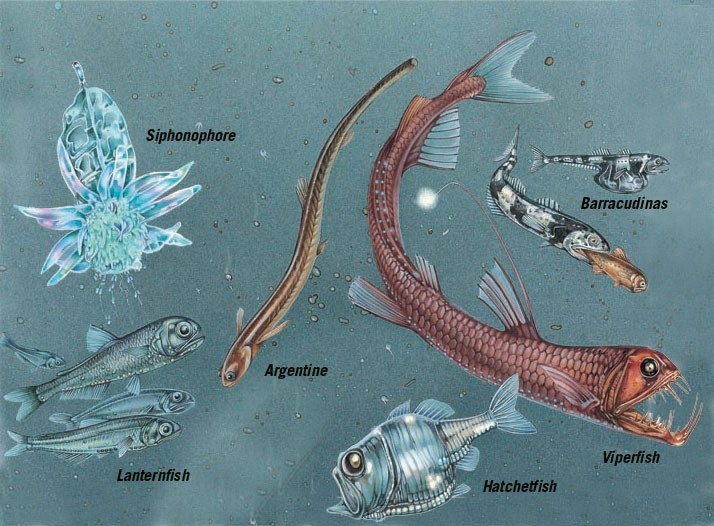

Some fish have organs that produce light. Viperfish use a light on their dorsal (back) fin to lure their prey towards their fang-like teeth. Barracudinas have loosely hinged jaws and expanding stomachs that allow them to consume prey even larger than themselves.
Some animals travel between surface and twilight zones, feeding in one zone and resting in the other. They include the hatchetfish and the lanternfish, which journey to the surface at night to feed, stinging jellyfish-like creatures called siphonophores, and certain kinds of shark.
Bathypelagic zone
Deeper still, and below 1000 metres (3300 feet) is the near-freezing world of the bathypelagic zone. Even in these completely black, cold depths there is animal life, although it is extremely sparse.
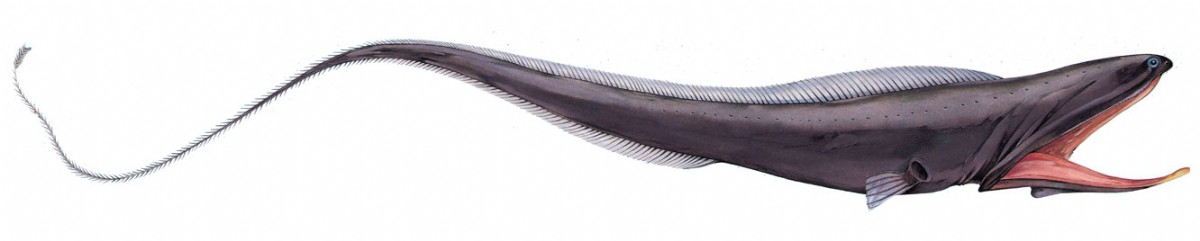
At great depths, food comes along only rarely so the animals that live here need to save energy between meals. Gulper eels wait to ambush their prey, rather than dash after it. With their massive jaws, taking up about a quarter of their total body length, they are well equipped to capture any size of animal. Their stomachs can stretch to hold fish even larger than themselves—a useful feature since it may be long a time before another meal comes along.

Members of the grotesque deep-sea anglerfish family are so-called because of their prowess at “fishing”. Their “rods” are long, thin fins on their backs with a glowing light at the tip. When the prey lunges at the bait, believing it to be the lights of a tiny animal it was itself preying upon, the anglerfish snaps it up. Some anglerfish have teeth that lie flat and then spring back around their prey when it is inside their mouth.

Sperm whale
Although, like all mammals, it must breathe air, the sperm whale is able to dive to depths of at least 1000 metres (3300 feet)—and almost certainly much deeper than that, perhaps as far as 3000 metres (10,000 feet). It can spend up to 90 minutes below water in search of its prey, giant squid. From the scratch marks often seen on the whale's skin, we know that the contest is violent.
The sperm whale has a special organ in its head which helps it to descend and ascend such long distances. This organ, called the spermaceti, is filled with a waxy substance. When the whale dives, the cold water cools the wax, causing it to solidify and make the head heavier. On ascent, blood flow to the head warms and melts the wax, making the head lighter.
Consultant: Chris Jarvis
pics


Without in any way limiting Q-files Ltd’s exclusive rights under copyright, any use of this publication to “train” generative artificial intelligence (AI) technologies to generate text is expressly prohibited. Q-files Ltd reserves all rights to license use of this work for generative AI training and development of machine learning language models.