
Fish

CITE
We have made every effort to follow citation style rules, but there may be some minor differences. If in doubt, please refer to the appropriate citation style manual.
Deep-ocean fish. (2026). In Q-files Encyclopedia, Life, Fish. Retrieved from
https://www.q-files.com/life/fish/deep-ocean-fish
"Deep-ocean fish." Life, Fish, Q-files Encyclopedia, 23 Mar. 2026.
https://www.q-files.com/life/fish/deep-ocean-fish.
Accessed 21 Sep. 2026.
Deep-ocean fish 2026. Life, Fish. Retrieved 21 September 2026, from
https://www.q-files.com/life/fish/deep-ocean-fish
Life, Fish, s.v. "Deep-ocean fish," accessed September 21, 2026.
https://www.q-files.com/life/fish/deep-ocean-fish


Deep-ocean fish
Fish that live in deep waters all the time are adapted to the extreme cold, permanent absence of light, high pressure and scarcity of food. They have large, extremely sensitive eyes to see in the near-black waters. Many are coloured brown or black (or are even see-through) for camouflage, to conceal themselves from predators. Prey is scarce. To take advantage of any prey they encounter, many predators, such as the gulper eel, have huge jaws and stomachs that can stretch to hold fish even larger than themselves.
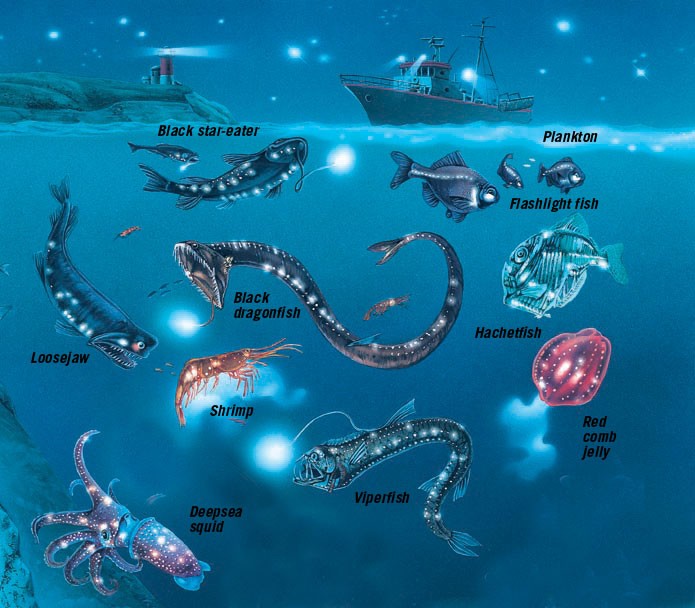
Bioluminescence
In the blackness of the deep ocean, some fish are able to produce light from their own bodies, either from their tissues or from special light-producing organs. This feature is known as bioluminescence. These lights may act as a lure to prey animals, or as a signal to others of the same species in the search for mates. They may also be used as search beams, or “flashed” on and off to confuse or temporarily blind an attacker. Sometimes, lights are used as “counter-illumination”, matching the little light filtering down from above and acting as a sort of invisibility cloak.

Viperfish
With large, glaring eyes and gaping jaws lined with long, curved, dagger-like fangs, viperfish look like terrible sea monsters. Fortunately, most are only a few centimetres long. Viperfish live at depths of 80 to 1500 metres (250 to 5000 feet).
The viperfish has a special light organ, called a photophore, at the end of a spine on its back, which is used to lure prey towards its mouth. It dangles the light in front of its mouth and snatches prey as it comes near. When its mouth is closed, its teeth curve up over the top of its head.
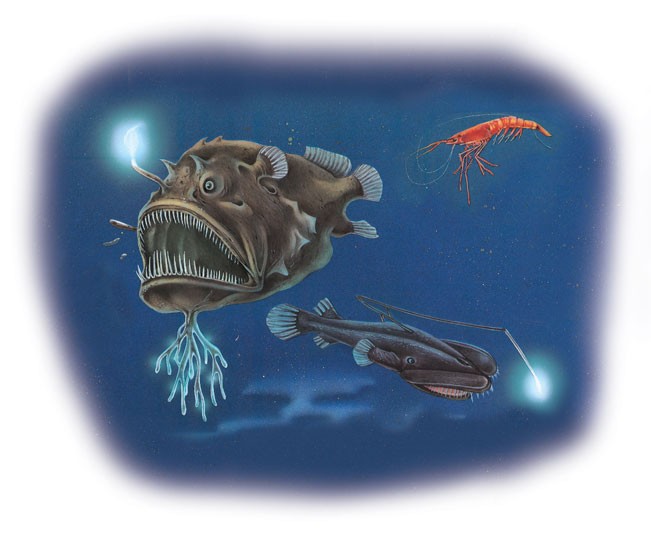
Anglerfish
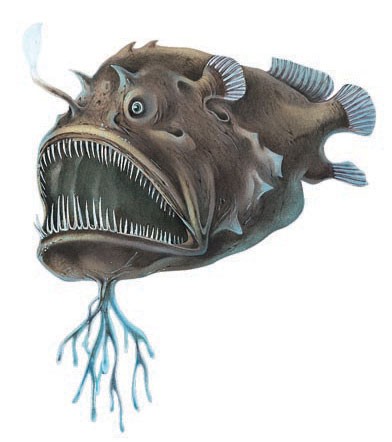
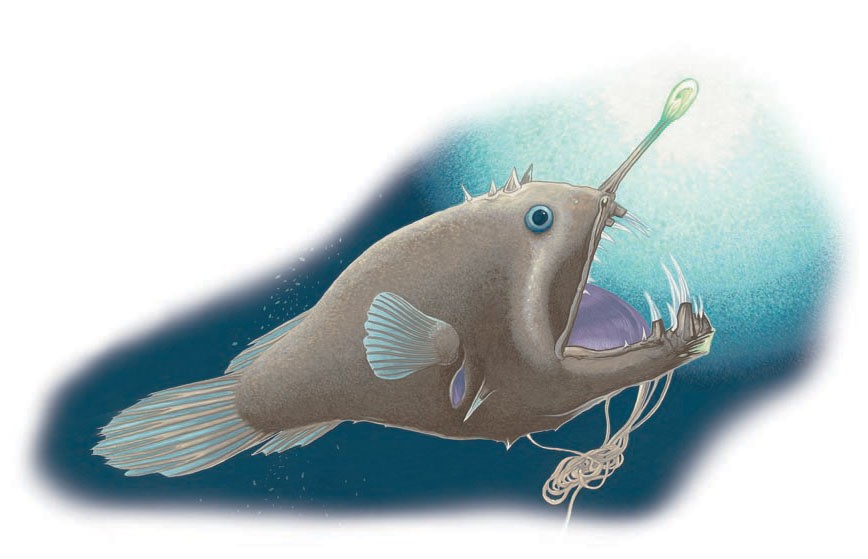
The anglerfish is a fierce-looking deep-water fish. It has a long, thin dorsal fin with a light at its tip, called a lure. The fish hangs this in front of its mouth. When its prey lunges at the light, believing it to belong to another tiny animal, the anglerfish closes its jaws. Some species of anglerfish have teeth that lie flat and then spring back around their prey when it is inside their mouth. The males of some species are hundreds of times smaller than the females. Most species of anglerfish live on or near the sea floor.

Gulper eel

The gulper eel is a 2-metre-long (6.5-foot) eel with a gaping mouth and a light organ on its tail, used to attract prey. It can live at depths of up to 5400 metres (17,700 feet). It has huge, loosely hinged jaws and a stretchy stomach that allows it to swallow animals that are larger than itself.
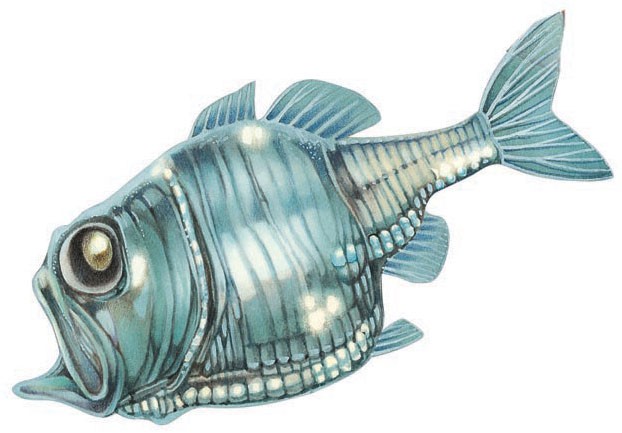
Hatchetfish
Hatchetfish are small, bioluminescent fish that live at depths of up to 1500 metres (5000 feet). They have a flattened body that makes them hard for predators to spot in the water. Hatchetfish feed on other, smaller fish, travelling up towards the surface at night to feed, then returning to the depths.

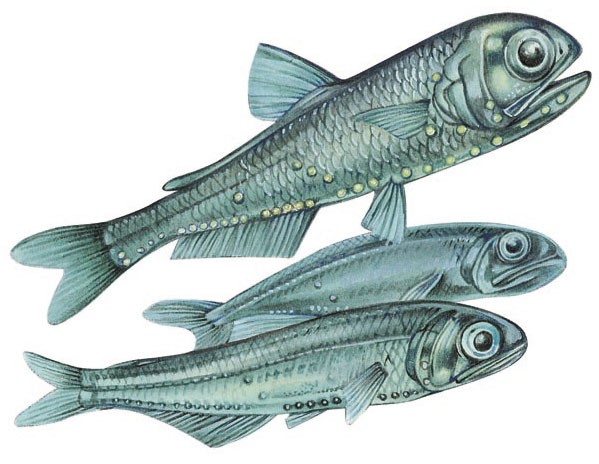
Lanternfish
The lanternfish is a small fish with bioluminescent spots. It spends the day at depths of 300 to 2000 metres (1000 to 6500 feet) but rises to the surface at night to feed on zooplankton. Lanternfish are not only the commonest deep-ocean fish; they are the most abundant vertebrates on Earth. An estimated 65% of the total biomass (body mass) of all deep-sea species is made up of lanternfish. Every night, when they rise to the surface to feed, lanternfish undergo the greatest migration on the planet.
Rat-tail
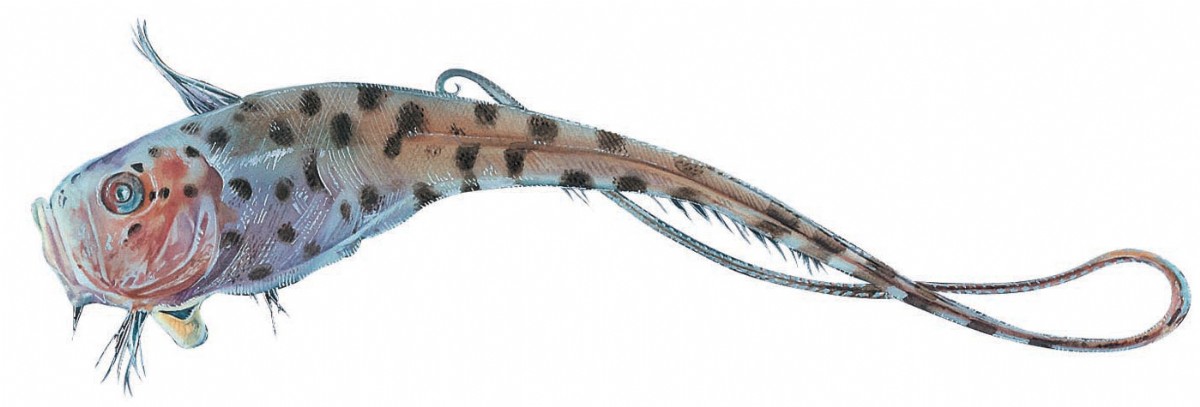
The rat-tail is a common fish, also known as a grenadier. It has a long thin tail and swims above the ocean floor. A special sensor running down its spine feels the movements of other creatures nearby. It makes a loud drumming noise by vibrating muscles attached to its swim bladder. This may be a way of signalling to others of its kind.
Chimaera
Chimaeras are cartilaginous fish, also known as ghost sharks, spookfish, rat fish (not to be confused with rat-tails) or rabbit fish, related to sharks. They live close to temperate ocean floors down to around 2600 metres (8500 feet) deep. They have long, soft, smooth-skinned bodies up to 1.5 metres (5 feet) in length, including their long tail. Most kinds of chimaera have a venomous spine located in front of their dorsal fin, which they use for defence. Like sharks, they have special organs in their heads to sense the electrical currents made by the muscle movements of their prey.

Snailfish
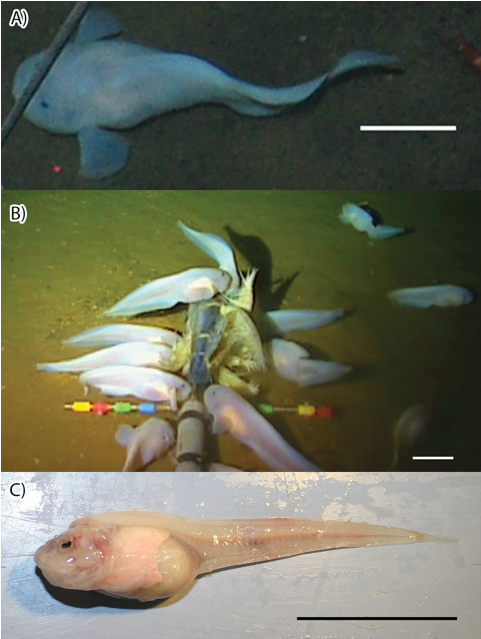
Snailfish are a family of ray-finned fish, made up of more than 400 species—most no longer than a few centimetres long. Adapted to life in cold waters, snailfish are found in oceans worldwide at depths ranging from shallow surface waters to the hadal zone, ocean trenches that plunge deeper than 8330 metres (27,300 feet), where they are commonest types of fish.
Snailfish have slender, tadpole-like bodies with large heads and small eyes. Lacking scales, they have jelly-like skins. Hadal zone snailfish feed on amphipods or other fish.
In 2023, an unknown species of snailfish belonging to the genus Pseudoliparis, was filmed at a depth of 8336 metres (27,342 feet) in an ocean trench to the southeast of Japan by a remote contriolled submersible. If the record of a species of cusk eel is not accepted (one was reportedly trawled from a depth of 8370 m / 27,460 feet in the Puerto Rico Trench in 1970, but some suggest it may have been caught in shallower waters), then the newly discovered snailfish species takes the record as the world's deepest-living fish.
Tripodfish
The tripodfish lives on the ocean floor at depths of up to 5000 metres (more than 16,000 feet). It rests on a “tripod” made of its long, stilt-like fins and tail. Another pair of fins is held up in the air to detect the movements of passing prey, whereupon the tripodfish pushes itself forward to snatch up its victim.

Consultant: Chris Jarvis
pics




Without in any way limiting Q-files Ltd’s exclusive rights under copyright, any use of this publication to “train” generative artificial intelligence (AI) technologies to generate text is expressly prohibited. Q-files Ltd reserves all rights to license use of this work for generative AI training and development of machine learning language models.