
Fish

CITE
We have made every effort to follow citation style rules, but there may be some minor differences. If in doubt, please refer to the appropriate citation style manual.
Lampreys and hagfish. (2026). In Q-files Encyclopedia, Life, Fish. Retrieved from
https://www.q-files.com/life/fish/lampreys-and-hagfish
"Lampreys and hagfish." Life, Fish, Q-files Encyclopedia, 23 Mar. 2026.
https://www.q-files.com/life/fish/lampreys-and-hagfish.
Accessed 30 Oct. 2026.
Lampreys and hagfish 2026. Life, Fish. Retrieved 30 October 2026, from
https://www.q-files.com/life/fish/lampreys-and-hagfish
Life, Fish, s.v. "Lampreys and hagfish," accessed October 30, 2026.
https://www.q-files.com/life/fish/lampreys-and-hagfish


Lampreys and hagfish
Lampreys and hagfish are ancient species that resemble fish in their early stages of evolution, more than 300 million years ago. Neither are considered to be true vertebrates: instead of a true backbone, lampreys have a series of cartilaginous (gristly) structures running down their backs, while hagfish have no vertebrae at all—just a “skeleton” made of cartilage. Both have eel-like elongated bodies, and, just like the earliest kinds of fish that evolved hundreds of millions of years ago, they have no jaws.

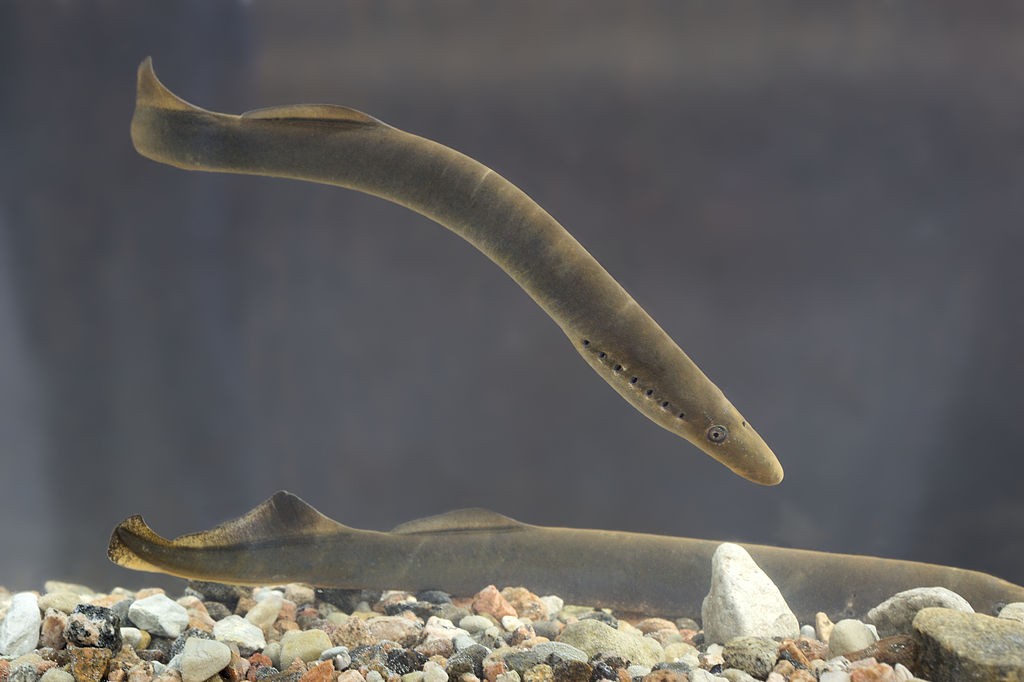
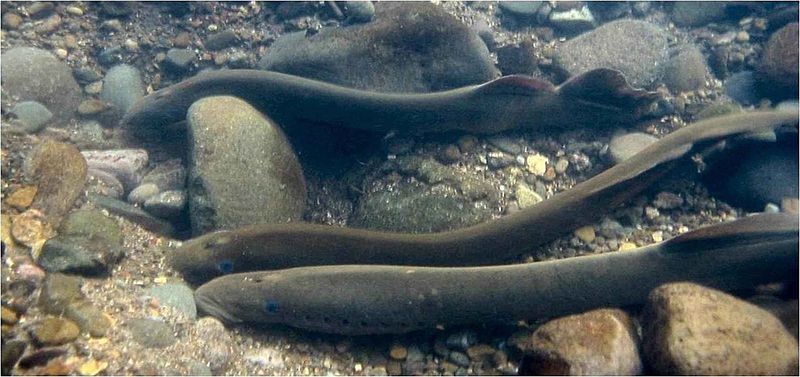
Lampreys
There are 38 known species of lamprey. They have a toothed, funnel-like, sucking mouth which they use to bore into the flesh of other fish to suck their blood. Like eels, adult lampreys have scale-less, elongated bodies, ranging between 13 and 100 centimetres (5–40 inches) in length. They have large eyes, a single nostril on top of their head and seven gill pouches on each side of their body.
Lampreys live mostly in temperate regions. Adults spawn in rivers and then die. The larvae spend several years in rivers, burrowed in sediments and feeding on microscopic organisms. After undergoing a metamorphosis, some species migrate to the sea or lakes, where they feed on other fish or marine mammals.
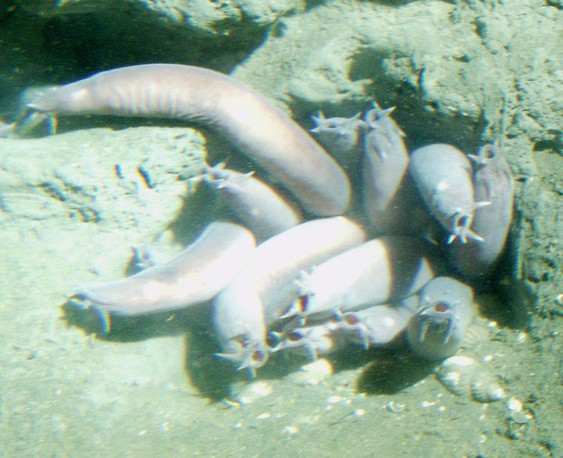
Hagfish
Hagfish are eel-shaped, with loose-fitting skin and paddle-like tails. They have no true fins. There are six or eight barbels around the mouth, used to sense their surroundings (their eyes are simple eyespots not capable of making out images). Hagfish range in size from 4 cm (1.6 inches) and 127 centimetres (4 ft 2 inches) long. Instead of jaws, they have a pair of horizontally movable mouthparts lined with comb-shaped teeth. These are used to grasp food and draw it into their bodies. Hagfish may feed by burrowing into the bodies of dead or dying sea creatures much larger than themselves and devouring their prey from the inside.


Hagfish are well known for producing slime from glands running down the sides of their bodies. For this, they are sometimes called “slime eels”. If the hagfish is captured, it releases this slime, which combines with water to create a mass of sticky material—up to 20 litres of it, enough to clog up a predatory fish’s gills and stop it breathing. The hagfish can even tie itself into a knot, which can be worked down the length of its body, both freeing it from its captor and scraping off the slime as it goes.
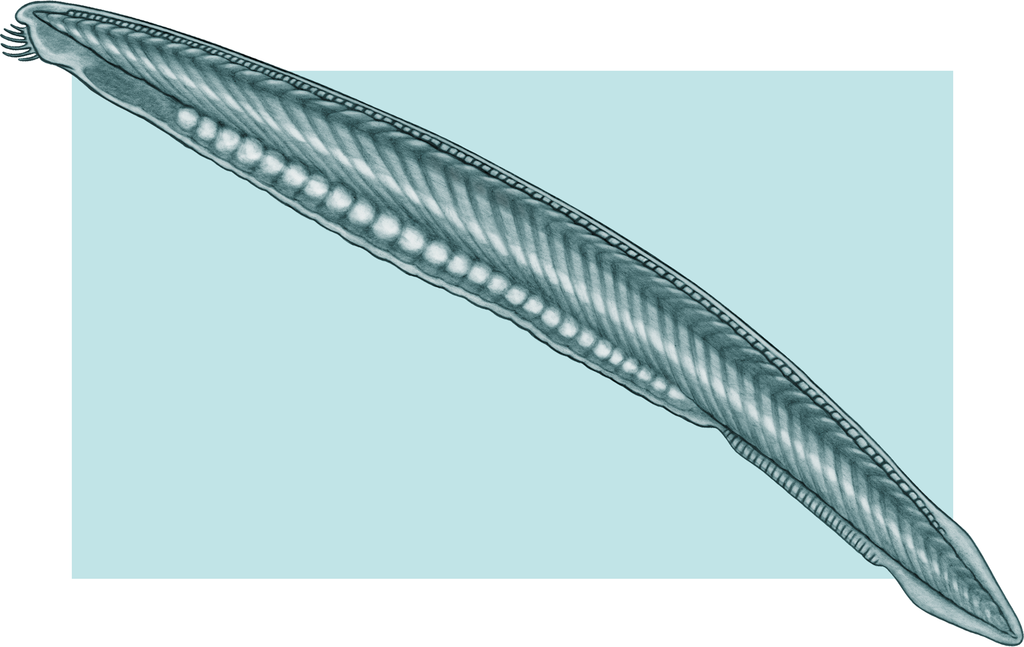
Lancelets
The lancelet, also known as the amphioxus (from the Greek, meaning "both ends pointed”, a reference to its shape), is another unusual, eel-like creature—not even considered to be a true fish. An ancient species, lancelets are important to zoologists because they provide clues for the evolutionary origins of the vertebrates (animals with backbones).
There are 32 species living in temperate and tropical seas. Lacking fins and the ability to swim well, they spend most of their time half-buried in the sand. Lancelets measure a maximum of 7 centimetres (3 inches) long. Apart from some cartilage (gristle) to stiffen their gill slits and tail and support the nerve cord running the length of their back, they have no skeleton. They also have a very small brain, relying on the thin tentacles hanging in front of their mouth to sense their surroundings. To feed, they strain food particles from the water as it passes through their gill slits.
Consultant: Chris Jarvis
pics
Without in any way limiting Q-files Ltd’s exclusive rights under copyright, any use of this publication to “train” generative artificial intelligence (AI) technologies to generate text is expressly prohibited. Q-files Ltd reserves all rights to license use of this work for generative AI training and development of machine learning language models.