
Micro-organisms

CITE
We have made every effort to follow citation style rules, but there may be some minor differences. If in doubt, please refer to the appropriate citation style manual.
Protists. (2026). In Q-files Encyclopedia, Life, Micro-organisms. Retrieved from
https://www.q-files.com/life/micro-organisms/protists
"Protists." Life, Micro-organisms, Q-files Encyclopedia, 24 Mar. 2026.
https://www.q-files.com/life/micro-organisms/protists.
Accessed 6 Aug. 2026.
Protists 2026. Life, Micro-organisms. Retrieved 6 August 2026, from
https://www.q-files.com/life/micro-organisms/protists
Life, Micro-organisms, s.v. "Protists," accessed August 6, 2026.
https://www.q-files.com/life/micro-organisms/protists


Protists
Like bacteria, protists are microscopic, single-celled organisms. But unlike bacteria, each protist has its genetic material (DNA) wrapped inside a bag-like membrane to form the nucleus, or control centre, of the cell. Protists live mainly in water or in damp places. They can be parasites living inside plants and animals, including humans, where they can cause diseases like malaria. Some are like tiny plants (protophyta), such as algae, absorbing their energy from sunlight and their raw materials for growth from the water around them. Others are like minute animals (protozoa), for example amoebae, which move around and consume food particles such as bacteria.
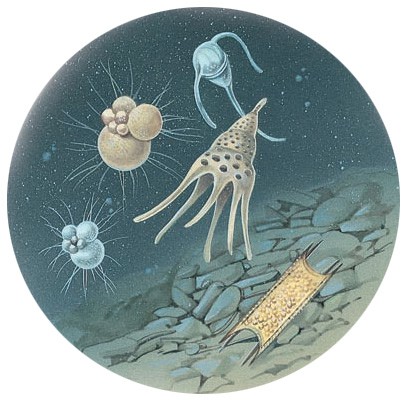
Forms
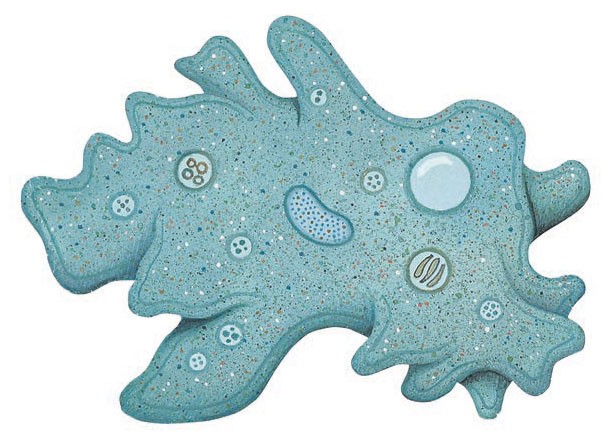
Some protists have a rigid, case-like cell wall around them. Some protozoans, the foraminiferans and radiolarians, have skeletons with beautiful shapes and patterns. Others have no rigid case and can take up any shape. The amoeba, for example, has no definite shape. It moves by flowing along like a plastic bag full of jelly.

Protozoa


Protozoa are microscopic animals. Ranging in size from as little as 1 micron (thousandth of a millimetre) to several millimetres, protozoa are abundant in fresh or salt water, as well as other moist environments such as soils and mosses. Most types are free-living: they move around and consume organic particles or micro-organisms such as bacteria. The group includes: flagellates, which move with the help of whip-like structures called flagella; ciliates, which move by using hair-like structures, called cilia, that beat in a regular pattern like oars; amoebae, which move by the use of foot-like structures called pseudopodia. Some protozoa are sessile—they do not move at all.
Parasitic protozoa live in or on other organisms, including other single-celled organisms, plants, animals and humans. Many are harmless or even beneficial to their host organisms—flagellates inhabiting the guts of termites enable their hosts to digest wood. Other protozoa may cause diseases. They include Plasmodium, which causes malaria, and Trypanosoma, the cause of sleeping sickness.
Consultant: Chris Jarvis
pics
Without in any way limiting Q-files Ltd’s exclusive rights under copyright, any use of this publication to “train” generative artificial intelligence (AI) technologies to generate text is expressly prohibited. Q-files Ltd reserves all rights to license use of this work for generative AI training and development of machine learning language models.