
Weather and climate

CITE
We have made every effort to follow citation style rules, but there may be some minor differences. If in doubt, please refer to the appropriate citation style manual.
Seasons. (2026). In Q-files Encyclopedia, Earth, Weather and climate. Retrieved from
https://www.q-files.com/earth/weather-and-climate/seasons
"Seasons." Earth, Weather and climate, Q-files Encyclopedia, 6 Mar. 2026.
https://www.q-files.com/earth/weather-and-climate/seasons.
Accessed 22 Sep. 2026.
Seasons 2026. Earth, Weather and climate. Retrieved 22 September 2026, from
https://www.q-files.com/earth/weather-and-climate/seasons
Earth, Weather and climate, s.v. "Seasons," accessed September 22, 2026.
https://www.q-files.com/earth/weather-and-climate/seasons


Seasons
In tropical regions it is hot all year round, but farther north or south the temperature varies through the year. These different periods, spring, summer, autumn and winter, are called the seasons. They occur because of the way the Earth orbits the Sun. The Earth’s orbit is not an exact circle around the Sun, but an oval-like ellipse. Also, the Earth spins each day around an imaginary line, or axis, going through the North and South poles. This axis is not at right angles to the Earth's orbit, but tilted at an angle of 23.5°. The combination of tilted axis and elliptical orbit produces the yearly cycle of seasons in northern and southern regions.
Equinox and solstice
The Earth takes just over 365 days to complete its orbit around the Sun. On 21st March it is the equinox. The Sun shines directly overhead at the Equator and everywhere on Earth there are 12 hours of daylight and 12 hours of darkness. In the Northern Hemisphere, spring begins; in the Southern Hemisphere, autumn begins.
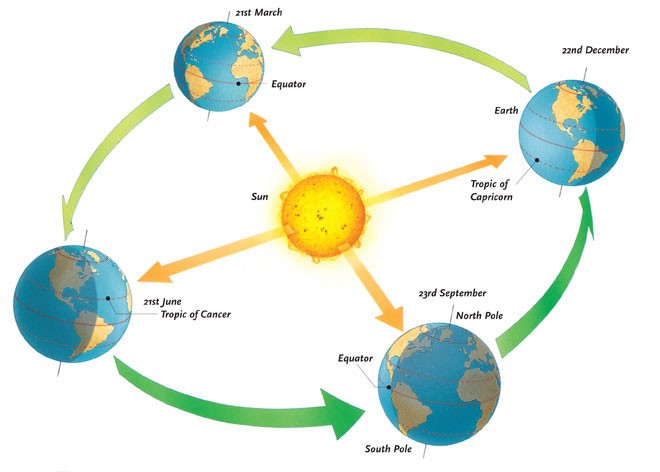
As the year goes on, the Earth’s Northern Hemisphere starts to lean towards the Sun. The Sun is nearer and higher in the sky for longer each day so the north begins its summer. The southern half leans farther away from the Sun and days are shorter so it turns to winter. On 21st June the Sun shines directly overhead at the Tropic of Cancer. In the Northern Hemisphere, it is the summer solstice; in the Southern Hemisphere, the winter solstice.
On 23rd September, it is the equinox once more as the Sun again shines directly overhead at the Equator. In the Northern Hemisphere, autumn begins, while the Southern Hemisphere enjoys the onset of spring. This time, it is the Southern Hemisphere that starts to lean towards the Sun. The summer solstice arrives in the Southern Hemisphere on 22nd December when the Sun is overhead at the Tropic of Capricorn. In Australia, people can celebrate Christmas on the beach, while the Northern Hemisphere is in the grip of winter.
Seasons in
temperate lands
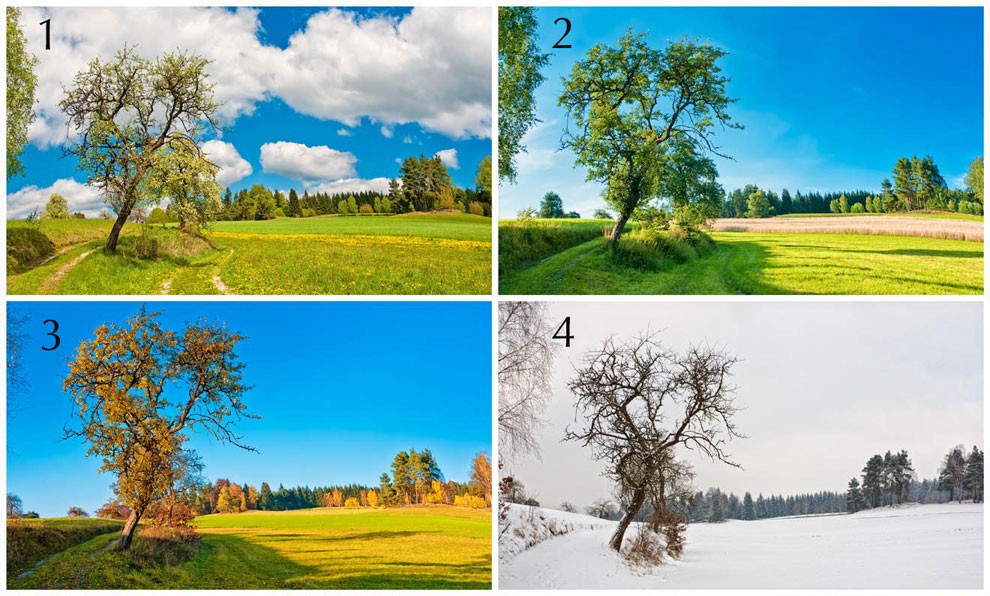
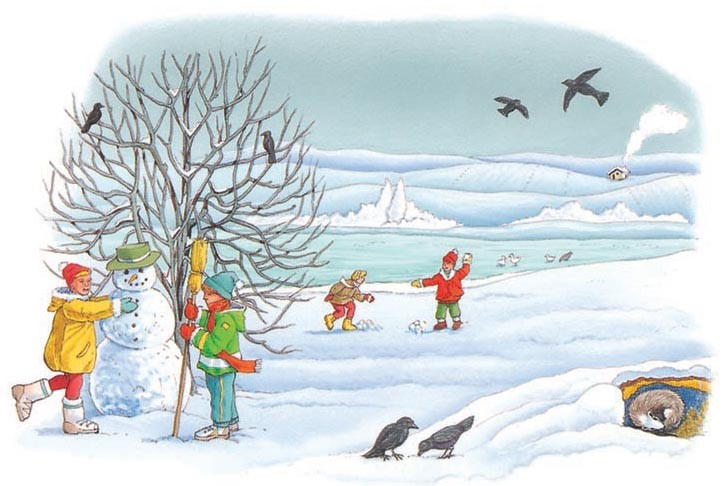
Regions close to the Equator are called the tropics. Those farther away, to the north and south, are called temperate lands. It is here where the seasons are most marked. Winter brings snow and ice. Deciduous trees have lost their leaves. To survive the cold, some animals sleep through the winter. This is called hibernation

When spring comes, plants and flowers start to grow again. Leaves on deciduous trees burst into bud. The weather is warmer, and many animals and birds make nests, give birth to their young and search for food for them. Crops sown in the fields are now growing.
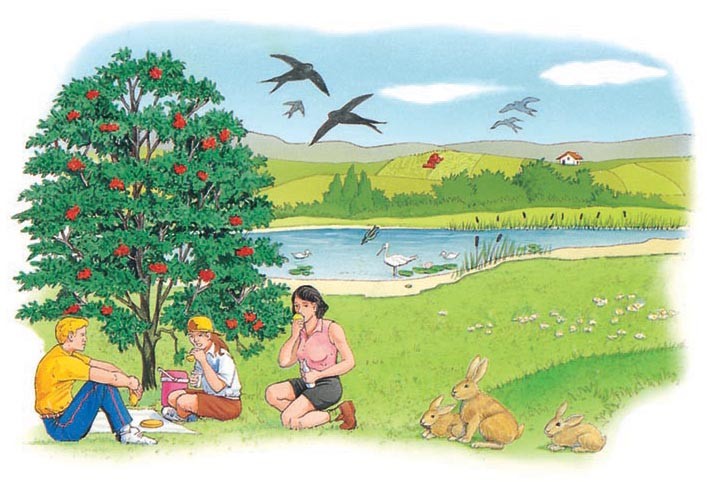
Summer days are long, sunny and warm. Tree leaves are fully open and their fruits ripen. Farmers work hard to bring in the harvest of crops. Birds that migrated to warmer lands for winter have returned. They feed on the rich variety of insects and fruits.

In the autumn—also called the fall in the United States—the leaves on the trees turn brown, yellow or red and fall to the ground. Migrating birds fly off to warmer countries for the winter. Some animals store food and find a warm, dry place to sleep. Farmers plough their fields to prepare the soil for next year’s crops.
Tropical seasons
In tropical or subtropical regions, there are only two seasons: dry and wet (rainy). The amount of rainfall in each season varies much more than the average temperature. So in some places, the dry season (November to April) is called "summer", and the wet season (May to October) is called "winter", even in the Northern Hemisphere.

Land of the
Midnight Sun
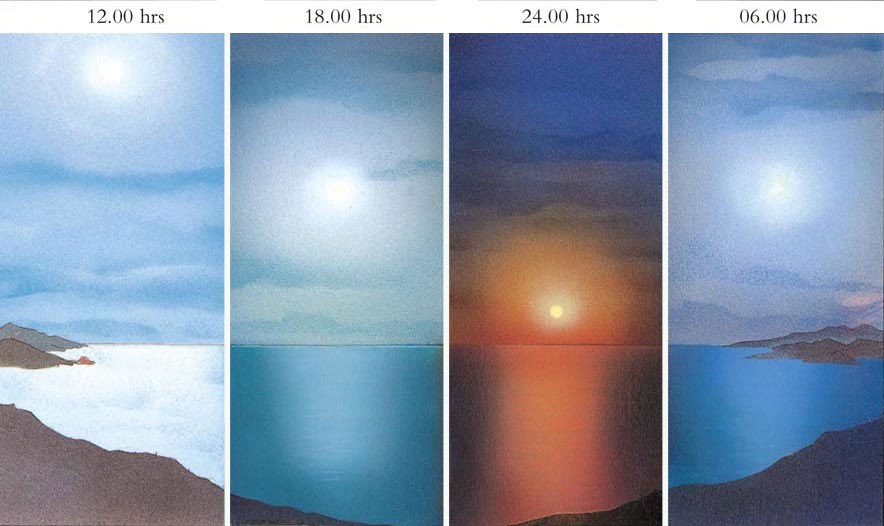
"Day" is when our part of the world faces the Sun, and "night" when it is turned away. Because the Earth's axis is slightly tilted, lands near the poles face towards the Sun for most of the summer and away from it for much of the winter. Summer days are very long, winter days very short.
Northern Scandinavia and other lands north of the Arctic Circle (about 66°N) are sometimes called “Land of the Midnight Sun”, for there is at least one 24-hour period, shown here, when the Sun never dips below the horizon.
Consultant: Ian Fairchild
pics
Without in any way limiting Q-files Ltd’s exclusive rights under copyright, any use of this publication to “train” generative artificial intelligence (AI) technologies to generate text is expressly prohibited. Q-files Ltd reserves all rights to license use of this work for generative AI training and development of machine learning language models.