
Weather and climate

CITE
We have made every effort to follow citation style rules, but there may be some minor differences. If in doubt, please refer to the appropriate citation style manual.
Tornadoes. (2026). In Q-files Encyclopedia, Earth, Weather and climate. Retrieved from
https://www.q-files.com/earth/weather-and-climate/tornadoes
"Tornadoes." Earth, Weather and climate, Q-files Encyclopedia, 6 Mar. 2026.
https://www.q-files.com/earth/weather-and-climate/tornadoes.
Accessed 31 Oct. 2026.
Tornadoes 2026. Earth, Weather and climate. Retrieved 31 October 2026, from
https://www.q-files.com/earth/weather-and-climate/tornadoes
Earth, Weather and climate, s.v. "Tornadoes," accessed October 31, 2026.
https://www.q-files.com/earth/weather-and-climate/tornadoes


Tornadoes
The most destructive storms on the planet, tornadoes are twisting columns of air, swirling at up to 400 km/h (250 mph). A tornado is even more powerful than a hurricane, although the damage it causes usually only affects a narrow strip of land. Its base may be only 100 metres (about 300 feet) across, but the winds are so strong it destroys nearly everything in its path. Most tornadoes occur in the US Midwest, but they are also quite common elsewhere—including the UK.


Formation
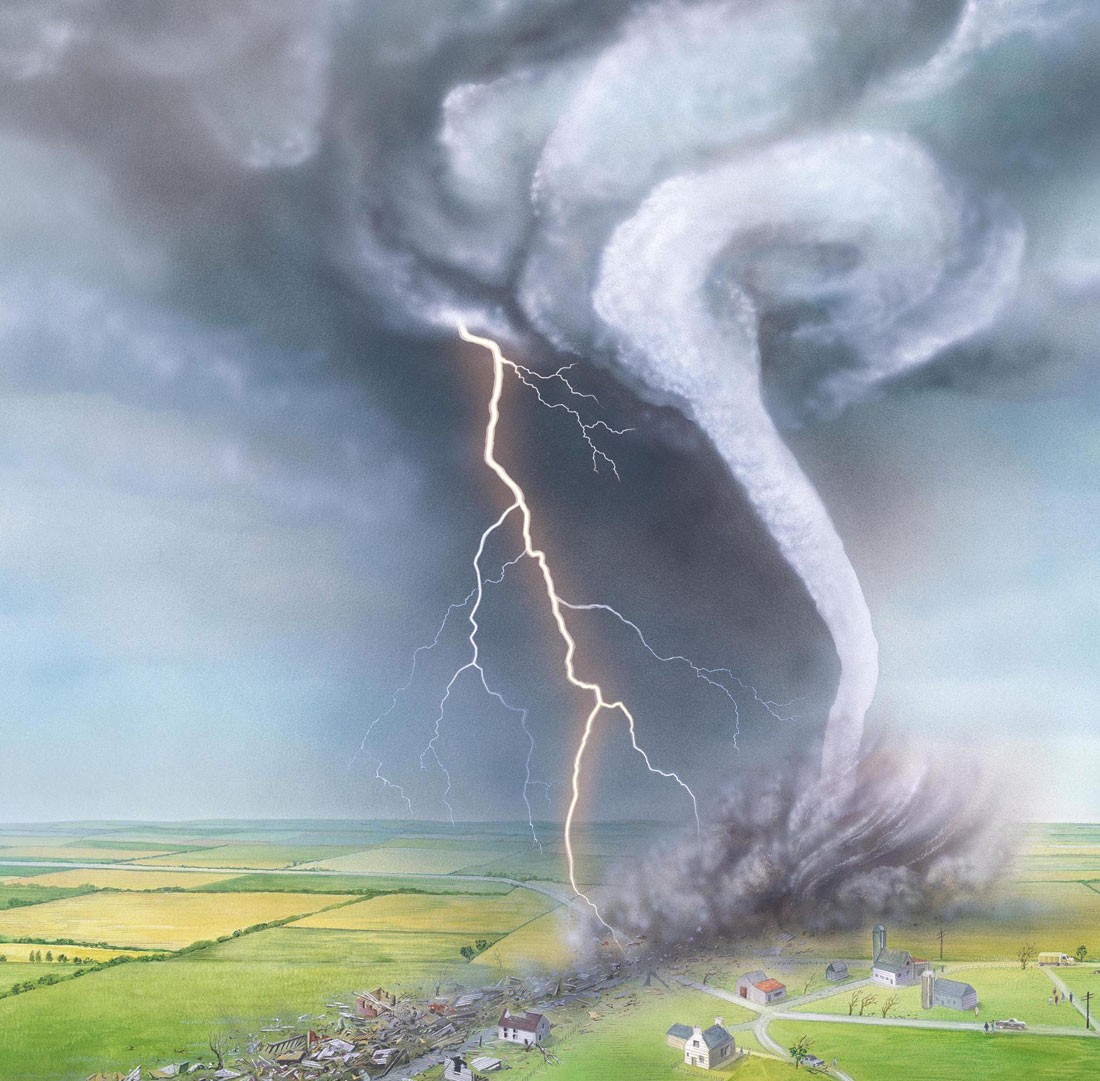
A tornado usually forms at the rear of a thundercloud as the winds swirl at 400 km/h (250 mph) or more. A twisting column of air grows downwards from the cloud like an upside-down funnel. When it reaches the ground, its base may be only 100 metres (about 300 feet) or less across. But the winds are so powerful that animals, people, cars and even houses are plucked up into the clouds and then thrown outwards.
As the main storm moves at between 40 and 80 km/h (25–50 mph), the base may “skip” along the ground, touching down here and there to do most damage. Most tornadoes occur in the Midwestern states of the USA, although they have been observed on every continent, especially east of the Andes in South America and in eastern India.
Tri-State twister
Each year, the United States is hit by about 1200 tornadoes. The most devastating "twister" of all, called the "Tri-State Tornado", took shape on 18th March 1925. Travelling at about 100 km/h (60 mph), it lasted for more than three hours and left a 350-kilometre (200-mile) trail of destruction across the states of Missouri, Illinois and Indiana. It killed 689 people, injured 1980, destroyed four towns and made 11,000 people homeless. Eyewitnesses reported that it looked like a giant upside-down cone with lightning darting through it. As the tornado raged, there was a thundering roar like a freight train passing close by.


Consultant: Ian Fairchild
pics


Without in any way limiting Q-files Ltd’s exclusive rights under copyright, any use of this publication to “train” generative artificial intelligence (AI) technologies to generate text is expressly prohibited. Q-files Ltd reserves all rights to license use of this work for generative AI training and development of machine learning language models.