
United States history

CITE
We have made every effort to follow citation style rules, but there may be some minor differences. If in doubt, please refer to the appropriate citation style manual.
Gold Rush. (2025). In Q-files Encyclopedia, History, United States history. Retrieved from
https://www.q-files.com/history/united-states-history/gold-rush
"Gold Rush." History, United States history, Q-files Encyclopedia, 5 Mar. 2025.
https://www.q-files.com/history/united-states-history/gold-rush.
Accessed 21 Sep. 2026.
Gold Rush 2025. History, United States history. Retrieved 21 September 2026, from
https://www.q-files.com/history/united-states-history/gold-rush
History, United States history, s.v. "Gold Rush," accessed September 21, 2026.
https://www.q-files.com/history/united-states-history/gold-rush


Gold Rush
In January 1848, James Marshall was inspecting his employer’s sawmill in the Sierra Nevada, California, when he noticed something glittering in the water of the millstream. He picked it up: it was gold. The news of the discovery of gold in California soon spread. People came from all over America, and many parts of the world, to seek their fortunes in the goldfields of the West. Some travelled overland across the continent; others came by sea to San Francisco. By 1849 over 90,000 men, called “forty-niners” after the year, had flocked to the area hoping to make their fortune. Very few succeeded.

At the goldfields

On arriving in the goldfields, miners staked their claim. Sites near streams were greatly preferred, as running water was the best way to find fragments of gold: it took away all the unwanted mud and gravel, leaving behind the heavier gold dust.
Miners often teamed up together to help speed up gold extraction. Some built rough wooden channels, hoping to trap fragments of gold in them. Others simply scooped up mud into pans or wooden troughs.
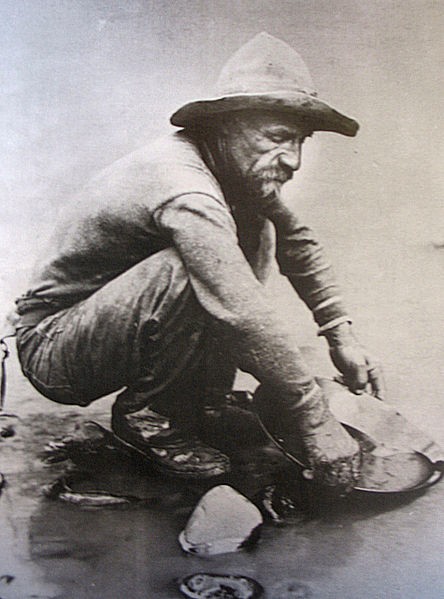
Panning for gold
To extract gold dust from the mud and gravels found on or near the banks of a stream was simple. Miners used metal pans to scoop up a likely pile of gravel along with some water. They swirled the mixture round a bit, allowing the muddy water to slop out of the pan. Gold dust was heavier than sediments, so, if they were lucky, any gold in the mixture would show up in the bottom of the pan. Even when prospectors found gold, they did not usually make their fortunes, as the price of the gold found did not often add up to much more than a miner's living expenses at the fields.

Consultant: Philip Parker
pics
Without in any way limiting Q-files Ltd’s exclusive rights under copyright, any use of this publication to “train” generative artificial intelligence (AI) technologies to generate text is expressly prohibited. Q-files Ltd reserves all rights to license use of this work for generative AI training and development of machine learning language models.