
Electricity and magnetism

CITE
We have made every effort to follow citation style rules, but there may be some minor differences. If in doubt, please refer to the appropriate citation style manual.
Batteries and cells. (2026). In Q-files Encyclopedia, Science, Electricity and magnetism. Retrieved from
https://www.q-files.com/science/electricity-and-magnetism/batteries-and-cells
"Batteries and cells." Science, Electricity and magnetism, Q-files Encyclopedia, 14 Apr. 2026.
https://www.q-files.com/science/electricity-and-magnetism/batteries-and-cells.
Accessed 4 Nov. 2026.
Batteries and cells 2026. Science, Electricity and magnetism. Retrieved 4 November 2026, from
https://www.q-files.com/science/electricity-and-magnetism/batteries-and-cells
Science, Electricity and magnetism, s.v. "Batteries and cells," accessed November 4, 2026.
https://www.q-files.com/science/electricity-and-magnetism/batteries-and-cells


Batteries and cells
Batteries store chemical energy and change it into electrical energy. Batteries are the common name for cells: units that produce electricity. They have three main parts: a negative electrode, a positive electrode and a mixture of chemicals in a moist paste (in dry batteries) or liquid form (in wet batteries), called an electrolyte. An electrolyte is a liquid that conducts electricity: it allows ions—atoms that have become electrically charged—to flow through the battery. A chemical reaction inside the battery causes electrons to flow from the negative electrode along a circuit, which includes the device that is being powered (the "load"), and back to the positive electrode. The points at which the circuit connects to the battery are called terminals.

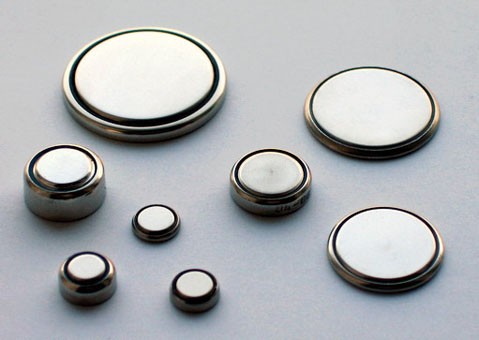
Primary or secondary?
Primary batteries can only be used once. They transform chemical energy into electrical energy but cannot do the reverse. When the supply of reacting chemicals is exhausted, the battery must be discarded. Most alkaline batteries are primary batteries.
Batteries that can be recharged are called secondary batteries. The chemical reactions that produce electricity can be reversed by supplying electrical energy to the battery. Examples include the lead-acid batteries used in cars and lithium-ion batteries used for portable electronic devices such as mobiles and laptops.
Alkaline batteries
Batteries used in radios, torches, toys, clocks and watches are usually the alkaline type. An alkaline battery has two terminals. One is the positive (+) terminal, the other the negative (-). Inside the steel case is an outer layer of manganese dioxide mixed with a little carbon powder. This is the cathode, the negatively charged electrode, which connects to the battery's positive terminal. The cathode surrounds an inner layer of powdered zinc, forming the anode, the positively charged electrode, which connects to the battery's negative terminal.
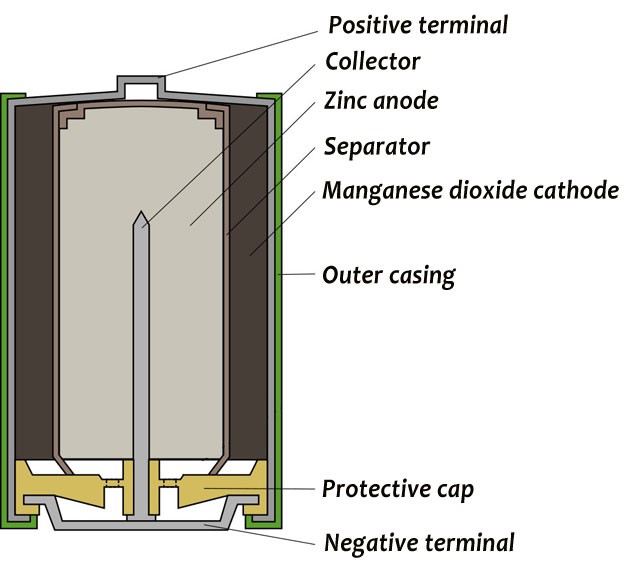
Filling the entire battery case is the electrolyte, a solution of potassium hydroxide (the alkali after which this type of battery is named) in water, which allows ions to flow between the cathode and anode. A separator forms a barrier between the cathode and anode, preventing the two electrodes from touching one another, while at the same time allowing the ions to flow between them. Although it contains a moist paste, this kind of battery is known as a dry cell. The zinc and manganese dioxide chemically react together to produce electricity. At the heart of the battery is the collector, a brass pin, which conducts the electricity to the outside of the battery and from there into the circuit.


Lithium-ion battery
Lithium-ion (Li-ion) batteries are rechargeable and are used in devices such as laptops, digital cameras, smartphones and electric cars. The positive electrode is made of lithium cobalt oxide; the negative electrode is made of carbon. The electrolyte is usually an organic mixture, such as a solution containing ethylene carbonate. Each battery produces around 3.7 volts.
Electromotive force
The amount of electric energy per electric charge delivered by a battery—or an electricity producer of any sort—is called its electromotive force (emf). This force, which pushes the electrons around a circuit, is measured in volts (V). The instrument used to measure the volts in a battery is called a voltmeter. A dry alkaline battery produces about 1.5 volts. Adding other batteries in a series increases the emf: they force a larger current around the circuit. For this reason, most torches contain more than one battery.

Wet cells
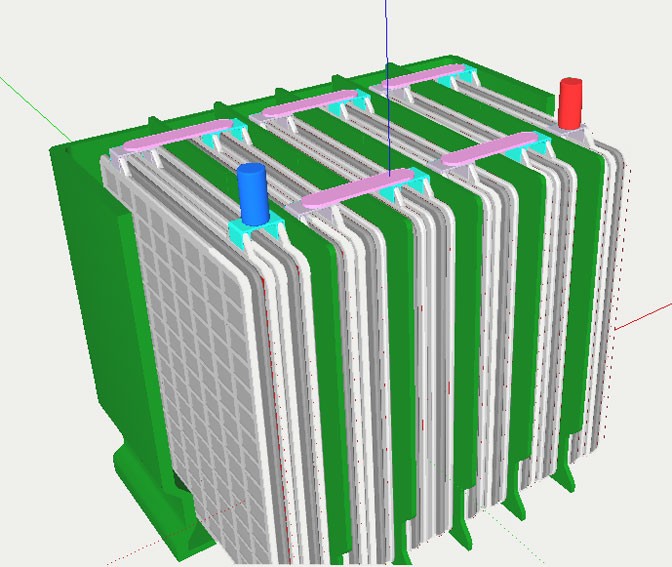
Vehicle batteries, called lead-acid batteries, are examples of wet cells. Inside, there are alternate plates of lead and lead dioxide, immersed in weak sulphuric acid. The lead plates are linked together to form the negative electrode, while the lead dioxide ones form the positive electrode. A reaction between the plates and acid produces electricity. Batteries of this type can be recharged: a device called an alternator, fitted to the drive of the engine, carries out this function in a vehicle.
Solar cells
Solar, or photovoltaic, cells do not use chemicals to store energy. Instead they convert light energy from sunlight into electrical energy. Small solar cells power pocket calculators, for example, while larger units power the electricity in people's homes or the electrical equipment on a satellite in space. Most solar cells are devices called silicon photodiodes. Light striking the join between two types of semiconductor causes electrons to flow through the cell.


Fuel cells
A fuel cell converts chemical energy into electricity through a reaction between hydrogen and oxygen. Every fuel cell has an anode, which has a positive charge, and a cathode, which has a negative charge. It also contains an electrolyte and a platinum catalyst, which speeds up the reaction. The electrolyte contains a membrane to keep the oxygen and hydrogen apart, and only permits the passage of certain types of ions.
Hydrogen atoms enter the fuel cell at the anode where a chemical reaction (assisted by the catalyst) strips them of their electrons. The hydrogen atoms are now "ionized" and carry a positive electrical charge. They travel through the electrolyte membrane to the cathode. Here they are rejoined by the negatively charged electrons, which have travelled round an external electrical circuit to give electricity. They also combine with oxygen atoms, which have entered the fuel cell at the cathode. The hydrogen ions, electrons and oxygen all react together to form water (H2O), which drains from the cell. Heat is also created during the reaction.


As long as a fuel cell is supplied with hydrogen and oxygen, it will generate electricity. However, each cell produces only a tiny amount of current, so many cells are stuck together in what are known as "stacks". Fuel cells are used as an alternative power source for vehicles: hydrogen-powered trains entered service for the first time in September 2018.
Consultant: Sharon Ann Holgate
pics
Without in any way limiting Q-files Ltd’s exclusive rights under copyright, any use of this publication to “train” generative artificial intelligence (AI) technologies to generate text is expressly prohibited. Q-files Ltd reserves all rights to license use of this work for generative AI training and development of machine learning language models.