
Rocks

CITE
We have made every effort to follow citation style rules, but there may be some minor differences. If in doubt, please refer to the appropriate citation style manual.
Gemstones. (2026). In Q-files Encyclopedia, Earth, Rocks. Retrieved from
https://www.q-files.com/earth/rocks/gemstones
"Gemstones." Earth, Rocks, Q-files Encyclopedia, 6 Mar. 2026.
https://www.q-files.com/earth/rocks/gemstones.
Accessed 13 Sep. 2026.
Gemstones 2026. Earth, Rocks. Retrieved 13 September 2026, from
https://www.q-files.com/earth/rocks/gemstones
Earth, Rocks, s.v. "Gemstones," accessed September 13, 2026.
https://www.q-files.com/earth/rocks/gemstones


Gemstones
As rocks undergo metamorphism, pockets of minerals trapped inside them can be transformed into gemstones—rare and beautiful jewels. Different gemstones form at different levels underground. Carbon, which makes up coal, forms diamonds in the mantle which are brought to the surface in volcanoes. Rubies and sapphires occur in metamorphizing sedimentary rocks. Amethyst originates in molten volcanic rock as it cools on contact with the air at the Earth's surface. Jade forms in subduction zones, while topaz occurs in granite, an igneous rock.

How do gemstones form?

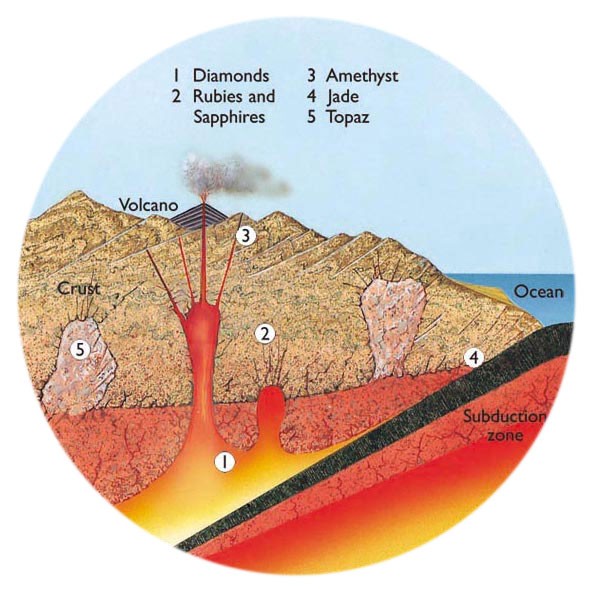
Gemstones form in types of rocks called metamorphic rocks. These are rocks that have changed because of intense heat or pressure underground, usually due to the movement of tectonic plates. This process is called metamorphism. As it takes place, the chemicals inside the rocks re-arrange themselves into new minerals. When pockets of minerals are trapped in the rocks, they too re-arrange their chemical structure and change into gemstones.
Most gemstones form in the upper part of the Earth’s crust, up to 40 kilometres (25 miles) deep underground. Diamonds form much deeper underground—up to 200 kilometres (125 miles) below the Earth’s surface.
Precious stones
Gemstones are divided into two main groups: precious and semi-precious stones. The four precious stones are diamonds, rubies, sapphires and emeralds. All other gemstones are known as semi-precious. This way of categorizing gems dates back to the ancient Greeks. The gemstones they considered "precious" were those that were rarest, and the finest quality, at that time. They are exceptionally translucent and hard.


Quartz gemstones
Many semi-precious gemstones are types of quartz minerals. They include amethyst, aventurine, onyx, agate, rose quartz and tiger’s eye. Most quartz crystallizes from molten magma. It is found in seams (layered strips) of rock. Pure quartz is colourless and transparent, but impurities give it colours such as purple (amethyst), pink (rose quartz), golden brown (tiger’s eye) and multi-coloured bands (agate and onyx). Aventurine contains tiny fragments of mica that turn it a sparkling green. Rutilated quartz contains needle-like shards of rutile, which look like streaks of gold.
Emerald and aquamarine

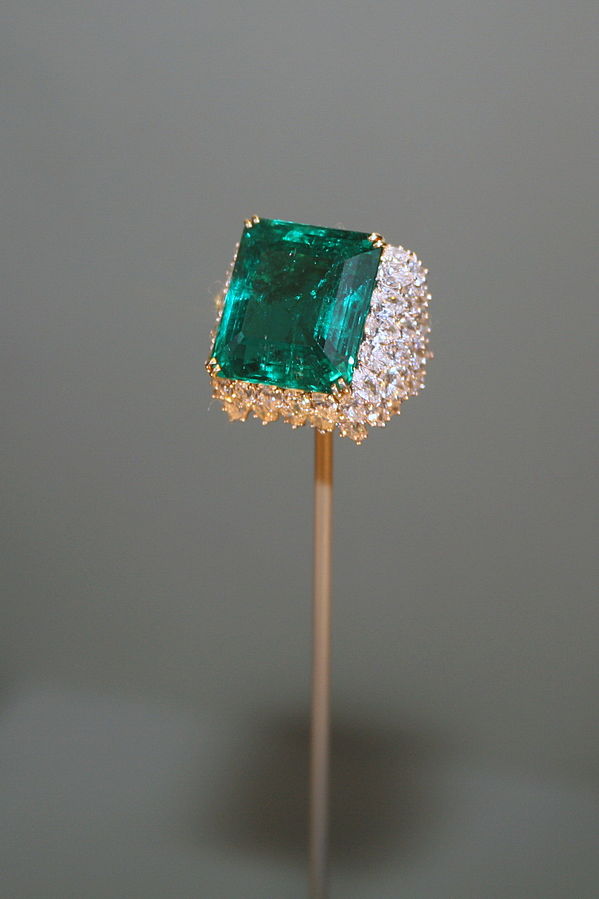
Emerald and aquamarine are two varieties of a type of mineral called beryl. Pure beryl is completely clear, but different types of impurities give it colour (and value). Beryl with green impurities is known as emerald, while blue or turquoise impurities result in aquamarine. Because of its appearance, aquamarine is named after the sea—it takes its name from the Latin words for “sea water”. Emeralds have been rare and precious gems since at least ancient Egyptian times, when they were prized by pharaohs. The oldest known emeralds were found in South Africa, and are thought to be 2.97 billion years old.

Ruby and sapphire
Ruby and sapphire are varieties of an extremely hard mineral called corundum, made from aluminium oxide. After diamond, it is the hardest known mineral on Earth. Pure corundum is transparent and colourless, but impurities can give it colours: it is called ruby when red (caused by chromium) and sapphire when it has shades of blue (iron), yellow (titanium) or green (magnesium). It is found in both igneous and metamorphic rocks.
Opals

With their kaleidoscopic patterns, precious opals are the most colourful of all gemstones. They formed when silica mixed with rainwater seeped into rock crevices, and was then left behind after the water evaporated. These little spheres stacked together, forming amazing light-reflecting crystals that can show all the colours of the rainbow, or appear iridescent (shimmering, like the scales of a fish). Opals have been prized for their beauty since the time of ancient Rome. Today nearly all the world’s opals are mined in South Australia. The rarest is black opal, a dark-coloured form of precious opal. Common opal is a pale milky colour, with no rainbow iridescence.
Diamonds
Diamonds formed when carbon atoms crystallized in the mantle, the layer of boiling-hot lava under the Earth’s crust. They were then carried to the Earth’s surface during volcanic eruptions, and buried in piles of volcanic material. The eruptions brought them to the surface so rapidly that the crystals cooled quickly; instead of changing into graphite, they remained as super-hard diamonds.
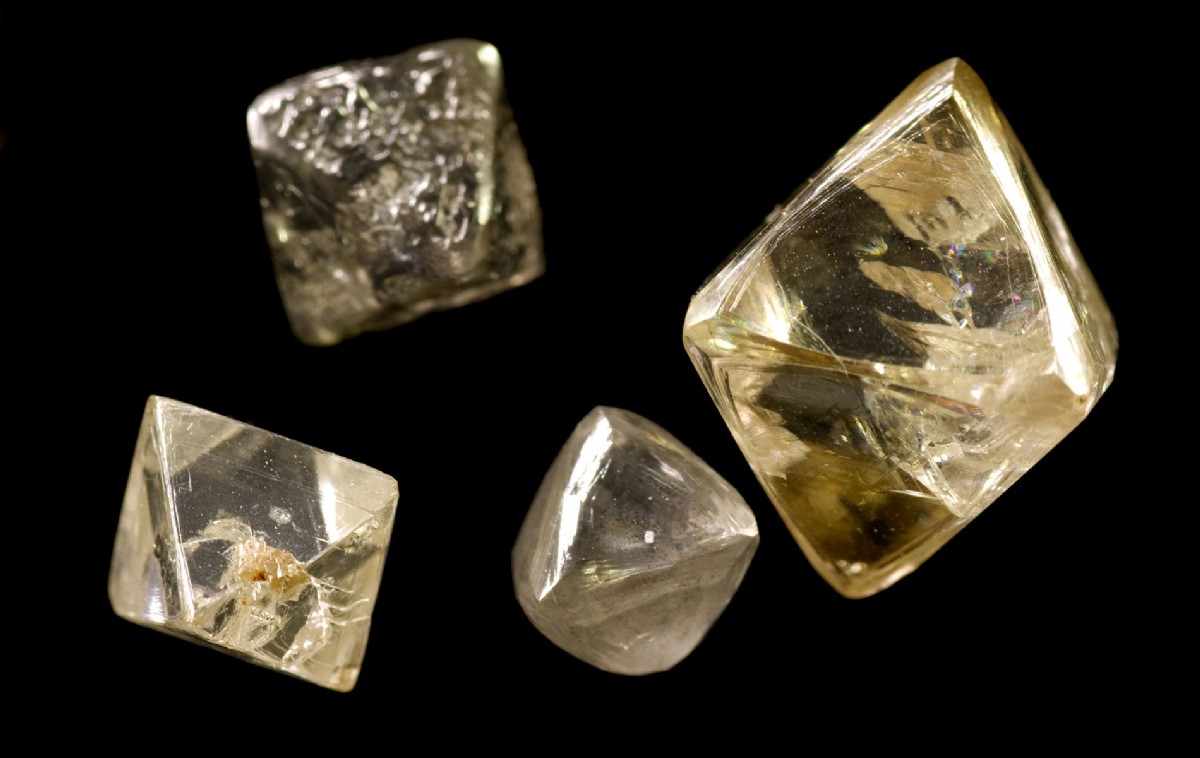
There are still some mysteries about diamonds. Because there is no way of sampling the mantle, scientists can only guess at the conditions in which diamonds formed. The source of carbon for diamonds could have come from above ground, introduced by subduction, or it could have been naturally present in the mantle. We do not know how exactly how old diamonds are, or whether they took days, years or even millions of years to form and grow.

Diamonds are usually mined using heavy machinery. In some countries such as Sierra Leone, miners cut diamonds from the rock using sharp hand tools. Another type of diamond mining involves using a sieve to inspect material gathered from the bottom of a stream, a process called panning. Sometimes diamonds known as “alluvial diamonds” may be among the gravel.
Topaz, garnet and jade
Topaz, garnets and jade are types of silicate minerals, part of the quartz family. Topaz usually forms in pockets in igneous rocks such as granite. In its natural state it is colourless, but impurities can turn it blue or golden orange. Garnets are usually red, but some rare types are blue. Jade is a pale green, white or yellow gemstone that is usually polished smooth instead of being cut. It was prized in ancient China—the philosopher Confucius wrote that it was a symbol of Heaven.


Turquoise
Turquoise is bright blue with an opaque appearance. It is found in only a few places on Earth, including Egypt, Iran and the southwest USA. Turquoise forms when groundwater rich in copper seeps underground and reacts with rocks containing aluminium and phosphorus.
Organic gemstones
Some gemstones are not minerals at all but instead are made of organic materials (matter that has come from once-living things). They include amber, jet and pearl. Amber is fossilized tree resin. It can contain the remains of insects, leaves, and other organic matter that were trapped inside it millions of years ago.


Pearls are produced by oysters, types of marine molluscs, inside their shells. When a piece of grit or a parasite invades the oyster’s shell, the oyster covers it with a substance called nacre, also known as mother-of-pearl. This makes it smooth, protecting the oyster from harm. Over several years, the smooth layers build up to form a perfectly round pearl. Pearls can also be produced synthetically (manufactured), by inserting a tiny bead into an oyster’s shell for it to form a pearl around. Known as cultured pearls, these are ready to harvest after around two years.
Jet is a gemstone made from lignite, a type of coal. It is formed when a piece of wood such as a tree trunk is buried in swampy sediment, squashed under high pressure and heated by the Earth’s geothermal energy. This transforms it into a hard, black rock which can be polished for use in jewellery.


Synthetic gemstones
Some gemstones can be manufactured. Known as synthetic gemstones, they share almost all the characteristics of natural gemstones. In industry, synthetic gems are used in microelectronics, communications, and machinery such as sanding and cutting equipment. Synthetic gems can even be “grown to order” to fit a required shape for use in jewellery. There are strict guidelines about how synthetic gemstones can be sold. This is to stop them being sold as natural gems and so reducing the value of the natural varieties.

Rubies (corundum) were the first gemstones to be made artificially, in the 1880s. The process used to make them is called flame fusion. Powdered chemicals are passed through a flame, which melts them, and the melted droplets crystallize into gemstones as they cool. This process is still in use today; synthetic corundum is among the easiest type of synthetic gemstone to produce.
Synthetic quartz can only be made by imitating the hot, pressurized conditions under which real quartz is made. Minerals are dissolved in water, and then crystals are left to grow. Synthetic quartz was first produced for use in industry.
The most common way to make synthetic diamonds is by subjecting carbon to intense pressure and heat, reproducing the conditions under which natural diamonds form in the Earth’s mantle. The carbon crystallizes within weeks to form synthetic diamonds, but the process is still unpredictable.

Cutting and polishing

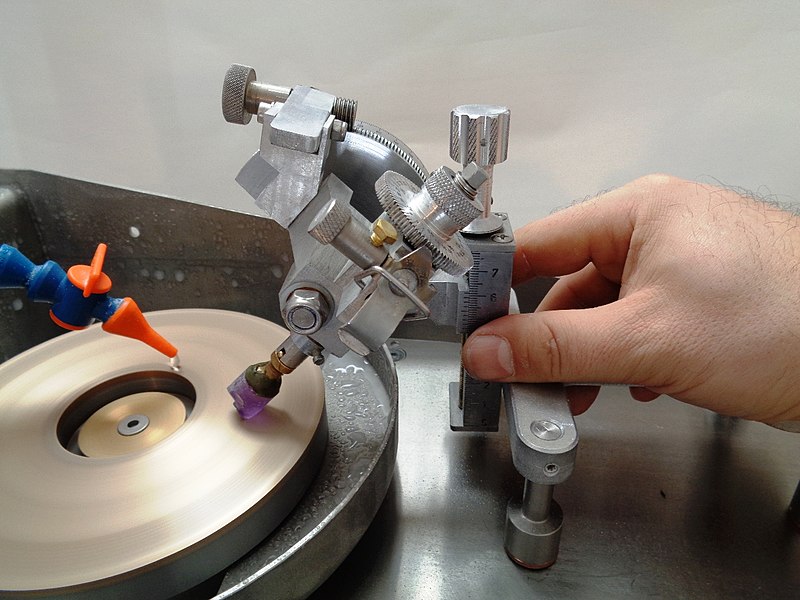
Gemstones in their natural state are known as “rough” gemstones. These uncut gems can often look like plain rocks with dull colours. Cutting and polishing—a skill called gemcutting, or lapidary—transforms them into glittering jewels.

Softer stones can be cut and shaped using silicon carbide, a mixture of silicon and carbon. Harder gems are cut using diamond, which is itself the hardest material on Earth. Some gem-cutting saw blades are encrusted with diamond grit. After cutting, a gemcutter uses a special sandpaper or grinding machine to shape the gem. At this point, features such as flat surfaces (facets) can be added to the design. A cabochon is a gem that has been cut with a rounded, polished shape on top, while the sides are flatter and sometimes left unpolished.
pics
Without in any way limiting Q-files Ltd’s exclusive rights under copyright, any use of this publication to “train” generative artificial intelligence (AI) technologies to generate text is expressly prohibited. Q-files Ltd reserves all rights to license use of this work for generative AI training and development of machine learning language models.