
Media and communications

CITE
We have made every effort to follow citation style rules, but there may be some minor differences. If in doubt, please refer to the appropriate citation style manual.
Mobile phones. (2026). In Q-files Encyclopedia, Technology, Media and communications. Retrieved from
https://www.q-files.com/technology/media-and-communications/mobile-phones
"Mobile phones." Technology, Media and communications, Q-files Encyclopedia, 19 Mar. 2026.
https://www.q-files.com/technology/media-and-communications/mobile-phones.
Accessed 21 Sep. 2026.
Mobile phones 2026. Technology, Media and communications. Retrieved 21 September 2026, from
https://www.q-files.com/technology/media-and-communications/mobile-phones
Technology, Media and communications, s.v. "Mobile phones," accessed September 21, 2026.
https://www.q-files.com/technology/media-and-communications/mobile-phones


Mobile phones
Mobile phones are radio telephones in which calls are routed through a network of radio aerials, or masts, linked to the main public telephone network. (Landline phones, which carry calls along electrical cables, work in a completely different way.) A mobile phone sends and receives calls without any wire connections. Instead, it uses electromagnetic waves to send and receive the sounds that would normally travel down wires. The first hand-held mobile phone call was made in 1973, using a handset that weighed about a kilogram (more than two pounds).


Digital signal
When you speak into a mobile phone, a tiny microphone in the handset converts the sounds of your voice into a pattern of electrical signals. A microchip inside the phone digitizes them (turns them into strings of numbers). The digital signal is carried by a radio wave and beamed out from the phone's aerial. The radio wave travels at the speed of light until it reaches the nearest radio aerial.
Cellular networks
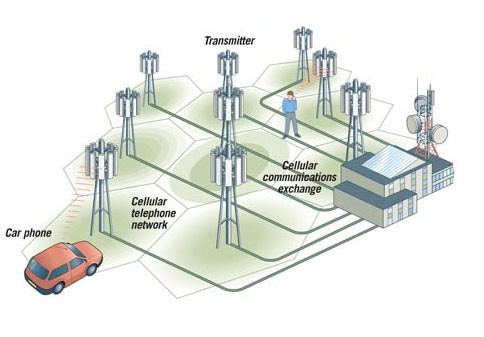
Mobile phones use radio waves for making calls or sending messages. The signals do not go directly from one phone to another. Instead, they are picked up by a transmitter in your local area, or “cell”. They are then passed along the network to a phone in another cell, or to a landline phone.
In a cellular telephone network, each cell (part of the landscape) has a radio aerial that communicates with any mobile phone that moves into it. The most-used digital network is GSM (Global System for Mobile communication).

Levels of technology
Mobile phones are classified according to the level of technology they use: second, third or fourth generation (2G, 3G or 4G). Second generation (2G) phones, introduced in 1991, transmit data at about 56 kbps (kilobits per second). Third generation (3G) phones were introduced in 2002. They vary in speed between about 200 kbps to 14 mbps (megabits per second). Fourth generation (4G) phones, introduced in 2010, have speeds of 100 mbps to 1 gbps (gigabits per second).

Fifth generation (5G) phones came into use in 2019. To begin with, speeds range from 50 mbps to more than 2 gbps, but these are expected to rise to 100 gbps—a hundred times faster than 4G. In addition to simply providing faster speeds, 5G networks will also need to meet the needs of new technologies, such as the Internet of things (IoT). This is a system of inter-connected devices (including smartphones) and appliances, such as lighting, thermostats, home security systems and cameras, together forming what is called the "smart home".
Smartphones
The most recent mobile phones are known as smartphones. They are mini-computers: they can be used for email, browsing the internet, taking digital photos and video, maps and satnav, using apps and playing music and games. Smartphones can send and receive information much faster than older phones. They include touchscreens and web browsers. With 3G, 4G or 5G digital technology, it means they can be used to send and receive computerized data, including text (SMS) messages, web pages, MP3 music files and digital photos.

Consultant: Chris Oxlade
pics

Without in any way limiting Q-files Ltd’s exclusive rights under copyright, any use of this publication to “train” generative artificial intelligence (AI) technologies to generate text is expressly prohibited. Q-files Ltd reserves all rights to license use of this work for generative AI training and development of machine learning language models.