
Media and communications

CITE
We have made every effort to follow citation style rules, but there may be some minor differences. If in doubt, please refer to the appropriate citation style manual.
Fibre optics. (2026). In Q-files Encyclopedia, Technology, Media and communications. Retrieved from
https://www.q-files.com/technology/media-and-communications/fibre-optics
"Fibre optics." Technology, Media and communications, Q-files Encyclopedia, 2 Jun. 2026.
https://www.q-files.com/technology/media-and-communications/fibre-optics.
Accessed 6 Aug. 2026.
Fibre optics 2026. Technology, Media and communications. Retrieved 6 August 2026, from
https://www.q-files.com/technology/media-and-communications/fibre-optics
Technology, Media and communications, s.v. "Fibre optics," accessed August 6, 2026.
https://www.q-files.com/technology/media-and-communications/fibre-optics


Fibre optics
Fibre-optic communication is a way of sending information—data, telephone calls and television signals—with pulses of light through an optical fibre. The light forms a wave that is modulated (shaped) to carry information, just like a radio wave is modulated to make a signal that represents sound. The first live telephone calls to be sent through a fibre-optic system were made in 1977 in Chicago, USA.
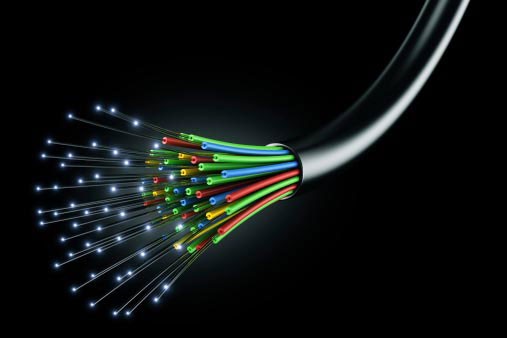

Optical fibres
An optical fibre is a flexible thread of transparent silica (glass) or plastic. It is about the same thickness of a human hair. It consists of a central core, surrounded by cladding and, outside that, a protective outer coating called a buffer. The light travels through the core by being reflected backwards and forwards between the core and cladding. This process is called total internal reflection.
As the light beam travels, its intensity, and thus the strength of its signal, becomes less and less. This is called attenuation, or transmission loss. This diagram shows beams of light travelling through the core of an optical fibre, reflecting backwards and forwards.

Fibre-optic communication system
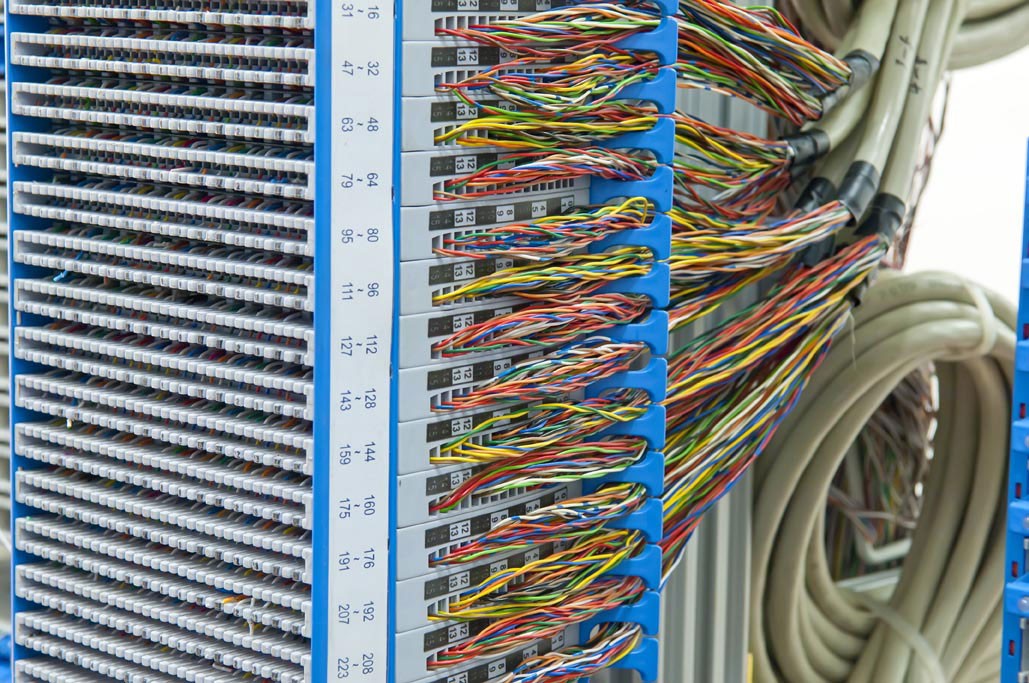
Modern fibre-optic communication systems consist of an optical transmitter, which converts an electrical signal into pulses of light, a cable containing bundles of optical fibres, amplifiers to boost the signal, and an optical receiver to convert it back to an electrical signal.
The most commonly-used optical transmitter is a laser diode, which produces a laser beam, an intense beam of light. The beam is modulated (shaped) by an electric current, which controls the pulses of light, and so produces an optical signal. The optical amplifier boosts the beam, preventing the signal from becoming too distorted or weak. The optical receiver contains a photodetector, which converts the optical signal back into an electrical one.
Advantages
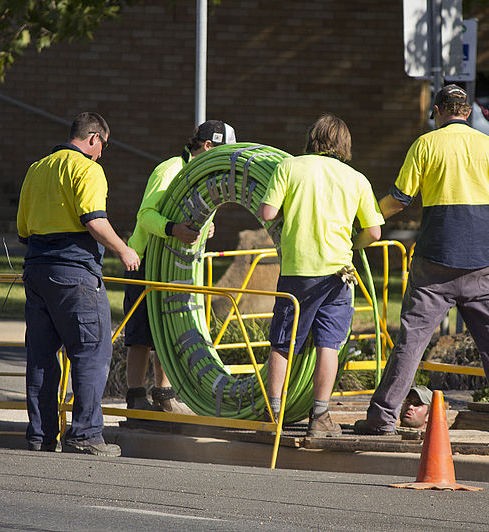
Optical fibres have great advantages over copper wires because signals travelling along fibres lose their strength (attenuate) far more gradually. They also do not suffer from interference from other electromagnetic waves. Because of this, optical fibres are used in most long-distance and important communication networks, such as undersea communications cables. The fibres can also carry a very high amount of information: a single, broadband optical fibre cable can replace thousands of copper wires.
Consultant: Chris Oxlade
pics
Without in any way limiting Q-files Ltd’s exclusive rights under copyright, any use of this publication to “train” generative artificial intelligence (AI) technologies to generate text is expressly prohibited. Q-files Ltd reserves all rights to license use of this work for generative AI training and development of machine learning language models.