
Media and communications

CITE
We have made every effort to follow citation style rules, but there may be some minor differences. If in doubt, please refer to the appropriate citation style manual.
Sound recording. (2026). In Q-files Encyclopedia, Technology, Media and communications. Retrieved from
https://www.q-files.com/technology/media-and-communications/sound-recording
"Sound recording." Technology, Media and communications, Q-files Encyclopedia, 19 Mar. 2026.
https://www.q-files.com/technology/media-and-communications/sound-recording.
Accessed 21 Sep. 2026.
Sound recording 2026. Technology, Media and communications. Retrieved 21 September 2026, from
https://www.q-files.com/technology/media-and-communications/sound-recording
Technology, Media and communications, s.v. "Sound recording," accessed September 21, 2026.
https://www.q-files.com/technology/media-and-communications/sound-recording


Sound recording
Sound recording and reproduction is the electrical storage and re-creation of sound waves. In a digital recording, sound signals picked up by a microphone are converted to a digital form by a process of digitization. The recording can then be stored in a variety of media, including CDs, DVDs and Blu-ray discs or on computers, portable media players and smartphones. A digital audio signal must be changed back to an electrical signal during playback before it is sent to loudspeakers or earphones. The signal causes a diaphragm inside each speaker to form sound waves.


First recording machine
The US inventor Thomas Edison (1847–1931) adapted the parts of a long-distance telephone he had invented to produce the first recording machine, which he called the phonograph. The first recorded sound he made on it was heard in 1878, when Edison recited the nursery rhyme “Mary had a little lamb”.
His phonograph was like a telephone, only with the vibrating parts connected to a steel needle. As Edison spoke into a horn, the needle "wrote" the pattern of vibrations on a piece of tinfoil wrapped round a drum, which was turned at the same time. When the needle was returned to the beginning of its written message and the drum turned again, the pattern cut in the foil made it vibrate in the same way. The telephone parts also vibrated and the sound came back out of the drum.
Alexander Graham Bell's Volta Laboratory made improvements in the 1880s, replacing the foil-wrapped drum with a wax-coated cardboard cylinder, and a needle that moved from side to side across it.

Gramophone records
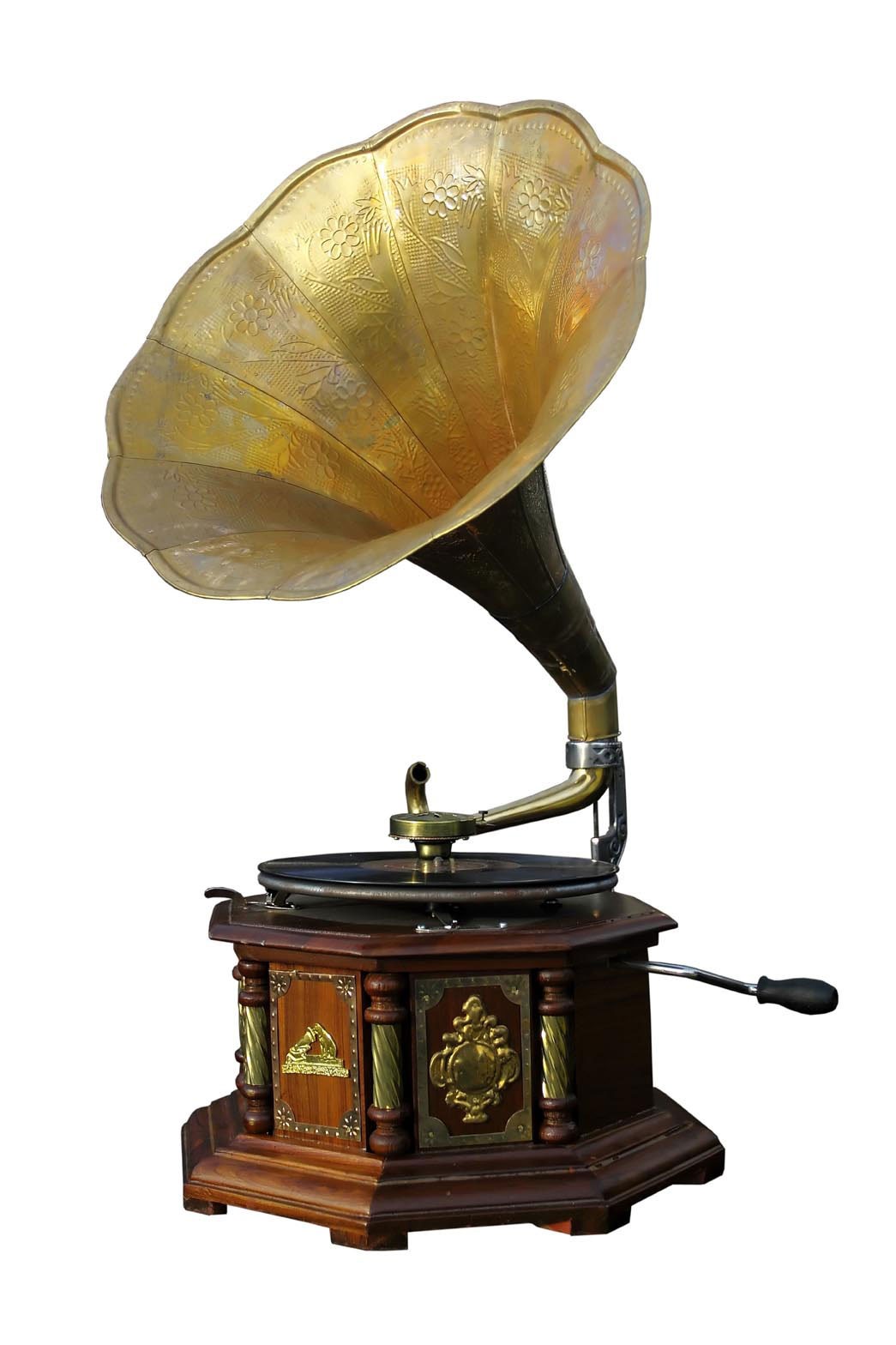
Gramophone (a name which later replaced the phonograph) records or discs were the chief method for recording and replaying sound for most of the 20th century. Developed by US inventor Emile Berliner, who invented them in 1887, gramophone records had completely replaced the phonograph cylinder by the 1920s. The 1920s also saw the introduction of the electric gramophone in which the vibrating needle created an electrical signal, which was then amplified and turned into sound through a loudspeaker.
The very earliest records, manufactured from 1889 onwards, were made of hard rubber. In around 1895, a material called shellac was introduced, and became standard. By 1925, the speed of the record on the turntable became fixed at 78 rpm (revolutions per minute). A lighter material, a type of plastic called vinyl, replaced shellac by the end of the 1930s.
The 33 1/3 rpm "long play" (LP) record first went on sale in 1948, with the smaller 45 rpm following in 1949. The slower speed and narrower grooves allowed for more music to be recorded on to both sides of the records. Both became standard until the introduction of CDs in the 1980s.


Tape recorder
Tape recording was developed in the 1940s. To record on to tape, the electrical signal from a microphone, representing the original sound waves, is sent to an electromagnet, which creates a pattern in the tiny magnetic particles that coat the tape. This pattern recreates the signal as the tape plays, and the signal is amplified before going to a loudspeaker.
Tape recording gave performing artists, record producers and the general public the power to record and re-record audio sounds with little loss in quality. Cassette recorders, for both recording and playing back music, became popular from the 1970s onwards. Sales of video cassette recorders (VCR), which made use of similar technology for recording and playing back TV programmes and films, boomed in the 1980s.
Digital recording
Most sound (and video) recording is now done digitally. A microphone turns the sound into an electrical signal, which is then digitized more than 44,000 times a second to create a long string of binary numbers. The binary numbers can be stored in computer memory or on a compact disc (CD), DVD or Blu-ray disc.

Compact disc
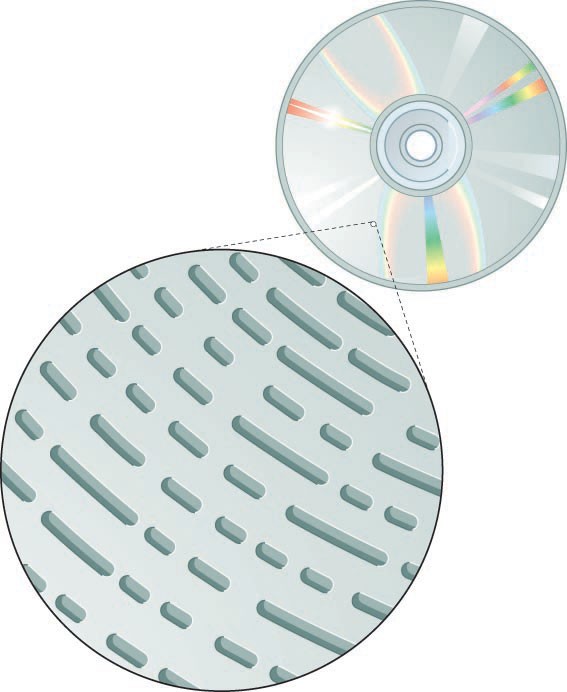
Both a compact disc (CD) and digital versatile disc (DVD) are plastic and aluminium discs measuring 12 centimetres (4.7 inches) in diameter. On a disc, the binary digits 0 and 1 are represented by flat areas (called lands) or shallow pits in the surface.
There may be about 3 billion pits in a single spiral track that starts at the centre and unwinds to the edge of the disc. A typical pit is one thousandth of a millimetre long.
CD player
In a CD audio player, the disc is read by a beam of laser light. As the disc spins, a series of mirrors and lenses focuses the beam on to the underside of the disc. The beam “reads” the various pits and lands that represent the original signal in coded form. The beam is then reflected to a light-sensitive device. Electronics rebuild the original electrical signal, which is amplified and sent to speakers, where they are changed back into sounds.

Computer CD-ROMs and DVDs work in the same way. Because the laser beam of a DVD player is very fine, it can focus on tiny pits and lands. This means a DVD can have more pits and lands than a CD and contain seven times more data.
A Blu-ray disc is similar to a DVD but read using blue laser light. Because blue light has a short wavelength it can read very tiny pits. Blu-rays have many more pits than DVDs and hold over five times more data.
MP3
Digital sound files can be stored in computers, portable media players (such as the iPod) and smartphones, instead of discs. MP3 audio files, compressed music files, are a type of digital audio file widely used to store sound on these devices. Compressed files take up much less memory than the original sound file, although they do result in some loss of quality. Hundreds of thousands of songs can, however, be stored on a computer, media player or smartphone in this way.
Consultant: Chris Oxlade
Timeline
1877
Thomas Edison demonstrates the phonograph, the first recording device.
1887
Gramophone records are invented by Emile Berliner
1898
Danish engineer Valdemar Poulsen demonstrates a magnetic recording device; these originally used wires, before being replaced by tape.
1920s
First electronic recordings
1935
The first practical tape recorder, the Magnetophon K1, is developed in Germany.
1958
First stereo LP records go on sale.
1982
The first music CD is sold in Japan.
1999
DVDs (digital versatile discs) are introduced
2001
The first portable media players go on sale.
pics
Without in any way limiting Q-files Ltd’s exclusive rights under copyright, any use of this publication to “train” generative artificial intelligence (AI) technologies to generate text is expressly prohibited. Q-files Ltd reserves all rights to license use of this work for generative AI training and development of machine learning language models.