
Famous inventors

CITE
We have made every effort to follow citation style rules, but there may be some minor differences. If in doubt, please refer to the appropriate citation style manual.
Alexander Graham Bell. (2026). In Q-files Encyclopedia, Technology, Famous inventors. Retrieved from
https://www.q-files.com/technology/famous-inventors/alexander-graham-bell
"Alexander Graham Bell." Technology, Famous inventors, Q-files Encyclopedia, 16 Mar. 2026.
https://www.q-files.com/technology/famous-inventors/alexander-graham-bell.
Accessed 6 Aug. 2026.
Alexander Graham Bell 2026. Technology, Famous inventors. Retrieved 6 August 2026, from
https://www.q-files.com/technology/famous-inventors/alexander-graham-bell
Technology, Famous inventors, s.v. "Alexander Graham Bell," accessed August 6, 2026.
https://www.q-files.com/technology/famous-inventors/alexander-graham-bell


Alexander Graham Bell
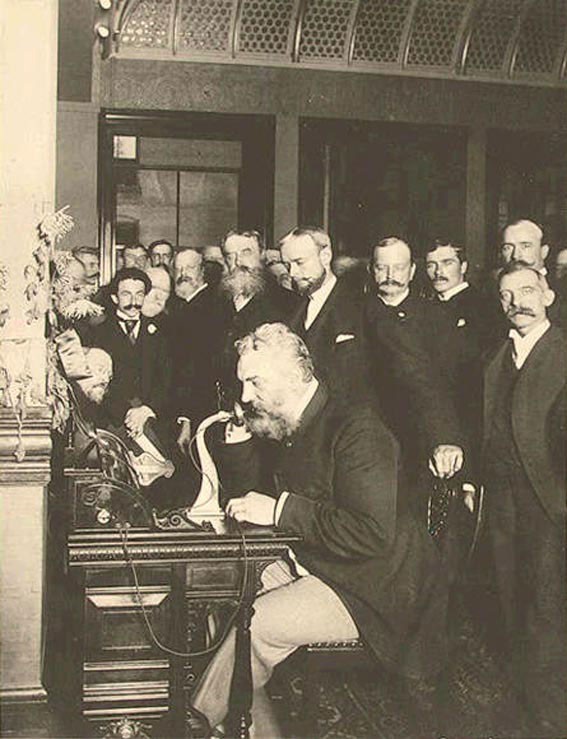
Alexander Graham Bell (1847–1922) was a Scottish-American scientist and inventor of the telephone. Born in Edinburgh, Bell moved first to Canada, then to the US in 1871. He founded a school in Boston to train teachers of deaf children. Interested in ways of transmitting speech, in 1875 he invented a receiver that could turn electricity into sound, a device he patented the following year. In March 1876 Bell made the world’s first telephone call. His assistant, Tom Watson, in the next room, heard the words “Mr Watson, come here, I want to see you.” By August, an experiment in which sounds of people talking and singing 6 kilometres (4 miles) away were received along a telegraph line proved that the telephone could worked over long distances.

First telephone
In Bell’s telephone, there was a steel strip that vibrated when someone spoke close to it. These vibrations could be sent along a wire with an electric current and make another strip vibrate, reproducing the original sounds. But these were not very clear: users had to shout to make themselves heard. This device both turned the sound of the user’s voice into an electrical signal, and an incoming signal into sound—which meant that the user could not talk and listen at the same time.
Photophone
With his assistant Sumner Tainter, Bell worked on a wireless version of his telephone, called the Photophone. Apparatuses—looking not unlike modern satellite TV dishes—transmitted and received sounds by a beam of light. The system was a forerunner to the fiber-optic communications of today. In 1880, a wireless telephone message was successfully delivered over a distance of more than 210 metres (700 feet) in Washington, D.C. Bell later described the Photophone as "the greatest invention I have ever made".

Consultant: Dave Hawksett
pics
Without in any way limiting Q-files Ltd’s exclusive rights under copyright, any use of this publication to “train” generative artificial intelligence (AI) technologies to generate text is expressly prohibited. Q-files Ltd reserves all rights to license use of this work for generative AI training and development of machine learning language models.