
Famous inventors

CITE
We have made every effort to follow citation style rules, but there may be some minor differences. If in doubt, please refer to the appropriate citation style manual.
Christiaan Huygens, inventor. (2026). In Q-files Encyclopedia, Technology, Famous inventors. Retrieved from
https://www.q-files.com/technology/famous-inventors/christiaan-huygens-inventor
"Christiaan Huygens, inventor." Technology, Famous inventors, Q-files Encyclopedia, 16 Mar. 2026.
https://www.q-files.com/technology/famous-inventors/christiaan-huygens-inventor.
Accessed 6 Aug. 2026.
Christiaan Huygens, inventor 2026. Technology, Famous inventors. Retrieved 6 August 2026, from
https://www.q-files.com/technology/famous-inventors/christiaan-huygens-inventor
Technology, Famous inventors, s.v. "Christiaan Huygens, inventor," accessed August 6, 2026.
https://www.q-files.com/technology/famous-inventors/christiaan-huygens-inventor


Christiaan Huygens, inventor
Christiaan Huygens (1629–95) was a Dutch mathematician and scientist. One of his greatest contributions to science was his proof that light travelled in the form of waves. He is also known for drawing the first map of the surface of Mars, and for his studies of the rings of Saturn and the discovery of its moon, Titan. His astronomical discoveries were made possible by the techniques Huygens and his brother Constantijn invented for making telescope lenses. His greatest invention, however, was made in 1656: the pendulum clock. This greatly increased the accuracy of clocks, from minutes to seconds per day.

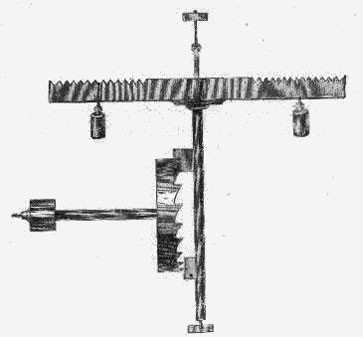
From foliot to pendulum
Before Huygens' time, all mechanical clocks were driven by some kind of "oscillator", a device that repeated the same motion with a constant time interval between repetitions. Until Huygens' invention of the pendulum clock, these oscillations were provided by a foliot balance controlled by a verge escapement.
An escapement is the mechanism that controls the movement of a clock by allowing the cogs to advance at regular intervals or "ticks". The movement of the clock was controlled by flat plates, called pallets, attached to the vertical shaft, the verge, on top of which was a bar, called the foliot, which had weights hanging from either end.
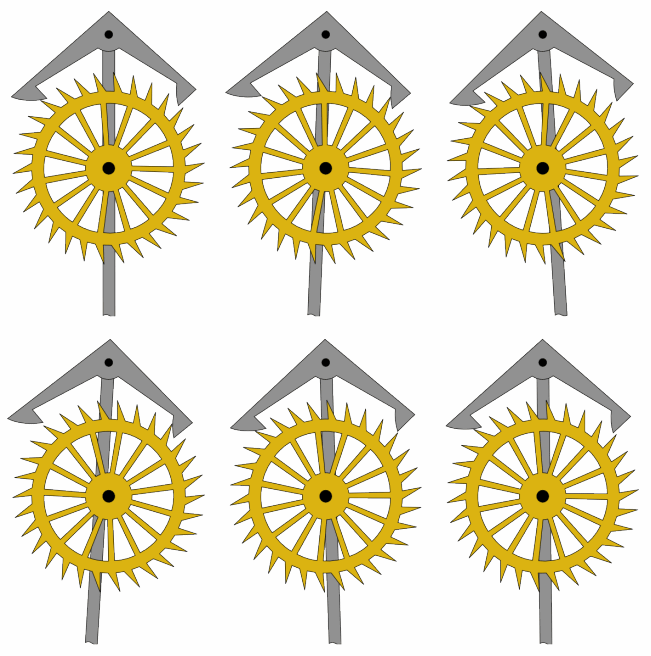
This animation shows how the pallets control the turning movement of the cog, which is connected to the clock hand.

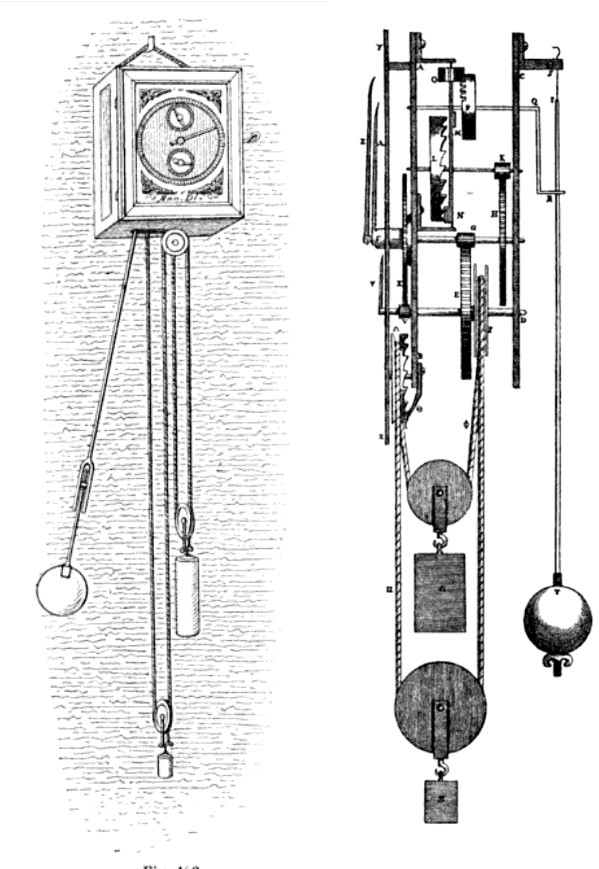
Huygens' clock
Huygens realised that swinging pendulum would make a much more reliable oscillator than a foliot. Huygens' first pendulum clock also used a verge escapement, powered by a weight that fell five centimetres per hour. Designed in December 1656 and constructed the following year, his pendulum clock was far more accurate than any previous clock. It could run for about three hours with an error of only one second, whereas clocks with foliot balances would gain or lose a second every few minutes.
Anchor escapement
In the late 1660s William Clement constructed the first successful anchor escapement—although it may actually have been invented by the English scientist Robert Hooke (1635–1703). This kind of escapement allowed one tooth of the wheel to pass each time the pendulum completed a swing, and required a smaller swing angle than a verge escapement did.
The anchor escapement was a significant improvement on the verge because when a pendulum swung through a large angle its accuracy was reduced.
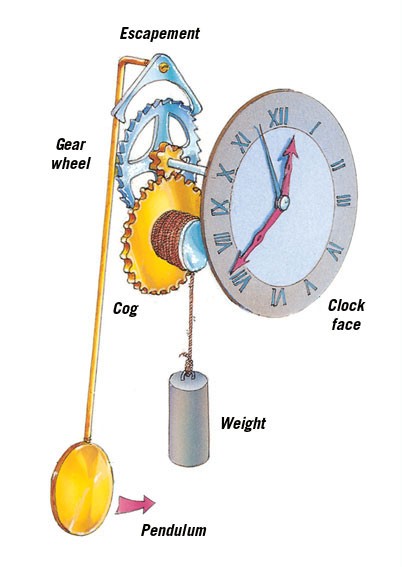
How a pendulum
clock works
A pendulum, a weight hung on a long arm, swings to and fro at regular intervals. It is connected to an escapement mechanism which turns a gear wheel, releasing it and stopping it, tooth by tooth (in this illustration, this is an anchor escapement). The gear wheel is itself connected by other cogs to a heavy weight on a string: this falls gradually, second by second, driving the clock.
Pocket watch
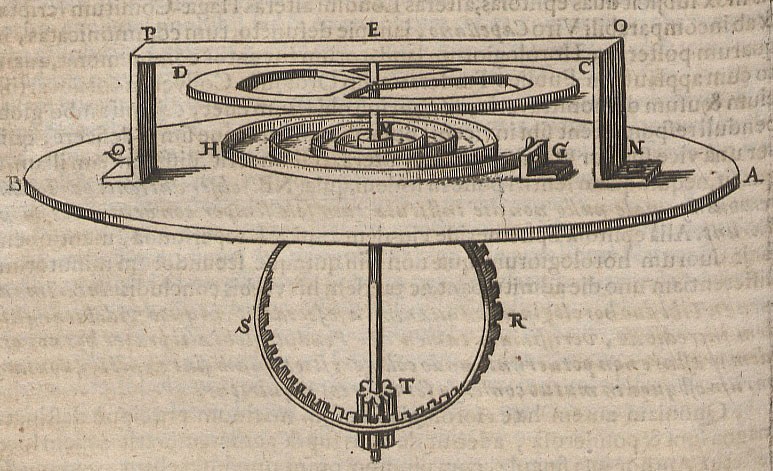
In 1675, Huygens invented a balance spring pocket watch. It was driven by a balance wheel and spiral spring. A similar mechanism had been developed independently at the same time by Robert Hooke, but Huygens' invention was the first to work properly. All watches used this same basic mechanism until the first quartz crystal oscillators were developed for watches in 1969.
Consultant: Dave Hawksett
pics
Without in any way limiting Q-files Ltd’s exclusive rights under copyright, any use of this publication to “train” generative artificial intelligence (AI) technologies to generate text is expressly prohibited. Q-files Ltd reserves all rights to license use of this work for generative AI training and development of machine learning language models.