
Famous inventors

CITE
We have made every effort to follow citation style rules, but there may be some minor differences. If in doubt, please refer to the appropriate citation style manual.
Leonardo da Vinci, inventor. (2026). In Q-files Encyclopedia, Technology, Famous inventors. Retrieved from
https://www.q-files.com/technology/famous-inventors/leonardo-da-vinci-inventor
"Leonardo da Vinci, inventor." Technology, Famous inventors, Q-files Encyclopedia, 16 Mar. 2026.
https://www.q-files.com/technology/famous-inventors/leonardo-da-vinci-inventor.
Accessed 22 Sep. 2026.
Leonardo da Vinci, inventor 2026. Technology, Famous inventors. Retrieved 22 September 2026, from
https://www.q-files.com/technology/famous-inventors/leonardo-da-vinci-inventor
Technology, Famous inventors, s.v. "Leonardo da Vinci, inventor," accessed September 22, 2026.
https://www.q-files.com/technology/famous-inventors/leonardo-da-vinci-inventor


Leonardo da Vinci, inventor
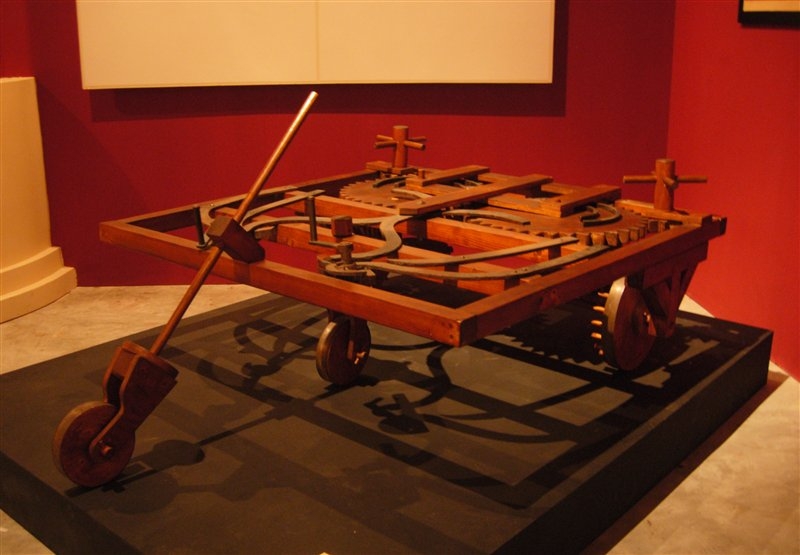
While Leonardo da Vinci (1452–1519) is today considered one of the greatest artists of all time, famous for his paintings such as the Mona Lisa and the Last Supper, he was also a scientist, mathematician, mapmaker, engineer and inventor. During his lifetime, he was employed as an engineer by the Duchy of Milan, the Republic of Venice and other states. Many of Leonardo's designs proved too costly or impractical at the time—or were simply intended as toys for amusement. But some of his ideas for inventions later turned out to be the forerunners of devices that were developed by other inventors hundreds of years later. They included: the parachute, the helicopter, an armoured vehicle, a self-propelled cart and even a humanoid robot. For hundreds of years, Leonardo's futuristic designs lay unpublished, before being rediscovered in the late 19th century.


Scientific knowledge
Leonardo understood the scientific principles of his day and applied these to his inventions. From this knowledge, he devised various machines using levers, wheels, pulleys, cranks, gears and bearings. For example, his designs for a lens-grinding machine involved a hand-turned grinding wheel which rotated a shaft via a gear. The shaft turned a dish containing the glass or crystal to be ground.
Hydraulics
Leonardo's study of the motion of water—a science called hydraulics—led him to design machinery that harnessed its force, including mills and engines. Among his projects for Florence (an independent republic in the late 15th and early 16th centuries) was a way of diverting the course of the River Arno, possibly in order to flood its rival, the neighbouring republic of Pisa, in the early 1500s. (Fortunately, it was too costly to be carried out.) Leonardo also came up with a plan to create a movable dyke for the protection of Venice against invaders.


Parachute
The first practical parachute was built by French inventor Louis-Sébastien Lenormand (1757–1837) in 1783. However, from his sketches and notes it seems that Leonardo came up with the idea 300 years earlier, between 1480 and 1483. He explained: "If a man has a tent made of linen of which the apertures have all been stopped up, and it be twelve braccia (about 7 metres / 23 feet) across ... he will be able to throw himself down from any great height without suffering any injury."
Armoured vehicle
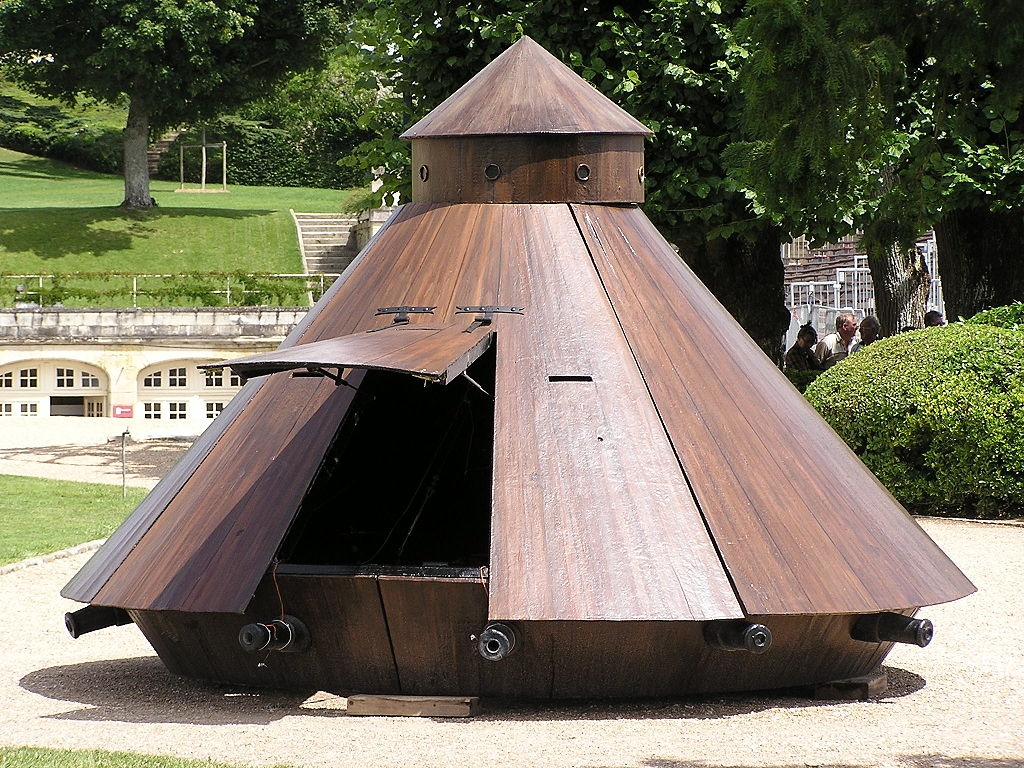
Responding to a commission in 1487 from Ludovico Sforza, Duke of Milan, who had been charged with defending his city from invasion, Leonardo developed a plan for an armoured vehicle. Powered by eight men inside turning cranks to spin the geared wheels, the metal-plated, cone-shaped vehicle was capable of moving in any direction. It was equipped with a number of cannons pointing outwards at different angles. Though the vehicle was never built, the design is considered to be a forerunner of the tank (which first appeared in 1916 during World War I).


Helicopter
Leonardo's design for a vertical-take-off flying machine, made in around 1493, was more than 400 years ahead of its time. Made of stretched linen sails and wooden masts, the machine was to have been powered by four men turning cranks. With enough rotation of this “aerial screw”, Leonardo believed that the machine's sails would cause the machine to spiral upwards into the air. Engineers now know the machine would never have worked as a helicopter. But they do acknowledge that what Leonardo had actually invented was a forerunner of the propeller, a crucial technology for powering both ships in the 19th century onwards and aircraft in the 20th.
Bridge
In 1502, Leonardo produced a drawing of a single span 240-metre (720-foot) bridge as part of a civil engineering project for the Ottoman sultan Beyazid II in Istanbul. It was intended to span an inlet at the mouth of the Bosporus known as the Golden Horn. Although the project was never realised, Leonardo's vision was resurrected in 2001 when a smaller bridge based on his design was constructed in Norway.


Other machines
Leonardo's mechanical "robot" was designed to mimic human limb movements using a system of pulleys, gears and cables operated by a hand crank.
He devised a machine (pictured) with 13 interlocking wheels and 10 faces numbered from zero to nine. Although it is not clear how the machine would work, it is believed to be a design for a counting machine.
Leonardo came up with the "ornithopter" (below), a wooden flapping machine inspired by birds and bats. The craft required the reclining pilot to power its silk wings with his or her legs. Had the machine ever been constructed, however, experts say it would never have made it off the ground.

Consultant: Mike Goldsmith
pics


Without in any way limiting Q-files Ltd’s exclusive rights under copyright, any use of this publication to “train” generative artificial intelligence (AI) technologies to generate text is expressly prohibited. Q-files Ltd reserves all rights to license use of this work for generative AI training and development of machine learning language models.