
Famous inventors

CITE
We have made every effort to follow citation style rules, but there may be some minor differences. If in doubt, please refer to the appropriate citation style manual.
Guglielmo Marconi. (2026). In Q-files Encyclopedia, Technology, Famous inventors. Retrieved from
https://www.q-files.com/technology/famous-inventors/guglielmo-marconi
"Guglielmo Marconi." Technology, Famous inventors, Q-files Encyclopedia, 16 Mar. 2026.
https://www.q-files.com/technology/famous-inventors/guglielmo-marconi.
Accessed 6 Aug. 2026.
Guglielmo Marconi 2026. Technology, Famous inventors. Retrieved 6 August 2026, from
https://www.q-files.com/technology/famous-inventors/guglielmo-marconi
Technology, Famous inventors, s.v. "Guglielmo Marconi," accessed August 6, 2026.
https://www.q-files.com/technology/famous-inventors/guglielmo-marconi


Guglielmo Marconi
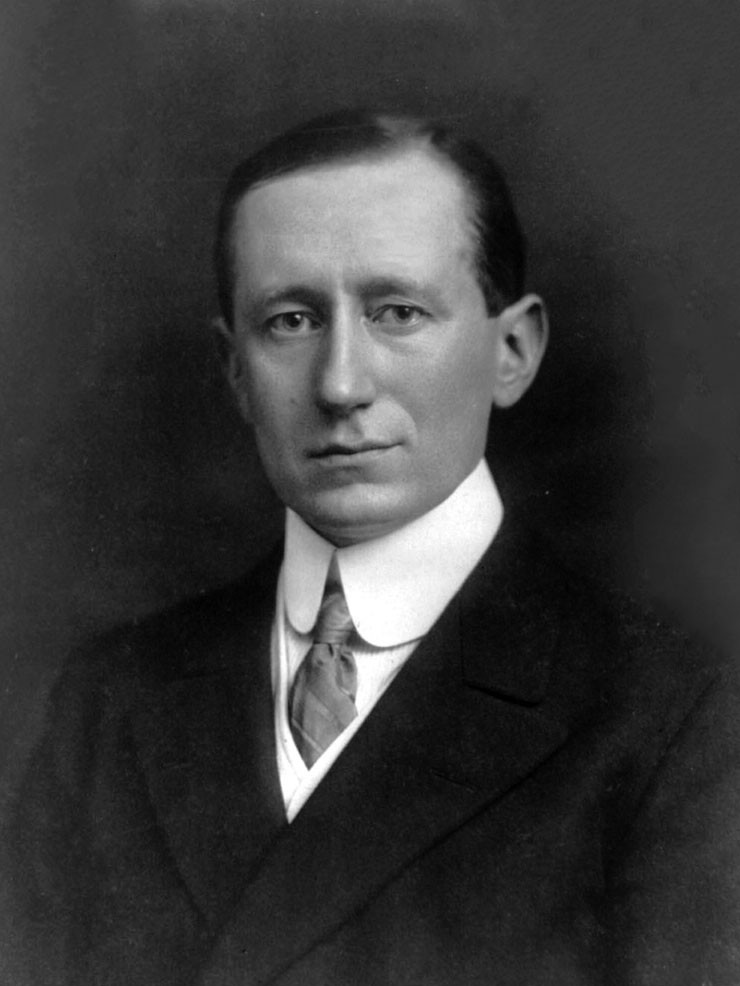
The existence of radio waves was confirmed in 1888 by the German physicist Heinrich Hertz (1857–1894), but it was the Italian inventor Guglielmo Marconi (1874–1937) who, in 1896, was the first to make long-distance radio transmissions. In 1909 he shared the Nobel Prize in Physics (with German physicist Karl Braun) for his work. Radio soon became a hugely important technology in the 20th century. It is used for broadcasting radio and TV, phone links, computer networks, including internet, Wi-fi and Bluetooth, and for remote control of machines.
The discovery
of radio waves
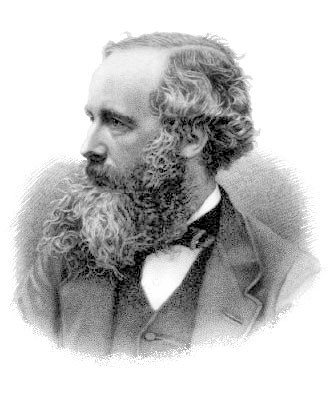
In 1865, the Scottish physicist James Clerk Maxwell (1831–79) proposed the existence of electromagnetic waves. It was already known that a changing magnetic field generates an electric field. But Maxwell claimed that a changing magnetic field could also produce an electric field. A disturbance, either electric or magnetic, would set off a pattern of changing fields, moving across space as waves, like ripples in water. Maxwell proposed that the speed of movement of these electromagnetic waves was equal to the speed of light. Light, he suggested, was just another form of electromagnetic wave.
It was left to Heinrich Hertz to prove the existence of electromagnetic waves with an experiment he carried out in 1888. His apparatus created an electric current and an oscillating (jumping back and forth) spark between rods. The spark caused another spark to jump across the gap in an almost-closed wire loop positioned a short distance away. Hertz realised that the oscillating spark was generating a signal that travelled through space as electromagnetic waves—just as Maxwell had predicted. Hertz called these radio waves.

Wireless telegraphy
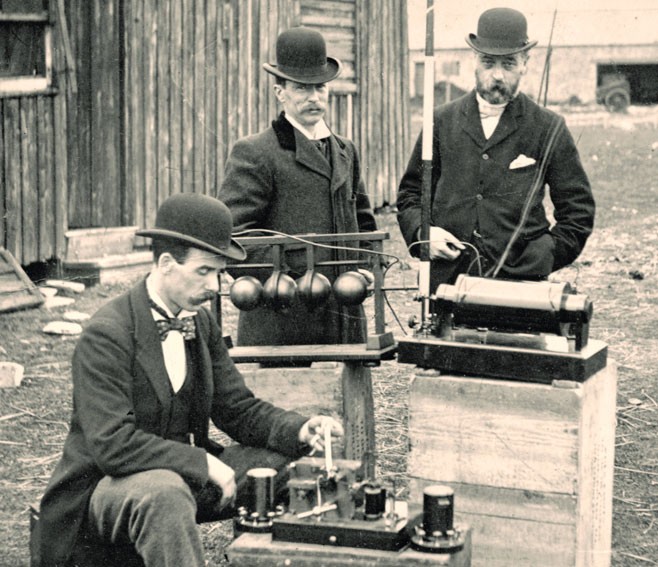
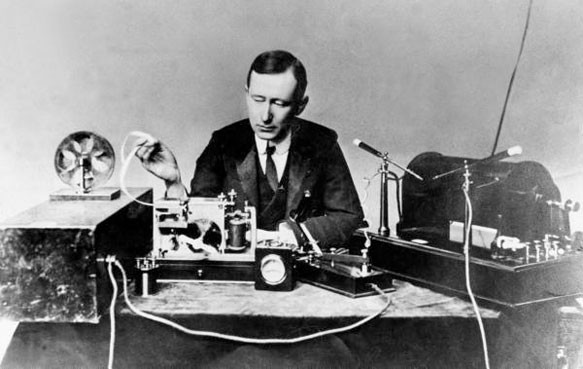
Marconi began to experiment with radio waves at a young age, with the aim of transmitting messages without connecting wires: "wireless telegraphy". By the summer of 1895, he was able to transmit wireless signals over 2.4 kilometres (1.5 miles) and, over the following two years, demonstrated his system successfully in London, on Salisbury Plain and across the Bristol Channel.
Transatlantic
radio signal
In 1899, Marconi established wireless communication between England and France across the English Channel. He was determined to prove that wireless waves were not affected by the curvature of the Earth, so he used his system to transmit the first transatlantic radio signal.
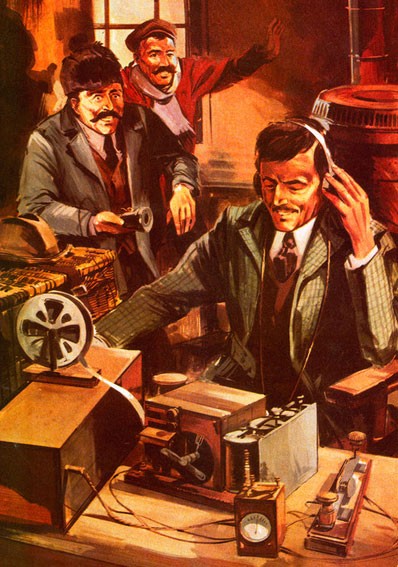
In 1901, the three dots of S in Morse code, from the Poldhu Wireless Station, Cornwall, England, were received extremely faintly at Signal Hill, Newfoundland in Canada, 3520 kilometres (2200 miles) away. Using an antenna carried by a kite, the signal was received by Marconi himself, but his claims were not verified. Marconi carried out further tests over the next two years to prove his success.
Consultant: Dave Hawksett
pics
Without in any way limiting Q-files Ltd’s exclusive rights under copyright, any use of this publication to “train” generative artificial intelligence (AI) technologies to generate text is expressly prohibited. Q-files Ltd reserves all rights to license use of this work for generative AI training and development of machine learning language models.