
Famous inventors

CITE
We have made every effort to follow citation style rules, but there may be some minor differences. If in doubt, please refer to the appropriate citation style manual.
Alan Turing. (2026). In Q-files Encyclopedia, Technology, Famous inventors. Retrieved from
https://www.q-files.com/technology/famous-inventors/alan-turing
"Alan Turing." Technology, Famous inventors, Q-files Encyclopedia, 16 Mar. 2026.
https://www.q-files.com/technology/famous-inventors/alan-turing.
Accessed 21 Sep. 2026.
Alan Turing 2026. Technology, Famous inventors. Retrieved 21 September 2026, from
https://www.q-files.com/technology/famous-inventors/alan-turing
Technology, Famous inventors, s.v. "Alan Turing," accessed September 21, 2026.
https://www.q-files.com/technology/famous-inventors/alan-turing


Alan Turing
Alan Mathison Turing (1912–1954) was an English mathematician and computer scientist. He was highly influential in the development of computers. His plans for what has become known as the "Turing machine", which he described in 1936, demonstrated how computers could work, and is now considered the model on which modern computers are based. During World War II, Turing devised machines that could decipher the Germans' secret messages. Knowledge of the enemy's plans and movements was key to the Allies' success in winning the war.
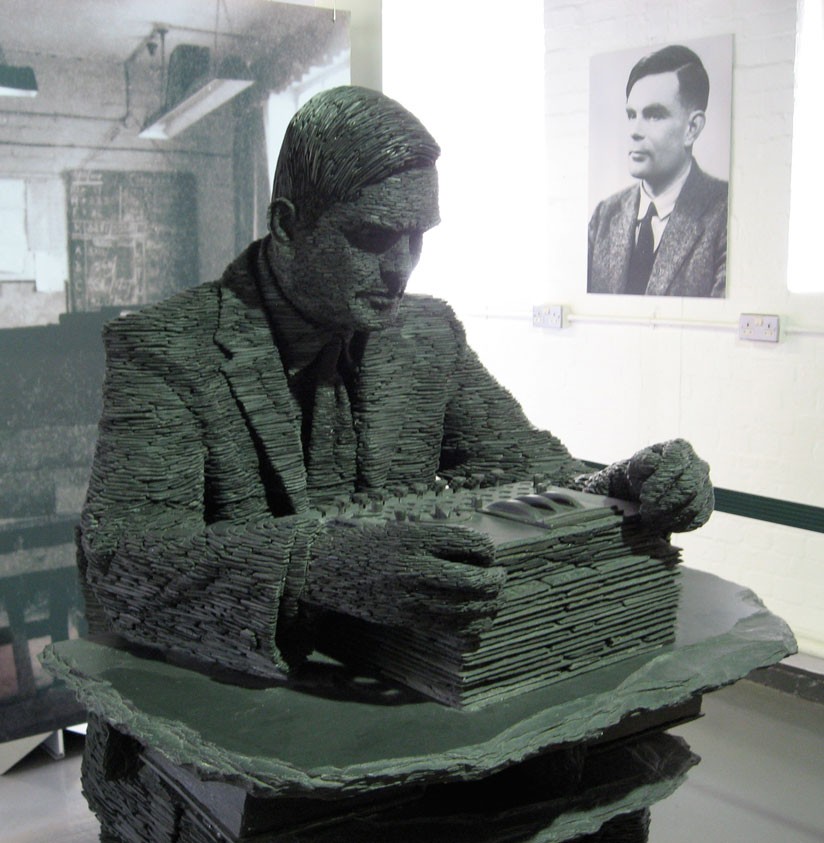
Code-breaking technology

During World War II (1939–45), Turing worked for the Government Code and Cypher School (GC&CS) at Bletchley Park—Britain's code-breaking centre. He devised a number of techniques for breaking German codes, working with, and improving on, electro-mechanical machines known as bombes to decipher intercepted secret messages that had been encoded by the German Enigma machines. The success Turing's team had in decoding German messages enabled the Allies to defeat Nazi Germany in several crucial battles of World War II.
Automatic Computing Machine
After the war, Turing concentrated on developing a machine that could process information in a logical way, and at high speed. At the National Physical Laboratory he made the first designs for a stored-program digital computer: the Automatic Computing Machine (ACE). A prototype was built in 1950 after he had left the laboratory.
Consultant: Dave Hawksett
pics
Without in any way limiting Q-files Ltd’s exclusive rights under copyright, any use of this publication to “train” generative artificial intelligence (AI) technologies to generate text is expressly prohibited. Q-files Ltd reserves all rights to license use of this work for generative AI training and development of machine learning language models.