
Europe

CITE
We have made every effort to follow citation style rules, but there may be some minor differences. If in doubt, please refer to the appropriate citation style manual.
Europe in the Late Middle Ages. (2025). In Q-files Encyclopedia, History, Europe. Retrieved from
https://www.q-files.com/history/europe/europe-in-the-late-middle-ages
"Europe in the Late Middle Ages." History, Europe, Q-files Encyclopedia, 7 Nov. 2025.
https://www.q-files.com/history/europe/europe-in-the-late-middle-ages.
Accessed 22 Sep. 2026.
Europe in the Late Middle Ages 2025. History, Europe. Retrieved 22 September 2026, from
https://www.q-files.com/history/europe/europe-in-the-late-middle-ages
History, Europe, s.v. "Europe in the Late Middle Ages," accessed September 22, 2026.
https://www.q-files.com/history/europe/europe-in-the-late-middle-ages


Europe in the Late Middle Ages
Kingdoms such as England, France and the Christian kingdoms of the Iberian Peninsula (Aragon, Castile and Portugal) continued to gain power in the Late Middle Ages (1250–1500). The long conflicts of this period strengthened royal control over their kingdoms, while weakening that of the feudal lords. But paying for the wars required taxing the population. This led to the creation of assemblies to represent the taxpayers, such as the English Parliament and, for a short time, the French Estates General. Because monarchs needed their consent to raise taxes, some of these parliaments began to gain power.


Trade
On the shores of the Baltic Sea, in central and northern Italy and in Flanders, the growth of towns in the Middle Ages led to increased trade between them. The Baltic cities traded with one another as the Hanseatic League, while the Italian Maritime Republics, including Venice, Genoa and Pisa, expanded trade throughout the Mediterranean Sea. In the late 13th century, new land and sea routes to the Far East were opened up, with the Venetian Marco Polo one of the first to travel along them.

Famine, disease and revolt
The first years of the 14th century were marked by famines, most catastrophically the Great Famine of 1315–17. At this time, the Medieval Warm Period had begun to give way to the Little Ice Age, a cooler period and much less favourable for agriculture. The Great Famine started with long periods of unusually heavy rain. The resulting widespread crop failures and cattle disease caused a severe lack of food across northern Europe.


This was followed in 1347 by the Black Death, a pandemic that spread throughout Europe and raged until 1350. The death toll was enormous—anywhere between about 35 and 50 million people in Europe, or between about one third and a half of the entire population. Towns were especially hard-hit because of their crowded, unhygienic conditions. After the plague faded, workers' wages rose as landowners competed with one another to hire farmworkers, now far fewer in number.
Popular uprisings broke out across Europe as the nobility tried to re-assert their dominance. They included the Jacquerie in France (1358) and the Peasants' Revolt in England (1381). Other rebellions broke out in the city of Florence in Italy, and Ghent and Bruges in Flanders.


Hundred Years' War
Throughout the 14th century, French kings sought to strengthen their authority at the expense of the powerful noble families. When they tried to to confiscate the lands of the English kings in southwestern France, war broke out between the two countries in 1337. Known as the Hundred Years' War, it would drag on for more than a century. To begin with, the English under Edward III (1327–77) and his son Edward, the Black Prince, gained the upper hand, winning battles at Crécy (1346) and Poitiers (1356).
The Battle of Crécy—in which Welsh and English longbowmen routed the French crossbowmen—caused a heavy loss of life among the French troops. The English then laid siege to the nearby port of Calais, taking it the following year. They were now in control of much of France.
The French fought back in the late 1420s with the military gains made by Joan of Arc. The English were decisively defeated at the Battle of Castillon in 1453, losing Gascony, their last remaining possession (apart from Calais) in France. Two years later a long civil war known as the Wars of the Roses broke out in England. It ended only after Henry Tudor defeated Richard III at the Battle of Bosworth in 1485. He was then crowned King Henry VII.


Kalmar Union
The Scandinavian nobility feared the Hanseatic League, the association of north German towns and traders, might extend its influence to the northern shores of the Baltic Sea. Margaret I of Denmark (1387–1412, also known as Margrete) had married King Haakon VI of Norway and Sweden. She declared her great-nephew Eric of Pomerania to be her heir, and he was proclaimed King of Norway in 1389. Eric then became King of Denmark and Sweden in 1396 and his coronation was held in Kalmar, Sweden, in 1397. Thus Norway—along with its colonies of Iceland, Greenland, the Faroe Islands, Orkney and Shetland—and Sweden (then including most of present-day Finland) became united with Denmark. The Kalmar Union, which comprised nearly all the Nordic lands, lasted until 1523, when Gustav Vasa became King of Sweden. Norway and Denmark remained united until 1814.
Balkan empires
In 1261, the Byzantine Empire recaptured Constantinople from the Crusaders (who had seized it in 1204). But much of the former empire's territory remained in enemy hands. Its Balkan lands (southeastern Europe) were divided up between rival powers in the region: the Serbian Empire under Stefan Dušan (1331–55), the Bulgarian Empire and the Republic of Venice.


Meanwhile, a powerful Turkish tribe, the Ottomans, who had established themselves in Anatolia (the Asian part of Turkey today) in the 13th century, started to expand their territory in the 14th. The Ottomans crossed into Europe to invade the Balkans, first overcoming Bulgaria in 1388, then taking over Serbia after defeating their forces at the Battle of Kosovo in 1389. Western Europeans launched a new crusade against this new Turkish threat, but their forces were routed by the Ottoman army at the Battle of Nicopolis in 1396. Constantinople was captured by the Ottomans in 1453, finally ending the Byzantine Empire.
Genoa
The fierce commercial rivalry between the maritime republics of Venice and Genoa continued through the Late Middle Ages. They fought each other in several wars between 1256 and 1381. Venice had gained control of much of the Eastern Mediterranean trade following the Crusaders' sacking of Constantinople in 1204 and the establishment of the new Latin Empire. Genoa, however, made an alliance with the Empire of Nicaea, a surviving remnant of the Byzantine Empire, which succeeded in recapturing Constantinople in 1261.


Genoa was richly rewarded from its alliance: the restored Byzantine Empire granted it ports in many islands and settlements in the Aegean Sea, greatly increasing Genoa's wealth and power. Genoa conquered parts of Crimea on the Black Sea and established its colony of Kaffa (or Caffa, present-day Feodosiya) there in the 1260s. Genoa later defeated another rival, the city-state of Pisa, at the naval battle of Meloria in 1284, thereby gaining control of Corsica and parts of Sardinia. Genoese merchants also set up trading posts on the island of Sicily and in Muslim North Africa.
Having gained supremacy over its rival Venice by the late 13th century, Genoa went into decline in the 14th. Defeat to Venice in the War of Chioggia (1379–81) and the growing power of the Ottoman Empire deprived Genoa its influence in the Eastern Mediterranean. By the early 15th century it had lost all its colonies and come under the control of first France then Milan. Genoa's newly founded banks, however, brought it prosperity in later centuries.
Venice
During the 14th and early 15th centuries, the Republic of Venice started to acquire territory on the mainland of Italy. It also expanded along the Dalmatian coast (the east coast of the Adriatic Sea) from Istria to Albania. With its powerful navy of 3300 ships, Venice was more than a match for its rivals—the Duchy of Milan and the Republic of Genoa to the west and the Kingdom of Hungary to the east. A new threat to its power, however, emerged during the Late Middle Ages: the Ottoman Empire. For the rest of the 15th century, Venice and the Ottomans fought a series of wars over control of the Aegean, Ionian and Adriatic seas.


Schism and rebellion
Disputes within the leadership of the Catholic Church led to the Avignon Papacy of 1309–76, and then to the Great (or Western) Schism, which lasted from 1378 to 1417. This was a split within the Church, during which there were two popes, one in Rome, one in Avignon, each claiming to be the true pope. (They were even joined by a third claimant from Pisa in 1409.) The split finally came to an end in 1417 when the Council of Constance elected Martin V as pope.

The Catholic Church was also shaken by rebellious movements. One of them was the Lollards, who were led by the English theologian John Wycliffe (died 1384). He was condemned as a heretic (someone who holds different views to those in authority) in 1415 for questioning the privileged status of the clergy (church leaders). Wycliffe insisted that the Bible should be translated into languages other than Latin so that the laity (ordinary church members) could read it.
Wycliffe's teachings influenced another rebellious group from Bohemia, known as the Hussites. They followed the teaching of Jan Hus, who was burned at the stake in 1415, after being condemned as a heretic by the Council of Constance.


Catholic Monarchs
With the marriage of King Ferdinand II of Aragon and Queen Isabella I of Castile in 1469, Spain became unified under a single monarchy (although Castile and Aragon remained separate kingdoms until much later). Known as the Catholic Monarchs, they set about stamping their authority by establishing the Spanish Inquisition in 1478. This made sure that Jews and Muslims who converted to Christianity did not revert to their previous faiths. Following a victory over Muslim forces in the south by the Catholic Monarchs in the Granada War of 1492, Muslim rule in Spain was finally ended.
Flight of the Jews
Jews had migrated across Europe during the High Middle Ages, establishing communities in Germany and England in the 11th and 12th centuries. But Spanish Jews, who had long settled in Spain under Muslim rule, came under increasing pressure to convert to Christianity as more and more of Spain came under the rule of Christian monarchs during the Reconquista. Jews in other parts of Christian Europe also became subjected to persecution.
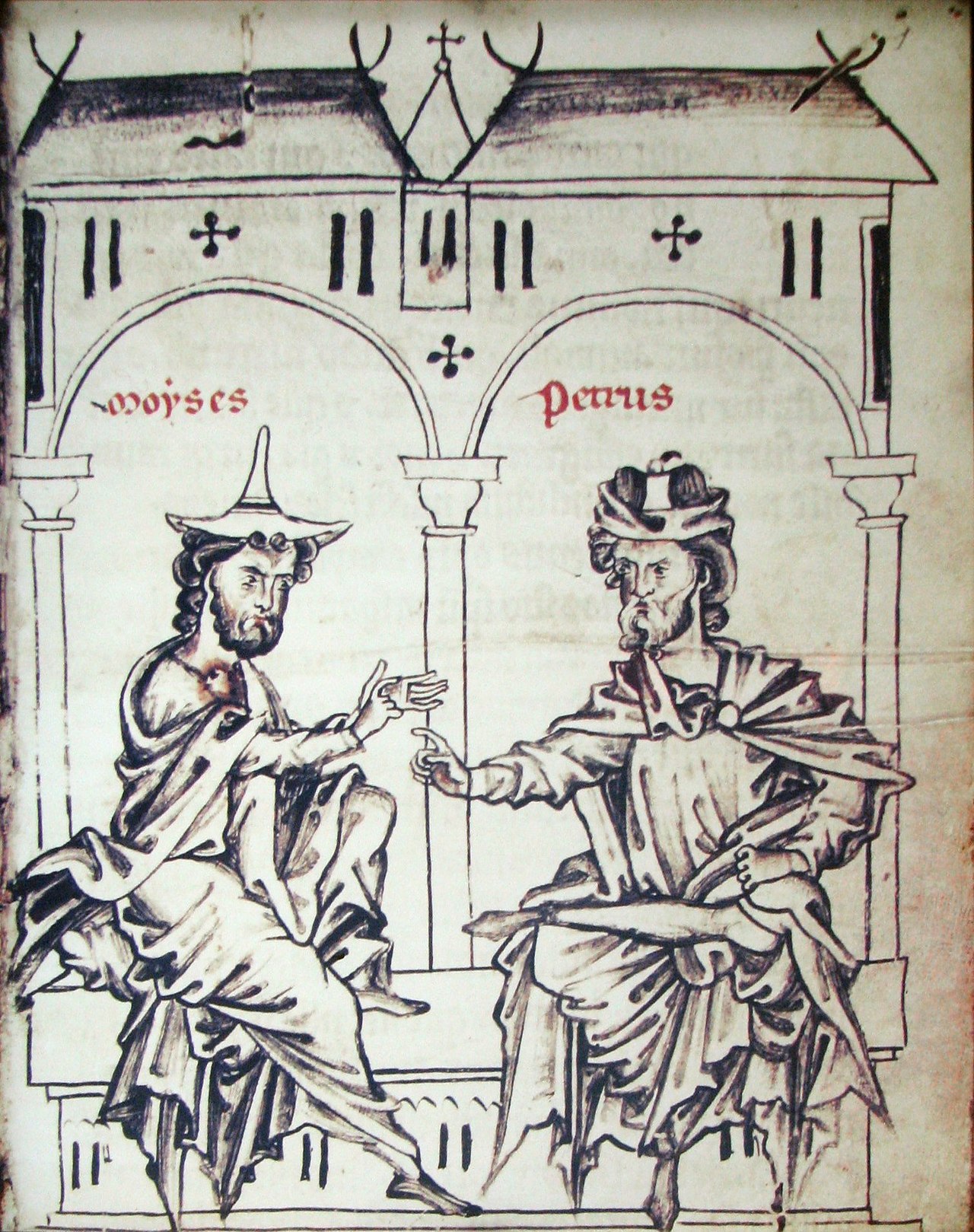
The final defeat of the Crusaders in the Holy Land in the late 13th century triggered mass expulsions of Jews: from England in 1290, France in 1394 and from Austria in 1421. Many Jews migrated to Hungary or Poland. By the Alhambra Decree of 1492, the Jews of Spain were forced to convert to Christianity or face expulsion. Most fled to Portugal (where they were forcibly converted to Christianity or expelled in 1496–97), the Ottoman Empire, North Africa and the Kingdom of Naples.

Voyages of discovery
Portugal became a maritime power during the 15th century, and concentrated on building trading links beyond Europe. Prince Henry the Navigator (died 1460) sent expeditions out into the Atlantic Ocean, which led to the discovery of the Canary Islands, the Azores and Cape Verde Islands during his lifetime. After his death, exploration continued and became more adventurous. In 1488 Bartolomeu Dias became the first European to round the Cape of Good Hope and Vasco da Gama sailed around Africa to India in 1498. Meanwhile, Ferdinand of Aragon and Isabella of Castile agreed to sponsor (provide funds for) the voyage of exploration carried out by Christopher Columbus in 1492 that led to the European discovery of the Americas.
Consultant: Philip Parker
pics


Without in any way limiting Q-files Ltd’s exclusive rights under copyright, any use of this publication to “train” generative artificial intelligence (AI) technologies to generate text is expressly prohibited. Q-files Ltd reserves all rights to license use of this work for generative AI training and development of machine learning language models.