
British kings and queens

CITE
We have made every effort to follow citation style rules, but there may be some minor differences. If in doubt, please refer to the appropriate citation style manual.
Tudor kings and queens. (2026). In Q-files Encyclopedia, History, British kings and queens. Retrieved from
https://www.q-files.com/history/british-kings-and-queens/tudor-kings-and-queens
"Tudor kings and queens." History, British kings and queens, Q-files Encyclopedia, 30 Mar. 2026.
https://www.q-files.com/history/british-kings-and-queens/tudor-kings-and-queens.
Accessed 13 Sep. 2026.
Tudor kings and queens 2026. History, British kings and queens. Retrieved 13 September 2026, from
https://www.q-files.com/history/british-kings-and-queens/tudor-kings-and-queens
History, British kings and queens, s.v. "Tudor kings and queens," accessed September 13, 2026.
https://www.q-files.com/history/british-kings-and-queens/tudor-kings-and-queens


Tudor kings and queens
Henry VII (1485–1509)
Descended from the independent princes of Wales, Henry Tudor was the Lancastrian claimant to the throne of England occupied by Richard III, a member of the rival Yorkist family. Henry defeated Richard's forces at the Battle of Bosworth in 1485. After the battle, Henry was crowned King Henry VII, the first Tudor king of England. Soon after he became king, Henry married Elizabeth of York, daughter of a previous Yorkist king, Edward IV. The marriage ended the rivalry between the houses of Lancaster and York. To symbolize the union, he took as his badge the Tudor rose, which incorporated both the white rose of York and the red rose of Lancaster in one flower.


Henry's reign was plagued by conspiracies in which others still pursued a claim to the throne. First, in 1487, Lambert Simnel, a 10-year-old boy, posing as Edward Plantagenet, Earl of Warwick, became the figurehead of a Yorkist rebellion. This was defeated in June of that year at the Battle of Stoke Field, Nottinghamshire. Henry pardoned young Simnel and put him to work in the royal kitchen as a scullion (a spit-turner).
A more serious threat was posed by Perkin Warbeck, who claimed to be Richard, Duke of York, the second son of Edward IV and one of the "Princes in the Tower". Warbeck received some support from Yorkists, James IV of Scotland and rebels in Cornwall. Backed by small armies, he made several landings in England. Captured by Henry's men in Hampshire in October 1497, he confessed to being an impostor and was hanged.
Henry was a skilful king. He reduced the power of the troublesome nobility and increased the wealth of the Crown by enforcing royal taxes and pursuing peaceful policies. By securing treaties with France and the Netherlands and arranging the marriage of his daughter, Margaret Tudor, to James IV of Scotland, he secured peace with countries that might otherwise threaten England. He set up the Court of Star Chamber to deal with judicial matters, helping to significantly increase the power of the monarchy at the expense of the barons. He died of tuberculosis in 1509, leaving behind a secure throne and a prosperous country.

Henry VIII (1509–1547)
Henry VIII was the second Tudor monarch. He is well known for having six wives: Catherine of Aragon, Anne Boleyn, Jane Seymour, Anne of Cleves, Catherine Howard and Catherine Parr. Henry VIII’s first wife, Catherine of Aragon, bore him only a daughter and not the son he had hoped for. Henry therefore tried to annul, or cancel, the marriage on the grounds that Catherine had previously been married to his brother, Arthur. He also wished to marry his mistress Anne Boleyn, who insisted on becoming queen.
Henry had to receive the approval of the Pope, Clement VII, but he refused to agree to the annulment. So, on the advice of his chief minister, Thomas Cromwell, Henry declared himself Supreme Head of the English Church in 1534 and broke off all relations with Rome so he could marry Anne. During what was known as the Dissolution of the Monasteries (1536–1540), Cromwell closed and demolished around 800 abbeys, monasteries, friaries and nunneries in England, Wales and Ireland. Henry established the Church of England and began the English Protestant Reformation, an event of crucial importance for the later history of England and the monarchy.
Overweight and in failing health, Henry turned his attention to attacking France in the last years of his reign. But the war proved an expensive failure. Henry died in London in January 1547.
Edward VI (1547–1553)
Edward VI was the only legitimate son of Henry VIII. From birth, Edward’s health was never strong. He became king at the age of nine, with his uncle, Edward Seymour, Duke of Somerset, as Lord Protector. Together with Thomas Cranmer, Archbishop of Canterbury, Seymour wanted to make England a Protestant state, backed by the young king. An English Prayer Book was issued in 1549.
After putting down a rebellion in Norfolk, John Dudley, Earl of Warwick, took over as Edward’s chief minister—effectively, ruler of England—in 1549. Protestant reform was stepped up even more. Now Duke of Northumberland, Dudley became concerned that his reforms should not be reversed after the sickly Edward’s likely early death, so he persuaded Edward to approve a new successor. His sister Mary was declared illegitimate, so the throne would pass to Northumberland's daughter-in-law, Lady Jane Grey, a great-granddaughter of Henry VII. Jane was queen for only a few days until, with great popular support, Mary took the throne.

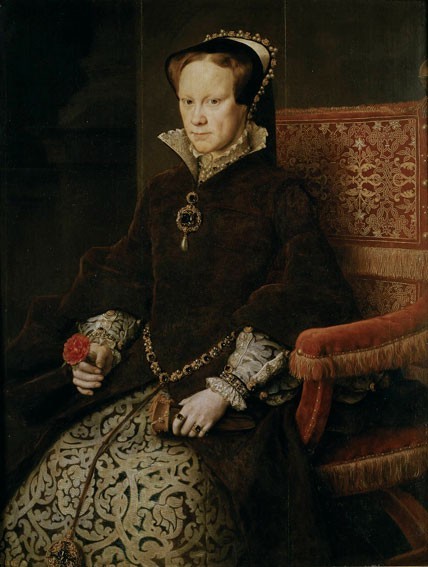
Mary I (1553–1558)
Mary was the first queen to rule England in her own right. She was the only surviving child of Henry VIII and Catherine of Aragon. After Anne Boleyn bore Henry another daughter, Elizabeth, Mary was stripped of her title of princess. With Anne Boleyn's fall, however, she was named as second in line to the throne after her younger brother Edward.
On Edward VI’s early death at the age of 15 from tuberculosis in 1553, Lady Jane Grey was declared queen. Mary, however, had widespread popular support and within days she took the throne. She was determined to re-impose Catholicism and marry Philip II of Spain, who was widely resented in England.
During Mary’s reign, the Pope's control over the Church was restored, Protestant laws brought in during the reign of Edward VI were repealed (cancelled) and hundreds of Protestants were burned at the stake for heresy. They included the Oxford Martyrs: Thomas Cranmer, Archbishop of Canterbury, and the Anglican bishops Hugh Latimer and Nicholas Ridley. For these deeds, Mary became known as "Bloody Mary". Her rapidly growing unpopularity was deepened by an unsuccessful war against France, which led to the loss of Calais, England's last possession in France, in January 1558. Deserted by her husband Philip, Mary died childless in November 1558.


Elizabeth I (1558–1603)
During Elizabeth’s reign, trade expanded overseas and England became rich. It was a Golden Age in art, theatre and music. After Elizabeth sent help to Dutch rebels fighting for independence from Spain, and executed her Catholic cousin, Mary, Queen of Scots, for treason, Philip II of Spain sent a huge fleet, the Spanish Armada, to invade England in 1588. It was successfully repelled in a great victory for the English navy. Elizabeth never married. When she died in 1603 without any children, the English throne passed to James VI of Scotland.
Elizabeth I had a difficult early life. Her mother, Anne Boleyn, had been executed when she was not yet three, and her half-sister, Mary, had imprisoned her during her reign. She came to the throne on Mary’s death in 1558 and proved to be a strong and highly popular monarch. Elizabeth was a shrewd woman who spoke six languages fluently. She chose extremely able ministers carefully, including William Cecil, Lord Burghley, who was her closest adviser almost throughout her reign, and Sir Francis Walsingham, her spymaster. During Elizabeth's reign, England became a Protestant nation again. William Shakespeare wrote many of his plays in Elizabeth's later years, and composers such as William Byrd and Thomas Tallis worked in Elizabeth's court.


Elizabeth never married, despite attention from many princes and lords. She was threatened by attack from Spain as well as a number of plots against her, principally from Catholics intent on putting Mary, Queen of Scots on the English throne. Elizabeth had Mary imprisoned, and eventually Mary was tried for treason and executed in 1587. The Spanish king, Philip II, had been married to Elizabeth’s half-sister, Mary, and expected good relations to continue between Spain and England after her death. But Elizabeth was a Protestant and feared Spanish and Catholic power. Philip launched the Spanish Armada in an attempt to conquer England in 1588. But it was defeated at the Battle of Gravelines by the English navy under the command of Lord Howard of Effingham and Sir Francis Drake.
Consultant: Philip Parker
pics

Without in any way limiting Q-files Ltd’s exclusive rights under copyright, any use of this publication to “train” generative artificial intelligence (AI) technologies to generate text is expressly prohibited. Q-files Ltd reserves all rights to license use of this work for generative AI training and development of machine learning language models.