
British kings and queens

CITE
We have made every effort to follow citation style rules, but there may be some minor differences. If in doubt, please refer to the appropriate citation style manual.
The story of the British monarchy. (2026). In Q-files Encyclopedia, History, British kings and queens. Retrieved from
https://www.q-files.com/history/british-kings-and-queens/the-story-of-the-british-monarchy
"The story of the British monarchy." History, British kings and queens, Q-files Encyclopedia, 30 Mar. 2026.
https://www.q-files.com/history/british-kings-and-queens/the-story-of-the-british-monarchy.
Accessed 30 Oct. 2026.
The story of the British monarchy 2026. History, British kings and queens. Retrieved 30 October 2026, from
https://www.q-files.com/history/british-kings-and-queens/the-story-of-the-british-monarchy
History, British kings and queens, s.v. "The story of the British monarchy," accessed October 30, 2026.
https://www.q-files.com/history/british-kings-and-queens/the-story-of-the-british-monarchy


The story of the British monarchy
After the Romans withdrew from Britannia in around AD 410, the Britons organized themselves into small kingdoms. They needed to protect themselves from invaders such as the Picts from beyond Hadrian's Wall in the north, the Scots from Ireland and Germanic tribes from the European continent. King Arthur may have been a leader of one these kingdoms during this period, although he is more likely to have been a legendary figure. The peoples who later invaded and settled in Britain started to form new kingdoms of their own, for example, the Angles in Mercia and East Anglia. But some ancient British kingdoms, such as Strathclyde, survived. By 650, Britain had become a patchwork of kingdoms. A few, including Northumbria, Mercia and Wessex, became dominant, by means of warfare or through marriages between ruling families. To resist the invading Vikings in the 9th century, however, the British kingdoms were forced to unite.


Scottish monarchs
Before the 9th century AD, Scotland was occupied by five different peoples. The Picts lived in to the north of the rivers Forth and Clyde. The Scots, who had arrived from Ireland in the fifth and sixth centuries, ruled Dalriada in the west. The Angles occupied Lothian, the ancient Britons held Strathclyde, and, in the ninth century, the Vikings started to settle in Orkney, Shetland, the Western Isles and the far north. The unification of these different peoples began in the mid-ninth century, when Kenneth MacAlpin became king of both Picts and Scots.
English monarchs
By the early 600s, the invading Anglo-Saxons had established seven main independent kingdoms in England. The seven—Kent, Sussex, Wessex in the south, Essex, East Anglia, Mercia in the midlands, and Northumbria in the north—continually fought each other for power. Northumbria dominated at first, then Mercia. After the death in 796 of the Mercian king Offa (who had married his daughters to the kings of Wessex and Northumbria and had established supremacy over England south of the Humber), Wessex became the most important kingdom and gave a united England its first kings.

Union of the Crowns
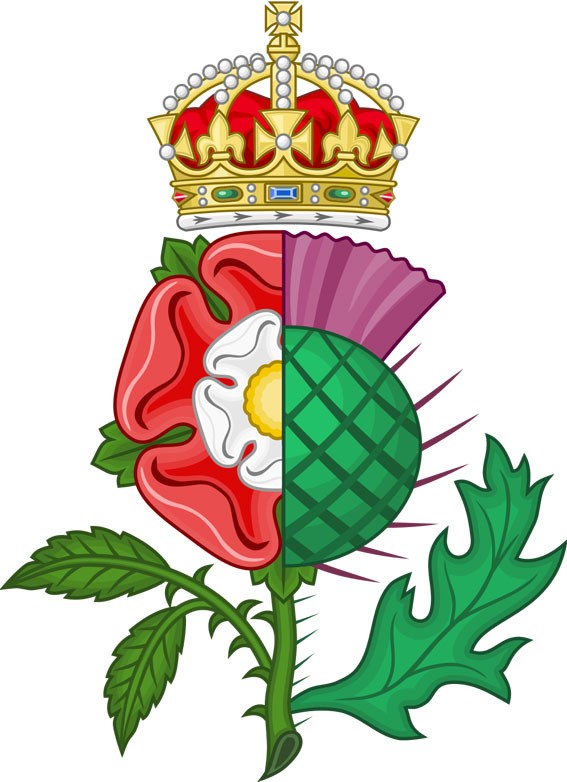
Conflict between Scottish and English monarchs persisted over the centuries, and deepened in the late 13th century, the time of the Scottish Wars of Independence, until the beginning of the 17th century. It was through the Stewart dynasty that the two thrones of England and Scotland—and later their governments—came to be united. A “Marriage of the Thistle and the Rose” (after the symbols of Scotland and England) took place at Stirling Castle in 1503 between King James IV of Scotland and Princess Margaret Tudor, daughter of King Henry VII of England. This union of the Scottish and English royal families eventually led to the the Union of the Crowns in 1603 when a Stewart (or Stuart) succeeded to the throne of England. He was King James VI of Scotland, who became James I of England.
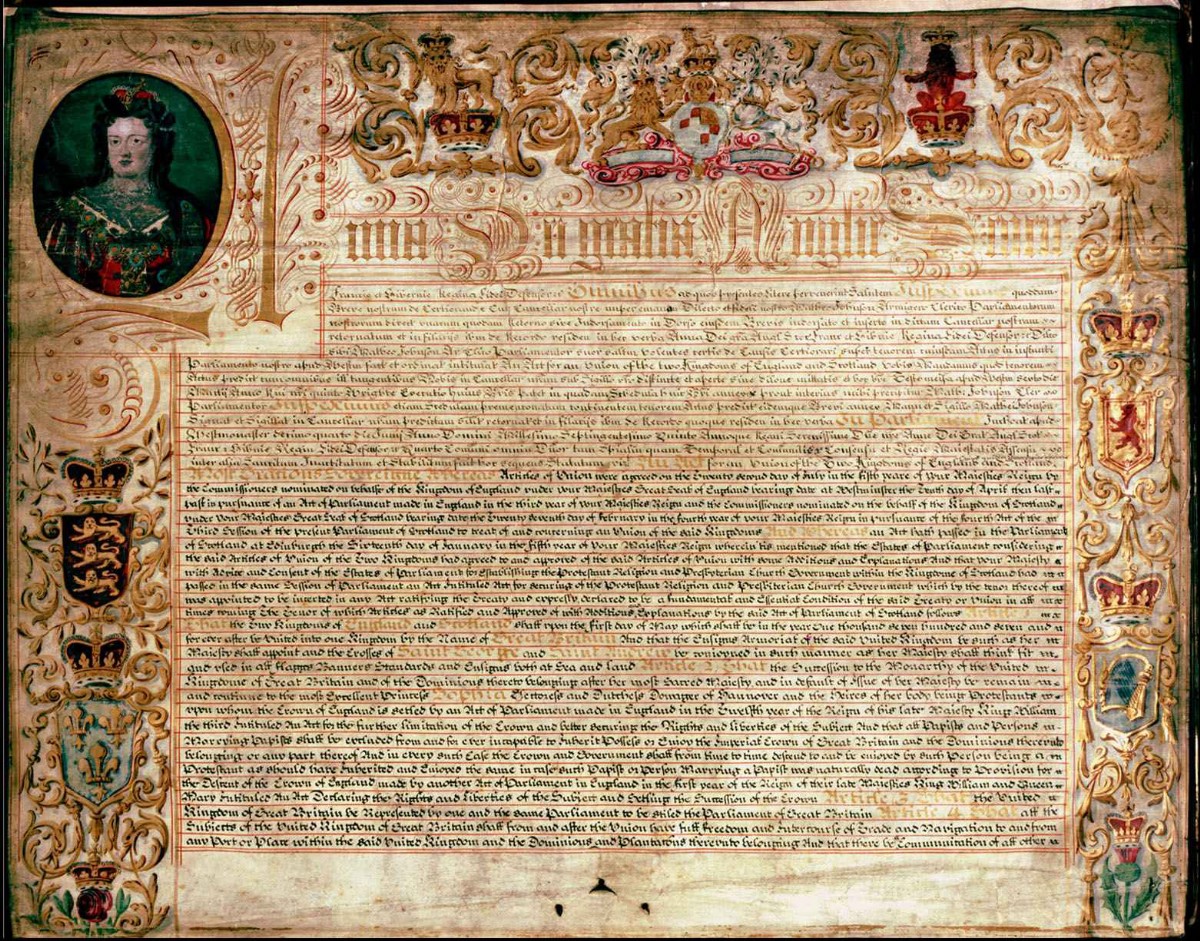
The Stuarts were monarchs of both England and Scotland, but the countries remained separate kingdoms. It was more than a century later, during Queen Anne's reign, that the union between England and Scotland took place. From then on, a British Parliament, including MPs from both England and Scotland, sat at Westminster, and there was a common flag and coinage. Scotland, however, kept its own established Church and its legal and educational systems. After the Treaty of Union came into effect on 1st May 1707, the United Kingdom had a single monarch.
Consultant: Philip Parker
pics
Without in any way limiting Q-files Ltd’s exclusive rights under copyright, any use of this publication to “train” generative artificial intelligence (AI) technologies to generate text is expressly prohibited. Q-files Ltd reserves all rights to license use of this work for generative AI training and development of machine learning language models.