
British history

CITE
We have made every effort to follow citation style rules, but there may be some minor differences. If in doubt, please refer to the appropriate citation style manual.
Tudors. (2026). In Q-files Encyclopedia, History, British history. Retrieved from
https://www.q-files.com/history/british-history/tudors
"Tudors." History, British history, Q-files Encyclopedia, 30 Mar. 2026.
https://www.q-files.com/history/british-history/tudors.
Accessed 26 Oct. 2026.
Tudors 2026. History, British history. Retrieved 26 October 2026, from
https://www.q-files.com/history/british-history/tudors
History, British history, s.v. "Tudors," accessed October 26, 2026.
https://www.q-files.com/history/british-history/tudors


Tudors
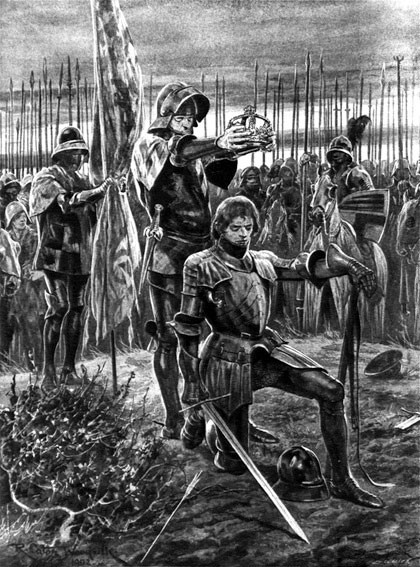
Henry Tudor was descended from the independent princes of Wales and was the Lancastrian claimant to the throne of England occupied by Richard III, a member of the rival Yorkist family. He defeated Richard's forces at the Battle of Bosworth in 1485. After the battle, Henry was crowned King Henry VII, the first Tudor king of England. During the Tudor period, which lasted until 1603, England became a Protestant country, defeated a Spanish invasion and laid the foundations for becoming one of the dominant nations in the world.
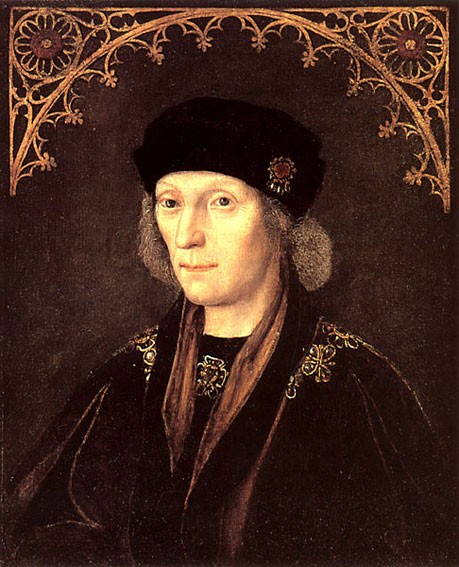
Henry VII
Soon after he became king, Henry married Elizabeth of York, daughter of a previous Yorkist king, Edward IV. The marriage ended the rivalry between the houses of Lancaster and York. To symbolize the union, he took as his badge the Tudor rose, which incorporated both the white rose of York and the red rose of Lancaster in one flower. Henry was a very skilful king, reducing the power of the troublesome nobility and increasing the wealth of the king by pursuing peaceful policies. He died in 1509.
The six wives of
Henry VIII
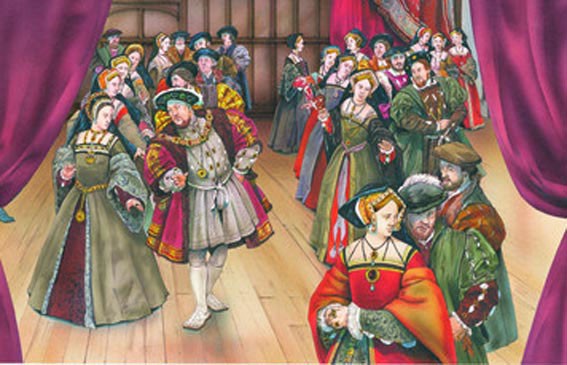
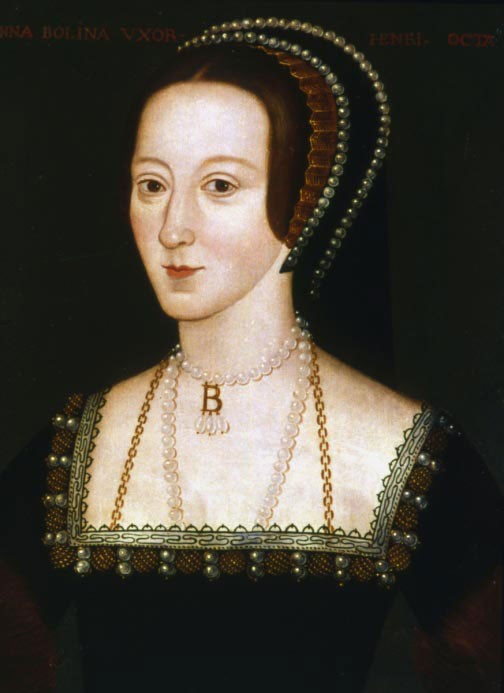
Henry VIII, who ruled England from 1509 to 1547, was the most married king in English history. In 1509, he married Catherine of Aragon, the former wife of his dead brother, but he divorced her in 1533 after she only produced a daughter, Mary. Henry then married Anne Boleyn, but she too only produced a daughter, Elizabeth, and was executed for treason in 1536. The same year he married Jane Seymour, who gave birth to a much wanted son, Edward, in 1537. Unfortunately she died soon after childbirth.
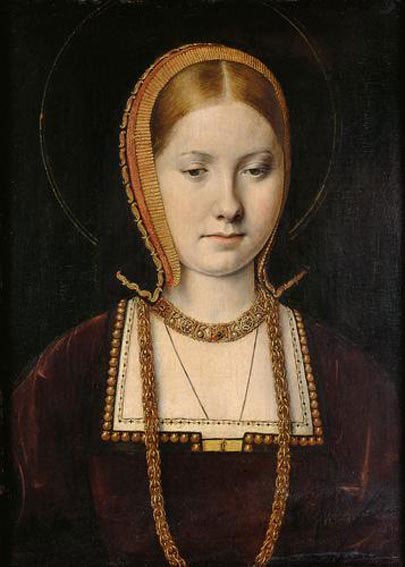
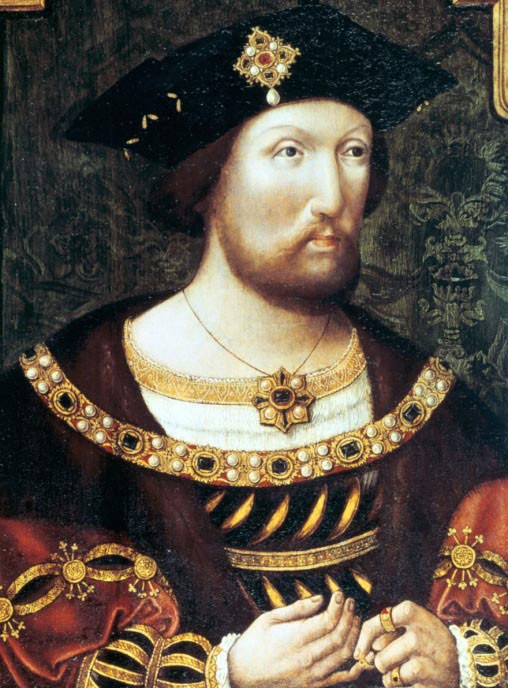
In 1540, Henry undertook an arranged marriage with a German princess, Anne of Cleves, but it was not a success and they soon parted. His fifth wife was Catherine Howard, whom he also married in 1540, but she continued to see her young lovers and was executed for treason in 1542.
Finally, in 1543, Henry married Catherine Parr, who outlived him on his death in 1547. She was also the most married English queen, as she had four husbands in total.
Dissolution of the Monasteries
Henry VIII’s first wife, Catherine of Aragon, bore him only a daughter and not the son he had hoped for. Henry therefore tried to annul, or cancel, the marriage on the grounds that Catherine had previously been married to his brother, Arthur. He also wished to marry his mistress Anne Boleyn, who insisted on becoming queen.
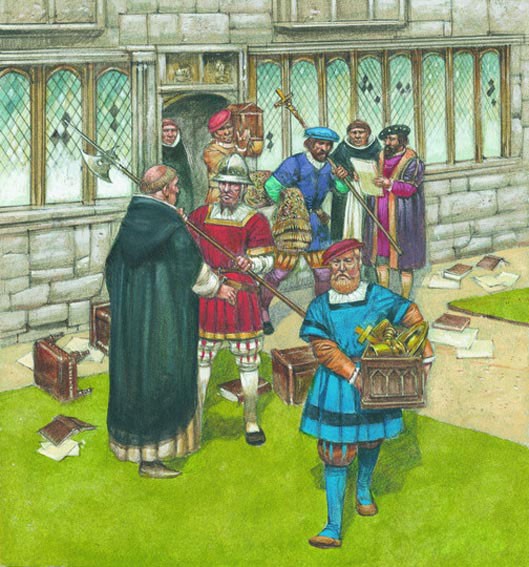
Henry had to receive the approval of the Pope, Clement VII, but he refused to agree to the annulment. So, on the advice of his chief minister, Thomas Cromwell, Henry declared himself Supreme Head of the English Church in 1534 and broke off all relations with Rome so he could marry Anne. During what was known as the Dissolution of the Monasteries (1536–1540), Cromwell closed and demolished around 800 abbeys, monasteries, friaries and nunneries in England, Wales and Ireland. Many of them possessed great wealth and land, which all became the property of the Crown.
At first, the new Church remained Catholic in its teachings, but during the reign of Henry's son Edward VI and, later, his daughter Elizabeth I, it became increasingly Protestant.
Mary I
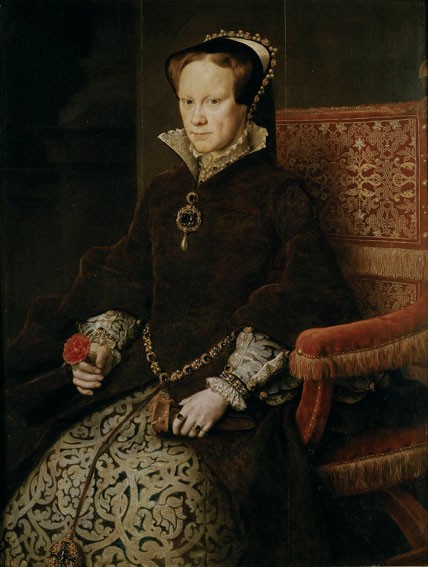
When Henry’s oldest daughter Mary became queen in 1553, after the death of her 15-year-old brother Edward, she returned England to Roman Catholicism. She also married Philip II of Spain, who was a Catholic. The Pope's control over the Church was restored, Protestant laws brought in during the reign of Edward VI were repealed (cancelled), and numerous Protestants, including the former Archbishop of Canterbury, were burned at the stake for heresy. For these deeds, Mary became known as "Bloody Mary". She died childless in 1558.
Queen Elizabeth I
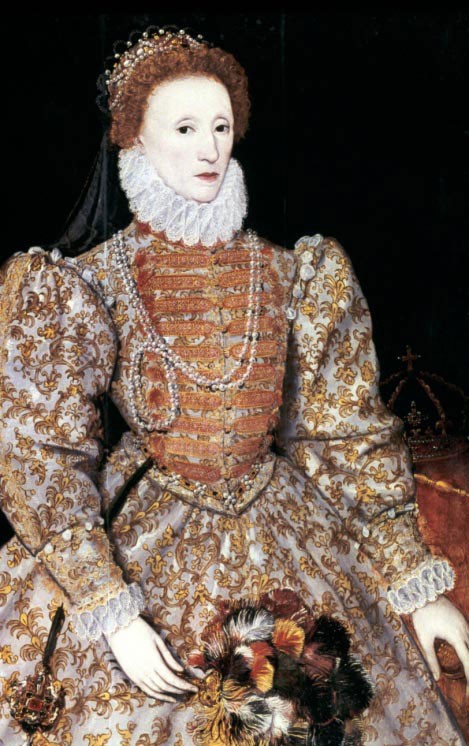
Elizabeth I had a difficult early life. Her mother, Anne Boleyn, had been executed when she was not yet three, and her half-sister, Mary, had imprisoned her during her reign. She came to the throne on Mary’s death in 1558 and proved to be a strong and very popular monarch. Elizabeth was a shrewd woman who spoke six languages fluently. She chose highly able ministers carefully, including William Cecil, Lord Burghley, who was her closest adviser almost throughout her reign, and Sir Francis Walsingham, her spymaster.
During her reign, England became a Protestant nation again. Trade expanded overseas and England became rich. William Shakespeare wrote many of his plays, and composers such as William Byrd and Thomas Tallis worked in Elizabeth's court. It was a Golden Age.
Elizabeth never married, despite attention from many princes and lords, as she said she was married to her kingdom. She was threatened by a number of plots against her, principally from Catholics intent on putting Mary, Queen of Scots on the English throne. Elizabeth had Mary imprisoned, and eventually Mary was tried for treason and executed in 1587.
The Spanish Armada
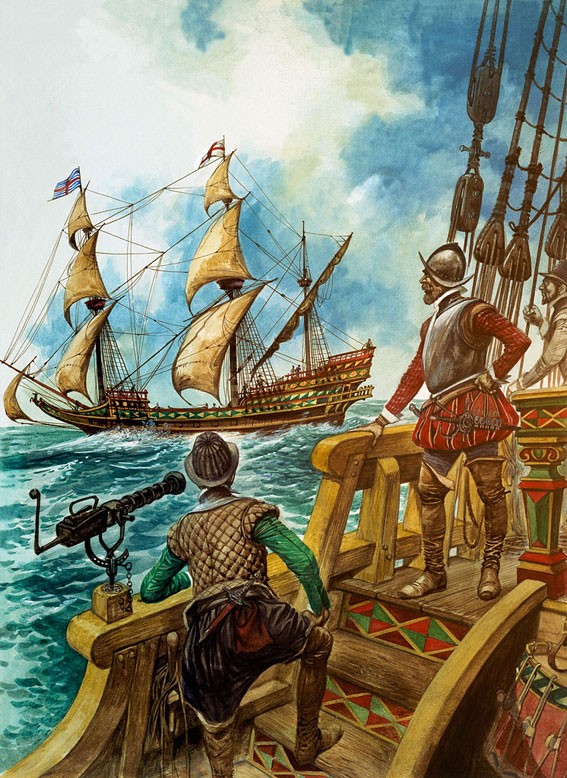
The Spanish king, Philip II, had been married to Elizabeth’s half-sister, Mary, and expected good relations to continue between Spain and England after her death. But Elizabeth was a Protestant and feared Spanish and Catholic power. After Elizabeth sent help to Dutch rebels fighting for independence from Spain, and executed her Catholic cousin, Mary Queen of Scots, for treason, Philip send a huge armada (fleet) to invade England in 1588.
The English navy was under the command of Lord Howard of Effingham and Sir Francis Drake. The navy's ships attacked and defeated the Spanish Armada in the English Channel—helped by bad weather. The Armada was forced to sail round Scotland, where many ships were wrecked. It was a great victory for the English navy against the superior might of Spain.
The Stuart succession
Elizabeth I’s aunt, Margaret Tudor, sister of Henry VIII, had married James IV of Scotland. When Elizabeth died in 1603 without any children, the English throne passed to Margaret’s great-grandson, James VI of Scotland. As James I of England, he became the first of the new line of Stuart kings that ruled both countries until 1714.
Consultant: Philip Parker
pics
Without in any way limiting Q-files Ltd’s exclusive rights under copyright, any use of this publication to “train” generative artificial intelligence (AI) technologies to generate text is expressly prohibited. Q-files Ltd reserves all rights to license use of this work for generative AI training and development of machine learning language models.