
British history

CITE
We have made every effort to follow citation style rules, but there may be some minor differences. If in doubt, please refer to the appropriate citation style manual.
Celtic Britain. (2026). In Q-files Encyclopedia, History, British history. Retrieved from
https://www.q-files.com/history/british-history/celtic-britain
"Celtic Britain." History, British history, Q-files Encyclopedia, 30 Mar. 2026.
https://www.q-files.com/history/british-history/celtic-britain.
Accessed 21 Sep. 2026.
Celtic Britain 2026. History, British history. Retrieved 21 September 2026, from
https://www.q-files.com/history/british-history/celtic-britain
History, British history, s.v. "Celtic Britain," accessed September 21, 2026.
https://www.q-files.com/history/british-history/celtic-britain


Celtic Britain
The people who lived in Britain before the Roman conquest are often described as Celts. They had similar languages, religions and lifestyles, but formed themselves into different tribes in different parts of the country, and waged war against one another. The tribes included the Trinovantes, Silures, Cornovii, Selgovae and the Iceni. The description of them as “Celts” was not introduced until the 18th century, when it was discovered that the languages they spoke were similar to those of the Gauls in France, who were named as Celts by the Greeks and Romans. Around 700 BC, the Celtic peoples of the British Isles introduced the metal iron to their homeland, along with the knowledge of how to use it and fashion it into weapons and tools. And so began the Iron Age in Britain.

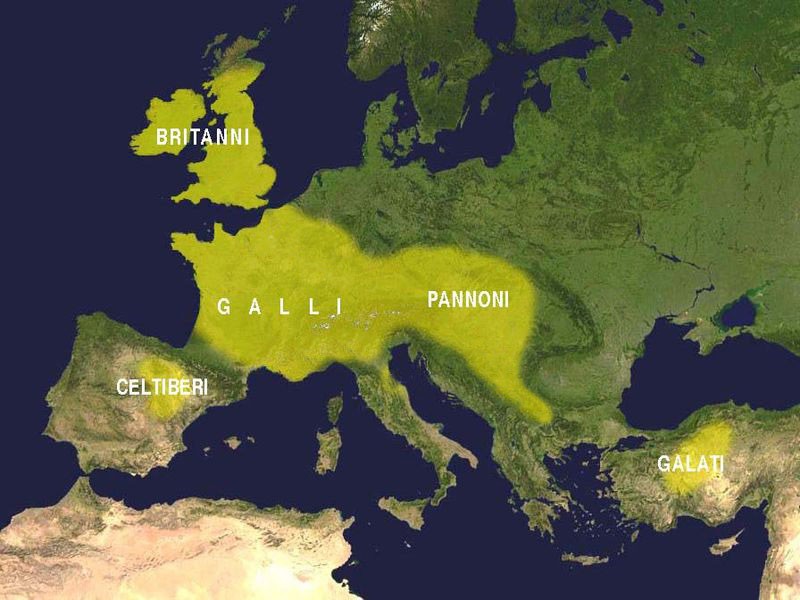
Who were the Celts?
The name “Celts” was first used around 500 BC by the ancient Greeks to describe peoples living in Europe north of the Alps, along with France, the Iberian Peninsula, Central Europe and the Balkans. To the Greeks, these “outsiders” or Keltoi, were uncivilized barbarians (although their art is nowadays considered the equal to that of the finest Greek and Roman artists). They were also skilled metalworkers and active traders.
Despite the fact their languages and culture were related, the Celts were actually many different peoples, among them the Gauls (Galli) who lived in what is now France and Belgium, and whom the Roman leader Julius Caesar fought and conquered during the Gallic Wars (58–50 BC).
The Celts in Britain
Some historians believe that Celtic peoples arrived in Britain perhaps over the course of several centuries, between about 750 and 50 BC. Other historians suggest that Celtic culture might have become more gradually introduced much earlier, during the Bronze Age (2500–700 BC)—and not with the arrival or invasions of Celts from continental Europe, but simply through close contacts between the peoples already living in Britain and Ireland and those who lived on the Atlantic coast of France, Spain and the Low Countries.


One way or the other, Celtic languages spread throughout the British Isles during the Iron Age (700–100 BC) and soon split into two major groups: the Goidelic Celts or Gaels (surviving today as the Irish, Scottish and Manx) and the Brythonic (Brittonic) Celts, or Britons (surviving today as the Welsh and Cornish—as well as the Bretons of Brittany in France). One group of Britons were the Picts, who lived in Eastern and Northern Scotland, but who eventually merged with the Gaels of Western Scotland.
Hillforts and villages

Celtic Britain saw a huge growth in the number of hillforts. They were often built on hilltops, where they were easier to defend. The circular forts were surrounded by a high fence and a series of ditches and ramparts. The forts often contained no source of water, however, so the fort-dwellers could not have settled in them for long.


People lived in round, window-less huts either clustered together inside forts or gathered more loosely in villages. The huts were made from wooden arches, with walls of wicker (flexible twigs, especially of willow) woven together to make wattle and covered with daub, a mixture of straw and mud. They had thatched roofs made from straw or heather. Some houses had walls built from stone held together with clay. Each house had a fire in the centre for cooking and heating.
Farming

The Celts were farmers who planted crops and raised livestock. Their iron ploughs made it possible for cultivate rich valley and lowland soils (whereas wooden ploughs used before could only till lighter upland soils). The ploughs required a team of eight oxen to pull them, so, in order to avoid the difficulties of having to turn the oxen, the fields were usually long and narrow. They grew wheat, barley and a wide range of vegetables.
Society
Celtic family life revolved around the clan, a kind of extended family. Clans, in turn, were grouped together with other clans for form tribes. Women were considered equal to men. They owned property, and could choose their own husbands. They could also be tribal leaders, as Boudicca (Boadicea) later proved.
Clothes
The Celts wore long-sleeved shirts or tunics, and long trousers, called bracae by the Romans. Their clothes were woven from wool and were brightly coloured using dyes made from plants and berries. In winter, they wore striped or chequered cloaks fastened at the shoulder with brooches. Nobles and chieftains wore torcs, ornamental neck-rings.


Religion
The Celts are said by the Romans to have held many of their religious ceremonies near sacred wells or springs. They believed in many gods and goddesses. The male gods were associated with particular skills, such Lugh and Dagda, while goddesses were often connected to rivers and wells.
The Druids were priests, teachers, poets and healers. In Celtic tribes they had great authority—sometimes being more powerful than the chieftain, king or queen.
Warriors
The Celts took great pride in their appearance in battle, their leaders proud to wear elaborate breastplates and helmets, whilst carrying shields and trumpets. Some ordinary soldiers might charge into battle completely naked, their bodies tattooed with blue dye called woad, swinging their long swords around their heads. Their frenzied fighting style inspired Roman writers to describe Celtic warriors as “wild beasts". Kings or queens favoured chariots, drawn by two horses, from which they would throw spears at an enemy before engaging with swords on foot.
A particularly savage Celtic practice was to cut off the heads of their enemies in battle and display them as trophies, for example, on doorposts or hung from belts. They saw this as a way of giving power to themselves.


Celts today
By around the 6th century AD, the expansion of the Roman Empire and the migration of Germanic peoples across Europe had restricted the Celtic peoples to Wales, Ireland, Scotland, the Isle of Man, Cornwall and Brittany, France. They are shown on this map: Wales (red), Ireland (green), Scotland (blue), Isle of Man (brown), Cornwall (yellow) and Brittany (black).
The original Celtic languages that are still spoken—or used to be—by people living in these places are related, as are many artistic and cultural traditions, but the ancestry of the people themselves is more complex.
Consultant: Philip Parker
pics

Without in any way limiting Q-files Ltd’s exclusive rights under copyright, any use of this publication to “train” generative artificial intelligence (AI) technologies to generate text is expressly prohibited. Q-files Ltd reserves all rights to license use of this work for generative AI training and development of machine learning language models.