
British history

CITE
We have made every effort to follow citation style rules, but there may be some minor differences. If in doubt, please refer to the appropriate citation style manual.
Bayeux Tapestry. (2026). In Q-files Encyclopedia, History, British history. Retrieved from
https://www.q-files.com/history/british-history/bayeux-tapestry
"Bayeux Tapestry." History, British history, Q-files Encyclopedia, 16 Sep. 2026.
https://www.q-files.com/history/british-history/bayeux-tapestry.
Accessed 21 Sep. 2026.
Bayeux Tapestry 2026. History, British history. Retrieved 21 September 2026, from
https://www.q-files.com/history/british-history/bayeux-tapestry
History, British history, s.v. "Bayeux Tapestry," accessed September 21, 2026.
https://www.q-files.com/history/british-history/bayeux-tapestry


Bayeux Tapestry
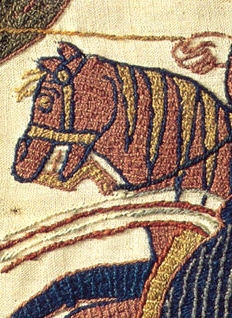
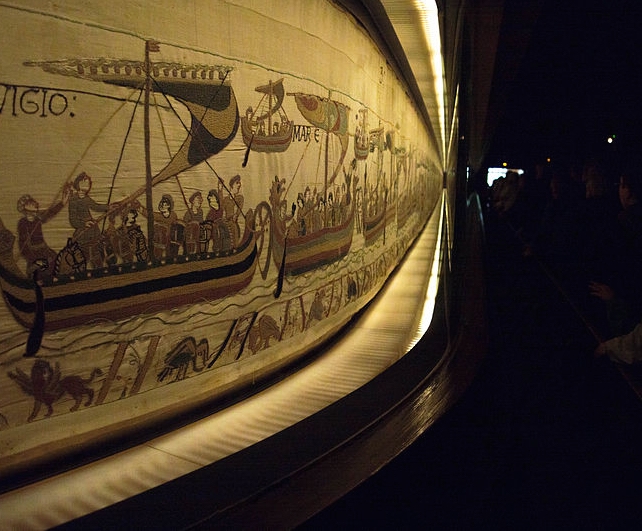
The Bayeux Tapestry, which is housed at the Musée de la Tapisserie de Bayeux in Bayeux, Normandy, France, depicts the sequence of events leading up to and including the Battle of Hastings in 1066. It shows William the Conqueror, then Duke of Normandy, crossing the English Channel with his army to seize the English crown from King Harold. It tells the story from the point of view of the conquering Normans. The "tapestry" is actually an embroidered cloth measuring nearly 70 metres (230 feet) long and 50 centimetres (20 inches) tall.

The story of the Tapestry
Scholars think the Bayeux Tapestry was made in the 1070s, shortly after the Battle of Hastings. It was probably commissioned by William the Conqueror's half-brother, Bishop Odo (who, after the Conquest, became Earl of Kent), for display in Bayeux Cathedral, which was also built by Odo around the same time. Many historians believe that the Tapestry was designed and constructed English artists. The work of stitching was most likely undertaken in Kent by female needleworkers; at the time, the quality of their work was famous across Europe.
The first written mention of the Tapestry was in 1476, when it was recorded in the Bayeux Cathedral treasury as “a very long and narrow hanging on which are embroidered figures and inscriptions comprising a representation of the conquest of England”. In 1803, Napoleon Bonaparte put it on display in Paris and in 1945 it was briefly displayed in the Louvre after being seized from the Nazi Germans, who still occupied Paris. The Tapestry was returned to Bayeux; it has been exhibited at the Musée de la Tapisserie de Bayeux since 1983.
What the Tapestry shows
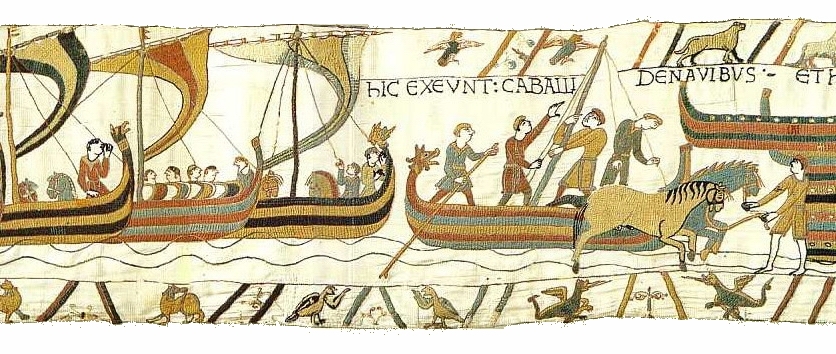
In a series of pictures accompanied by Latin text (called tituli), the Tapestry tells the story of the events of 1064–66, leading up to the Battle of Hastings. The two most important figures are Harold Godwinson, recently crowned King Harold II of England, who leads the Anglo-Saxon English army, and William, Duke of Normandy, commander of the Norman army.
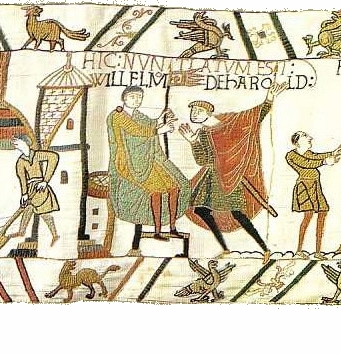
The Tapestry describes events from the point of view of the conquering Normans. King Edward the Confessor is said to have promised that William would succeed him on the throne of England. Harold, Edward's brother-in-law and the most powerful noble in the country, had sworn to William to honour this (as recorded in detail by the Tapestry), but later claimed that Edward, on his deathbed, had made him heir over William. Enraged by this turn of events, William sailed with an army to England to seize the crown. The two sides met at the Battle of Hastings on 14th October 1066. Harold was killed and William emerged the victor.
Tapestry details
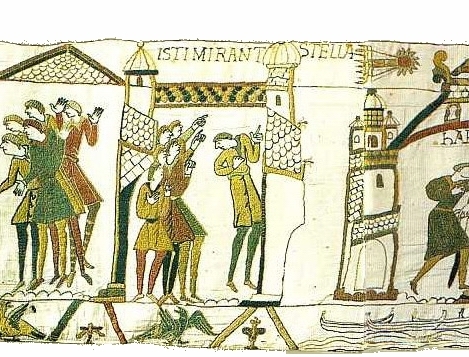
The Tapestry is rich with fascinating detail. At one point in the story, a star with a streaming tail appears. It is now identified as Halley’s Comet making its once-in-every-76-years appearance in the sky. It is seen as a bad omen for Harold. The news of Harold's coronation is taken to Normandy, and William responds by ordering a fleet of ships to be built. After crossing the sea in their dragon-headed ships, the Norman invaders arrive on the English coast, and land unopposed. William orders his men to find food, and a meal is cooked. A house is burnt by two soldiers, while a woman, holding her little boy’s hand, asks to be spared.


When the battle begins, the English fight on foot behind a shield wall, while the Norman soldiers are on horseback. Both armies are shown fighting bravely. The two sides are clearly identifiable by their haircuts: the English have shoulder-length hair and moustaches while Normans are clean-shaven with short hair. The battle becomes bloody with troops on both sides being slaughtered. Harold is shown being killed, either shot through the eye with an arrow or slain with a sword—it is not clear which.

Consultant: Philip Parker
pics
Without in any way limiting Q-files Ltd’s exclusive rights under copyright, any use of this publication to “train” generative artificial intelligence (AI) technologies to generate text is expressly prohibited. Q-files Ltd reserves all rights to license use of this work for generative AI training and development of machine learning language models.