
British history

CITE
We have made every effort to follow citation style rules, but there may be some minor differences. If in doubt, please refer to the appropriate citation style manual.
Life in 18th-century Britain. (2026). In Q-files Encyclopedia, History, British history. Retrieved from
https://www.q-files.com/history/british-history/life-in-18th-century-britain
"Life in 18th-century Britain." History, British history, Q-files Encyclopedia, 30 Mar. 2026.
https://www.q-files.com/history/british-history/life-in-18th-century-britain.
Accessed 6 Aug. 2026.
Life in 18th-century Britain 2026. History, British history. Retrieved 6 August 2026, from
https://www.q-files.com/history/british-history/life-in-18th-century-britain
History, British history, s.v. "Life in 18th-century Britain," accessed August 6, 2026.
https://www.q-files.com/history/british-history/life-in-18th-century-britain


Life in 18th-century Britain
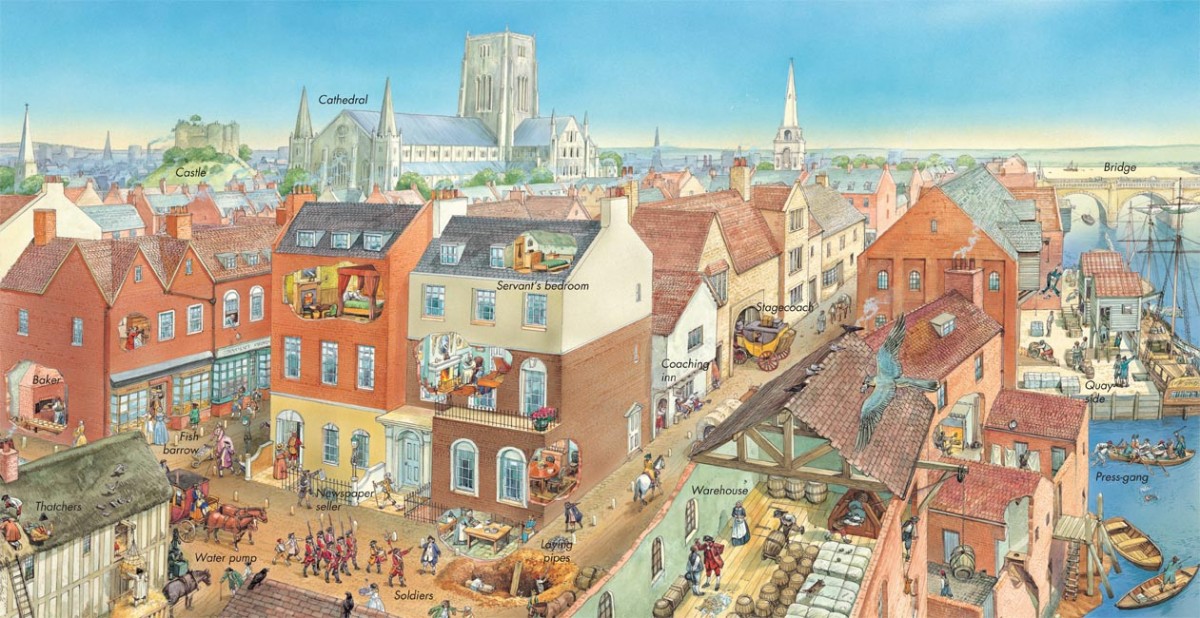
During the Georgian era (1714–1830), trade with different parts of the world continued to grow, making British cities larger and more prosperous. In the countryside, improvements in farming methods led to an increase in food production—which led to an increase in population. However, the new farming technology meant that fewer people were needed to work the land. Many people moved from the countryside into the ever growing cities, where they might work in the docks or learn a new trade in a workshop. A growing number of people took professional jobs such as lawyers, doctors and bankers.
City life
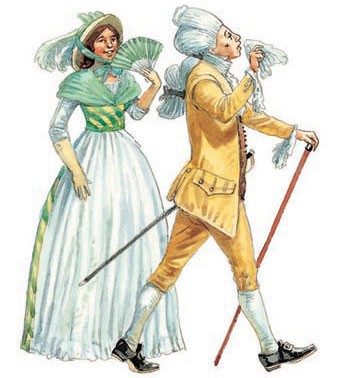
Rich city-dwellers lived in elegant houses full of paintings and expensive furniture. While the poorest people probably had only one set of clothes, the rich may have had large wardrobes of fine clothes. Men wore long coats with knee-length breeches (kinds of trousers) and stockings. Underneath their bodices, women wore corsets stiffened by whalebone to narrow their waists. A framework of cane hoops supported the flowing skirt. Both men and women wore powdered wigs on formal occasions.
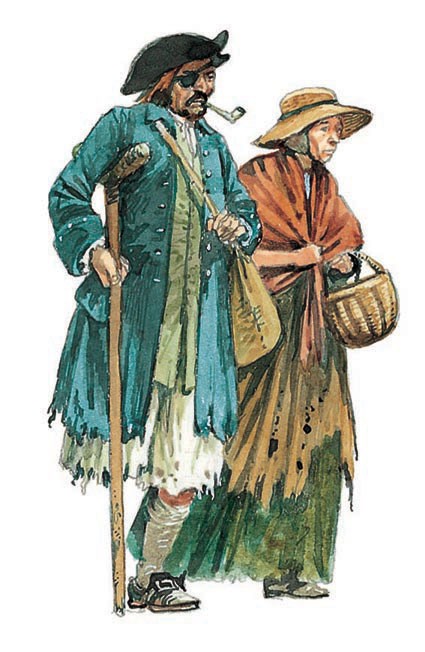
Poor people had to work hard to survive in a city in the 1700s. Some made a living as craftsmen or shopkeepers. Others worked as porters, needleworkers, coachmen, chair-carriers or street traders. Press-gangs and soldiers were always on the look-out to force people to join the army
or navy.
Some of the very poor turned to crime or excessive drinking. Thieves and pickpockets roamed the streets. The presence of nightwatchmen helped to reduce crime.
Schools
In the 1700s, it was usually just boys from well-off families who were educated. They may have been taught at home by a tutor or at a grammar school. They wrote using quill pens, made from goose feathers with sharpened tips. Girls from well-of families were taught at home, where they usually learned “accomplishments” such as embroidery and music. Poor children rarely went to school, although in many towns and cities there were some schools for less well-off children founded by charities.

Getting about
The well-to-do travelled through the noisy, filthy city streets in sedan chairs. These could be hailed like taxis. Wealthy people travelled longer distances around town or to different parts of the country by carriage. This was a four-wheeled, horse-drawn, private vehicle. It had springs or leather straps for suspension to give a smoother ride over cobblestones or unmade streets. The driver, or coachman, sat on a raised seat at the front. Public carriages, for which passengers had to pay fares, were called stagecoaches.
Highwaymen
Whether you rode in a private carriage or stagecoach, an ambush by highwaymen was always a risk in Georgian times. Highwaymen were armed robbers who stole from road travellers. They wore dark masks and their three-cornered hats pulled low over their brows to conceal their identities.


They would wait for a carriage or stagecoach to pass by before galloping out on horseback and forcing the coach to stop. Brandishing their flintlock pistols, they threatened the terrified passengers with their lives. The passengers would quickly empty their purses, hoping for a peaceful end to their ordeal. Some highwaymen, known as “gentlemen of the road”, were always polite, while others were cruel murderers.
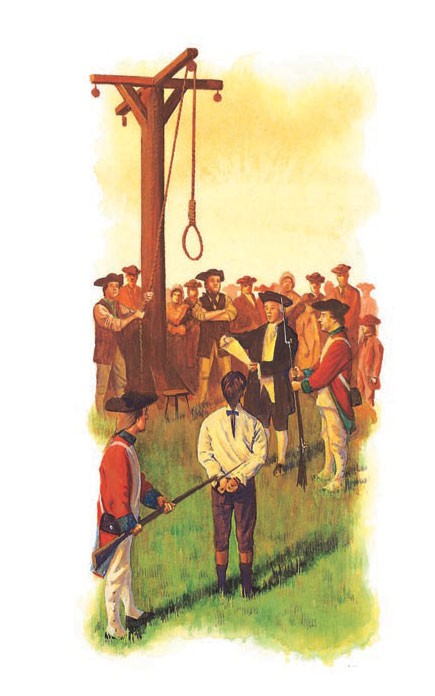
If caught, highwaymen were hung from the gallows. Dick Turpin was one of many to meet this fate. In those days there were no police to catch criminals, so it was often bounty hunters who caught and turned them in for a reward.
Consultant: Philip Parker
pics
Without in any way limiting Q-files Ltd’s exclusive rights under copyright, any use of this publication to “train” generative artificial intelligence (AI) technologies to generate text is expressly prohibited. Q-files Ltd reserves all rights to license use of this work for generative AI training and development of machine learning language models.