
British history

CITE
We have made every effort to follow citation style rules, but there may be some minor differences. If in doubt, please refer to the appropriate citation style manual.
Magna Carta. (2026). In Q-files Encyclopedia, History, British history. Retrieved from
https://www.q-files.com/history/british-history/magna-carta
"Magna Carta." History, British history, Q-files Encyclopedia, 28 Apr. 2026.
https://www.q-files.com/history/british-history/magna-carta.
Accessed 6 Aug. 2026.
Magna Carta 2026. History, British history. Retrieved 6 August 2026, from
https://www.q-files.com/history/british-history/magna-carta
History, British history, s.v. "Magna Carta," accessed August 6, 2026.
https://www.q-files.com/history/british-history/magna-carta


Magna Carta
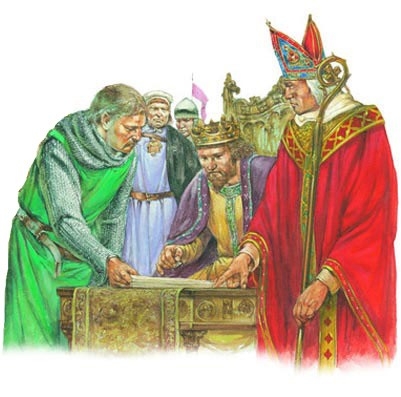
King John (ruled 1199–1216) was unpopular with the leading noblemen (barons) of his day. They objected to his high levels of taxation and the loss of English lands in France after 1204. The barons were also displeased by John’s bitter quarrel with the Pope over who was to be Archbishop of Canterbury, a dispute that led to many church services being banned. Following a disastrous defeat John suffered at the hands of the French, the barons rebelled. On 15th June 1215, they forced John to agree to Magna Carta (Great Charter), a list of demands by which the barons attempted to limit the power of the sovereign and gain rights for themselves.
Loss of Normandy
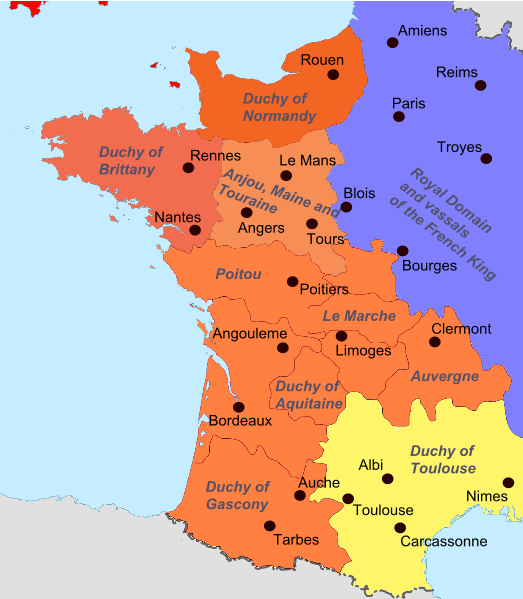
When John ascended to the the English throne, English kings owned much of northern and western France—the Angevin Empire. In 1201 a powerful alliance of French nobles from Normandy, the Lords of Lusignan, rebelled against John, their feudal lord, over John's decision to marry Isabella of Angoulême, who was already engaged to Hugh de Lusignan. Although John crushed the uprising, King Philip II of France invaded Normandy, and, in 1204, drove the English out. Philip then advanced south to occupy Anjou and Poitou as well. John's only remaining possession in France was now the Duchy of Aquitaine.
King John
John inherited a weakened monarchy from his brother Richard I (Richard the Lionheart). Richard had spent all the money in the Treasury on his crusades, and, when he was captured, for his ransom. Richard lived in England for only seven months of his 10-year reign, leaving the business of governing to clerks and court advisers. In Richard's absence, the barons, who held most of the country's lands, became more powerful.
John tried to strengthen the monarchy. He improved its finances through raising a new land tax from the barons and re-established control over northern England, Ireland and Wales, while maintaining friendly relations with William the Lion, King of Scotland. In 1205, John tried to force the Church to accept his candidate for Archbishop of Canterbury, but the Church insisted it had the sole right to elect the Archbishop. Pope Innocent III resolved the dispute by appointing his own candidate, Stephen Langton. When John objected, Innocent prevented English priests from holding religious services (the "interdict") and excommunicated John between 1209 and 1213.

All this made John highly unpopular with the barons, who resented both paying taxes and their loss of influence. John, along with the kings of England before him, ruled on the principle of "force and will"—that he was above the law. The barons were determined to challenge this.

Battle of Bouvines
John mounted a campaign to reconquer Normandy, raising extensive taxes on the barons to accumulate the money he needed to do so. However, his forces were crushed by the French at the Battle of Bouvines in 1214. John asked the barons for more money to finance another campaign in France—but his authority was now completely undermined.
Barons' rebellion
After his return from France John found that rebel barons in the north and east of England were actively organizing resistance to his rule. The rebels took an oath that they would "stand fast for the liberty of the church and the realm". They demanded that the king confirm his agreement to the Charter of Liberties, proclaimed by King Henry I in 1100, and which they believed protected their rights.
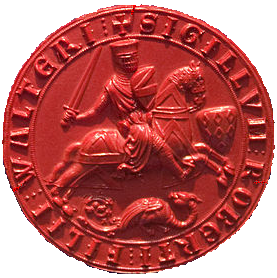
In May 1215, 40 of the rebel barons renounced (vowed to abandon) their feudal ties to the king. With support from the French and Scots, they formed an army, which they called the "Army of God". Under the leadership of Robert Fitzwalter, the rebels marched on Lincoln, Exeter and London.
Once London had fallen to the rebels, John had no alternative but to enter negotiations with them. He instructed Archbishop Langton to arrange peace talks.
Runnymede
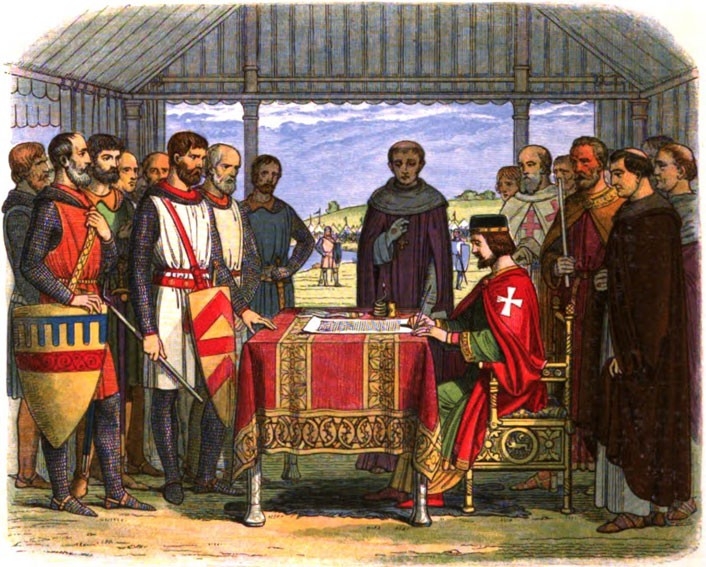

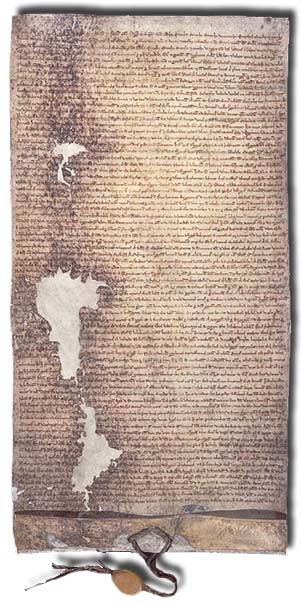
King John met the rebels at Runnymede, near Windsor, on 15th June 1215. The rebels presented John with a proposed peace agreement known as the "Articles of the Barons". This was a series of demands for reform which, drafted by Langton, were set out in a charter (it was to be a few years later that this agreement was renamed Magna Carta, meaning "Great Charter"). Agreement was reached, the king's Great Seal was attached to it and, on 19th June, the rebels renewed their oaths of loyalty to John. Copies of the charter were then formally issued.
The charter
The charter contained 63 clauses. They guaranteed a number of rights to the barons (for example, a £100 limit on the tax they had to pay to inherit their lands), the Church and the City of London. The sovereign (monarch) was to consult the Great Council (an assembly of church leaders and wealthy landowners) in disputes over taxation. The charter also laid down that no one should be arrested or imprisoned without trial, or by the "Law of the Land". This became the basis of habeas corpus (“you have the body”).

Under the terms of clause 61, a council of 25 barons would be established to ensure that the sovereign observed the charter. If he did not, the barons would be empowered to seize royal castles and lands, by armed force if necessary—a process called "distraint", which was normal in feudal times but had never before been applied to the sovereign. The charter was the first treaty to state that the sovereign was not above the law, and that an individual's rights were to be upheld, even if against the sovereign’s wishes.
First Barons' War
The charter—in particular, clause 61—was so heavily weighted against the king that it was highly unlikely it would last for long. Almost immediately, John asked Pope Innocent III for permission to ignore it. As part of the peace agreement, the barons were supposed to surrender London by 15th August, but they refused to do so.
Innocent III then declared the charter to be "not only shameful and demeaning but also illegal and unjust" since John had been "forced to accept" it, and thus the charter was "null, and void of all validity for ever".

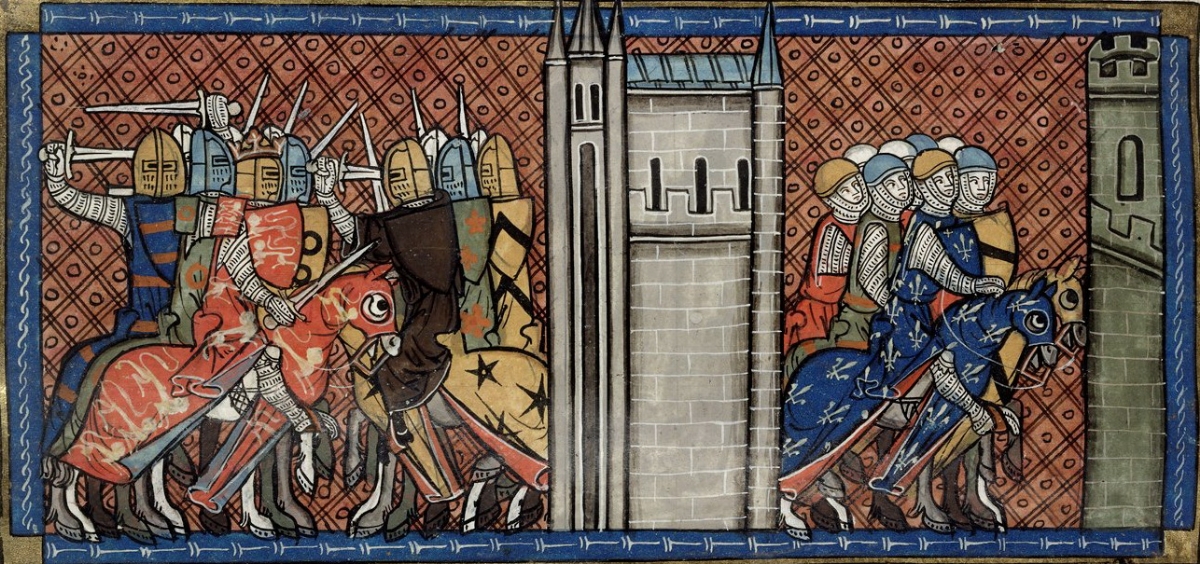
Realising that peace with John (on their terms) was impossible, the rebel barons turned to to France for help, offering Philip II's son, the future Louis VIII, the throne of England. The First Barons' War broke out, with French troops invading England in May 1216. Louis met little resistance when he reached London and was proclaimed king. John, meanwhile, became ill with dysentery and died on the night of 18th October 1216, leaving his nine-year-old son, Henry III, to inheirt the throne. Many rebel barons switched sides and defeated Louis. The civil war came to an end with the signing of the Treaty of Lambeth in September 1217.

Later kings
The charter agreed by John in June 1215—with some clauses, including clause 61, removed and others amended—formed the basis of the peace treaty agreed at Lambeth. The charter now had the name by which we know it today: Magna Carta. Henry re-issued the charter in 1225 in exchange for the granting of new taxes. His son, Edward I, did so once more in 1297. On this occasion, Magna Carta became part of England's statute (written) laws, and remains so today, although most of its clauses have since been repealed.
Legacy
Although Magna Carta was not a declaration of human rights, it was the first time a set of rules had been written down for a king to obey. Many demands were intended to tip the balance of power in favour of the barons. But no monarch of England ever held "absolute" power again. For this reason, Magna Carta is considered to be one of the most important documents in English history.
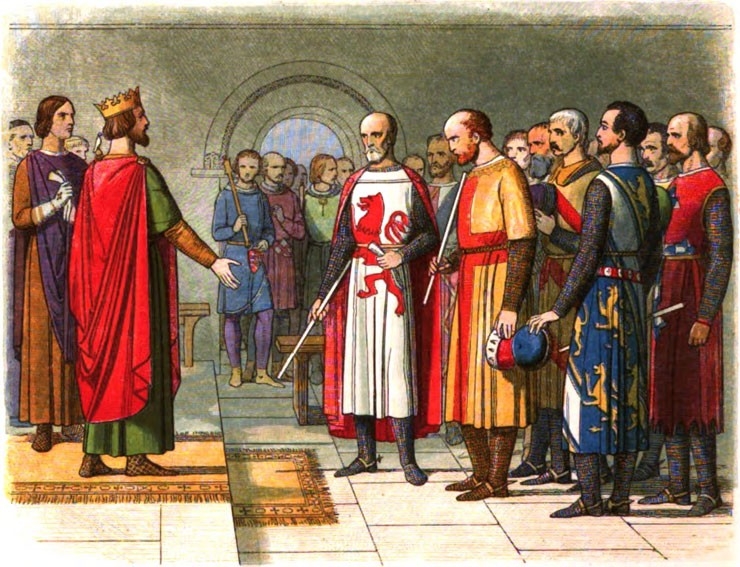
Later in Henry III's reign, in 1265, Parliament came into existence. From then on, Parliament represented the interests of the barons, and later the gentry (landowners, but without titles of nobility). Over the next century, Parliament gained the power to make laws and raise taxes. Most clauses of Magna Carta were replaced by these laws.
Consultant: Philip Parker
pics


Without in any way limiting Q-files Ltd’s exclusive rights under copyright, any use of this publication to “train” generative artificial intelligence (AI) technologies to generate text is expressly prohibited. Q-files Ltd reserves all rights to license use of this work for generative AI training and development of machine learning language models.