
Europe

CITE
We have made every effort to follow citation style rules, but there may be some minor differences. If in doubt, please refer to the appropriate citation style manual.
Ancient Europe. (2022). In Q-files Encyclopedia, History, Europe. Retrieved from
https://www.q-files.com/history/europe/ancient-europe
"Ancient Europe." History, Europe, Q-files Encyclopedia, 10 Feb. 2022.
https://www.q-files.com/history/europe/ancient-europe.
Accessed 6 Aug. 2026.
Ancient Europe 2022. History, Europe. Retrieved 6 August 2026, from
https://www.q-files.com/history/europe/ancient-europe
History, Europe, s.v. "Ancient Europe," accessed August 6, 2026.
https://www.q-files.com/history/europe/ancient-europe


Ancient Europe
Europe's first inhabitants were hunter-gatherers, who hunted for wild animals and picked plants to eat. By around 7000–6500 BC, some people living in southeastern Europe had settled down to grow crops, beginning the Neolithic period. It took a few thousand years for farming to spread across Europe. Although people still hunted wild animals and fished in the rivers, they usually lived in simple farming communities, often close to water. They cut down trees to make room for fields. They could grow barley, wheat and other grains, as well as keep livestock. From around 4000 BC, some Europeans could make goods from metal.

Stone monuments
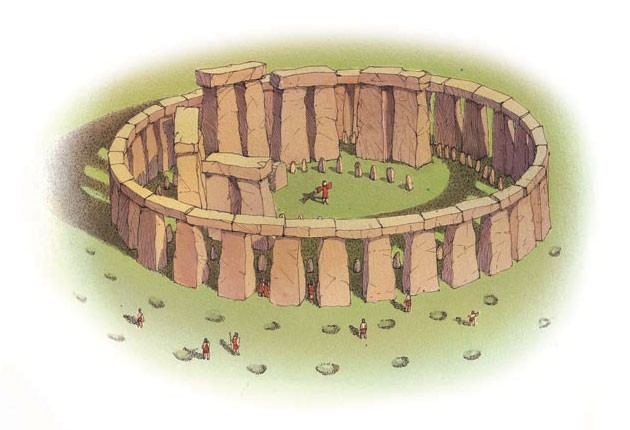
By about 2000 BC, people in Europe had begun to build huge stone monuments for religious worship. To build Stonehenge, which stands on Salisbury Plain in southern England, massive stones had to be dragged across the plain on rollers, placed in deep pits and then hauled upright.
Farming villages
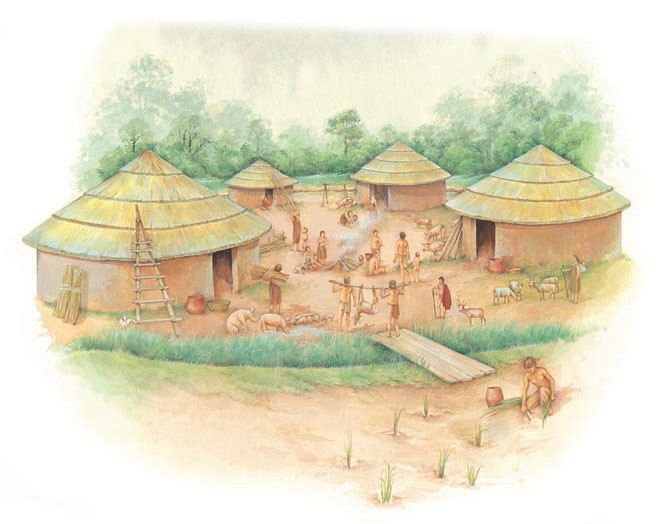
A patch of forest was cleared by cutting down and burning trees. Then the people built huts of mud and straw. They grew crops such as wheat. The farmers had simple ploughs to work the land, and oxen to pull them. The people could produce everything they needed in the village. They chopped wood for their fires and spun yarn and wove cloth to make clothes. If they could grow enough food, they could exchange it for other products such as metal.
Bronze Age Europe
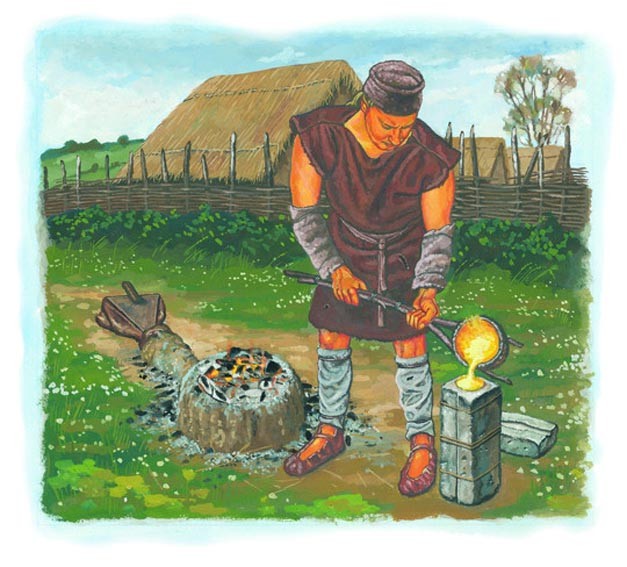
The first metal objects in Europe were produced from copper or gold and date from about 5000 BC. These metals, easy to shape into jewellery and other artefacts, were too soft for making tools and weapons. The discovery around 2800 BC that copper could be strengthened by mixing, or alloying, it with another metal, tin, heralded the start of the Bronze Age in Europe. By about 1200 BC, metalworkers in Europe had switched almost entirely to using bronze.
Chieftains
By about 1500 BC, communities had become more complex. The leaders of the communities were not gods or remote nobles like the kings in other parts of the ancient world, but farmers or craftworkers, just like the people themselves. However, these leaders, or chieftains, wanted recognition of their rank. They liked to wear luxurious clothes adorned with gold and carry expensive bronze weapons signifying their prowess as a warrior. When a chieftain died, these treasures were put in his tomb to serve him in the next world.

Trade

By 1500 BC, bronze work had become very advanced. New types of weapons had appeared throughout Europe, including armour and shields. Bronze was no longer a luxury metal used only by the rich, but was also made into tools and ornaments. The demand for bronze led to an increase in trade. In northern parts of Europe, fur, skins and amber (a yellow fossil resin prized for making beads) were traded for bronze, and Scandinavian metalworkers became expert in working the metal. Throughout Europe, chieftains became wealthy because of bronze.
The Celts
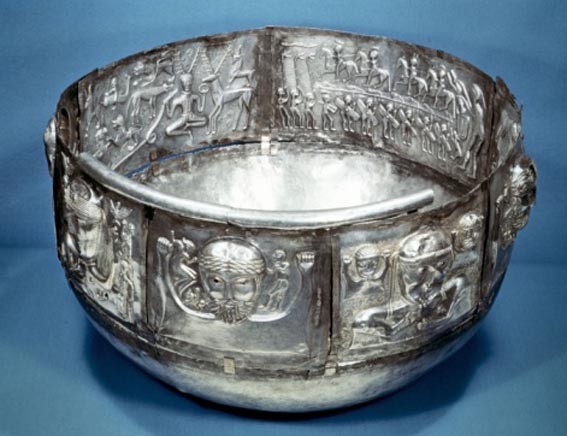
The Celts were a farming people from central Europe. By 450 BC, they had spread across much of Europe. They were divided into many separate tribes. They often fought one another for land. Besides being farmers, they were skilled metalworkers and active traders. As warriors, they were no match for the powerful Roman armies, who began to conquer most of their lands after
225 BC.
Celtic hillfort
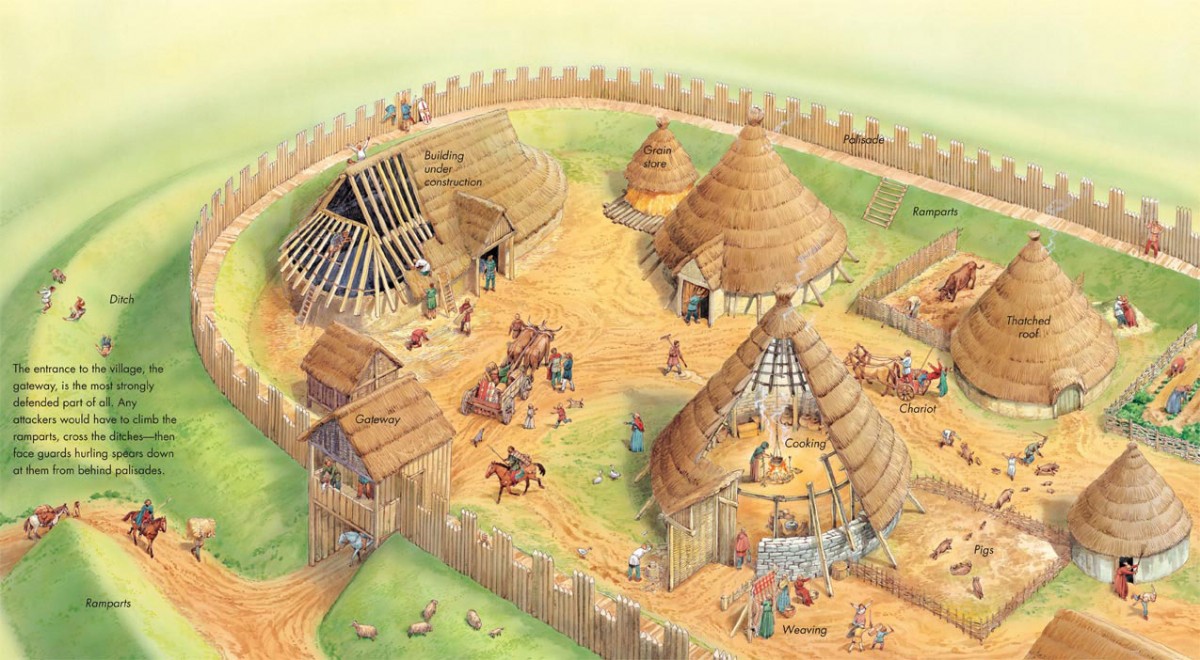
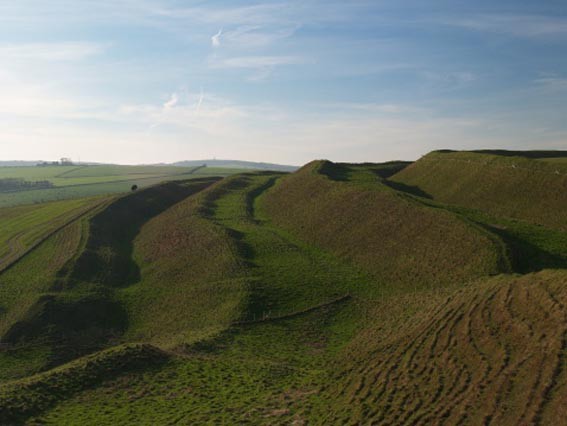
Some Celtic tribes built their villages inside forts on hilltops. The villagers’ houses were round and made mostly of wood. Each had a cone-shaped framework of branches held up by posts driven into the ground. Bundles of reeds (a thatch) formed a roof, while dried mud or stone made up the outside walls. To protect their village, the people built up “walls” of earth called ramparts all round it. On top of the ramparts they erected wooden fences called palisades.
Safe inside the hillfort, the villagers tended their animals, cooked food, chopped wood, ground corn and wove cloth. The chieftain lived near the centre of the settlement. Bronze workers were so important that their workshops were often packed closely together inside the fort. The entrance to the village, the gateway, was the most strongly defended part of all. Any attackers would have had to climb the ramparts, cross the ditches—then face guards hurling spears down at them from behind palisades.
Celtic Europe
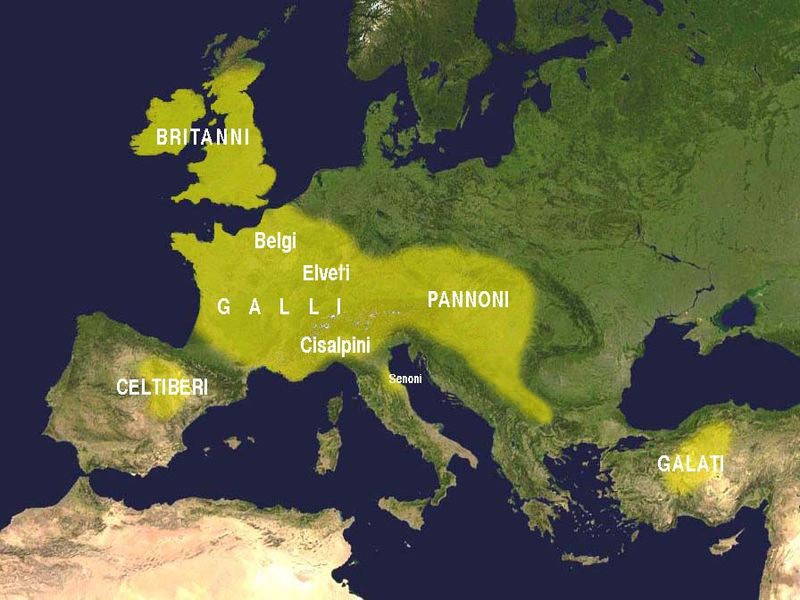
The name “Celts” was first used around 500 BC by the ancient Greeks to describe peoples living in Europe north of the Alps, along with France, the Iberian Peninsula, Central Europe and the Balkans. To the Greeks, they were “outsiders” or, in their language, Keltoi.
Despite the fact their languages and culture were related, the Celts were actually many different peoples, among them the Gauls (Galli) who lived in what is now France and Belgium, and whom the Roman leader Julius Caesar fought and conquered during the Gallic Wars (58–50 BC).
Consultant: Philip Parker
pics
Without in any way limiting Q-files Ltd’s exclusive rights under copyright, any use of this publication to “train” generative artificial intelligence (AI) technologies to generate text is expressly prohibited. Q-files Ltd reserves all rights to license use of this work for generative AI training and development of machine learning language models.