
Europe

CITE
We have made every effort to follow citation style rules, but there may be some minor differences. If in doubt, please refer to the appropriate citation style manual.
Europe in the Early Middle Ages. (2023). In Q-files Encyclopedia, History, Europe. Retrieved from
https://www.q-files.com/history/europe/europe-in-the-early-middle-ages
"Europe in the Early Middle Ages." History, Europe, Q-files Encyclopedia, 19 Jun. 2023.
https://www.q-files.com/history/europe/europe-in-the-early-middle-ages.
Accessed 6 Aug. 2026.
Europe in the Early Middle Ages 2023. History, Europe. Retrieved 6 August 2026, from
https://www.q-files.com/history/europe/europe-in-the-early-middle-ages
History, Europe, s.v. "Europe in the Early Middle Ages," accessed August 6, 2026.
https://www.q-files.com/history/europe/europe-in-the-early-middle-ages


Europe in the Early Middle Ages
The Middle Ages, or medieval period, is the period of European history between the late 5th century, when the Western Roman Empire fell, and the late 15th century with the emergence of the Renaissance and the Age of Discovery. The period is often divided into three periods: the Early Middle Ages (late 5th to 10th centuries), once known as the "Dark Ages", the High Middle Ages (1000–1250) and the Late Middle Ages (1250–1500). While Germanic peoples (also known as barbarians), including the Franks, Visigoths and Ostrogoths, formed new kingdoms in the lands once ruled by the Western Roman Empire, the Eastern Roman Empire continued on as the Byzantine Empire—and remained a power. In the 7th century, Byzantine lands in North Africa and the Middle East, including the Holy Land (Palestine, where Jesus Christ was born and lived) were conquered by the Islamic Caliphate.

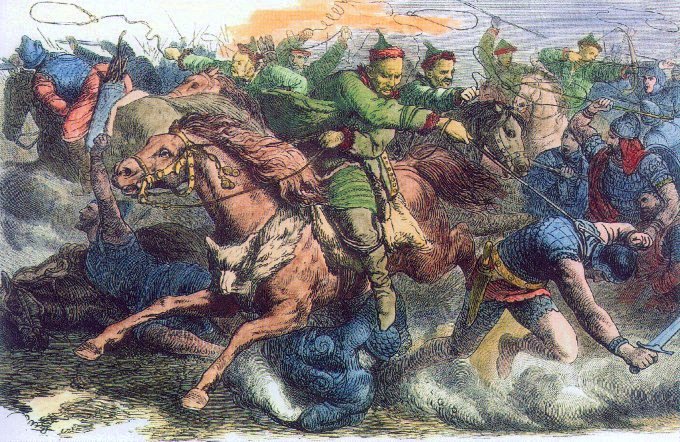
Fall of the Western Roman Empire
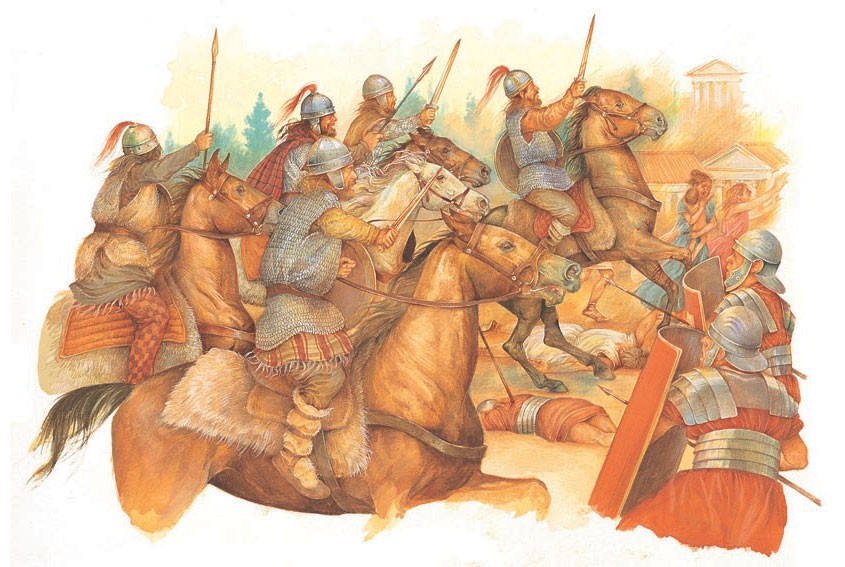
By the end of the 4th century, the Western Roman Empire was already in decline. Its emperors were less and less able to control its vast territory, while the once mighty Roman army and prosperous economy were now weaker. At the same time, the empire came under increasing pressure from invading barbarians—non-Roman peoples. Large numbers of Goths and other Germanic peoples fleeing from the Huns migrated to lands lying within the empire's boundary where they settled. Soon, barbarian kingdoms established themselves across much of the Western Roman Empire. The Goths were divided into Visigoths and Ostrogoths.

By 410, the year the Goths under Alaric I sacked the city of Rome, the Alans, Vandals and Suebi had spread across Gaul (roughly, modern France) and on over the Pyrenees Mountains into the Iberian Peninsula. The Franks, Alemanni and the Burgundians settled in northern Gaul while, a little later, the Angles, Saxons and Jutes migrated to Britain. Meanwhile, the Huns, a nomadic people from Central Asia, whose aggressive expansion had led to the migration of the Germanic peoples into Roman territory, carried out frequent raids of their own into both Eastern and Western Empire led by their king, Attila, in the 440s and 50s.
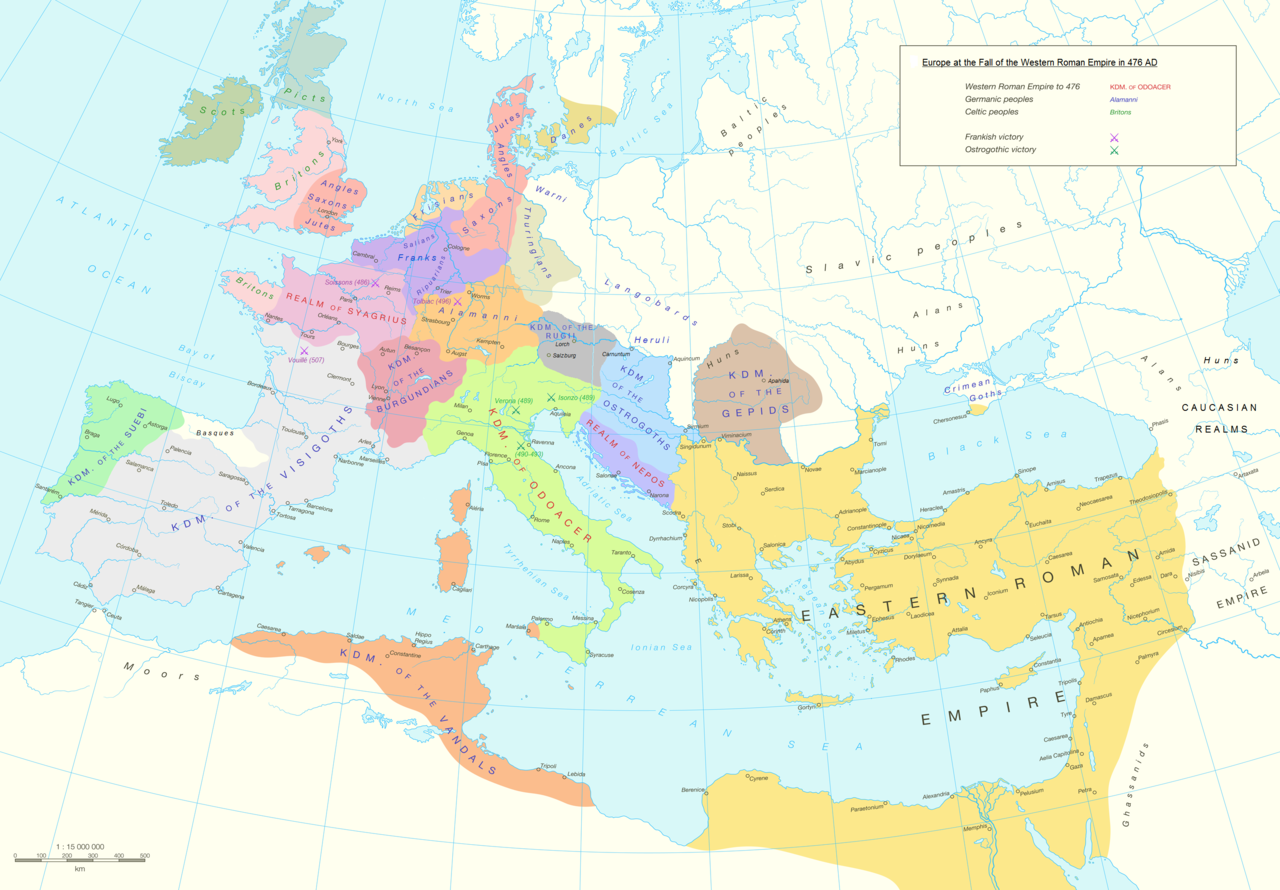
By 439 the Vandals had occupied North Africa and established a kingdom there. It included the Roman province of Africa as well as Sicily, Corsica, Sardinia, Malta and the Balearic Islands. From their western Mediterranean base, the Vandals sacked the city of Rome in 455.
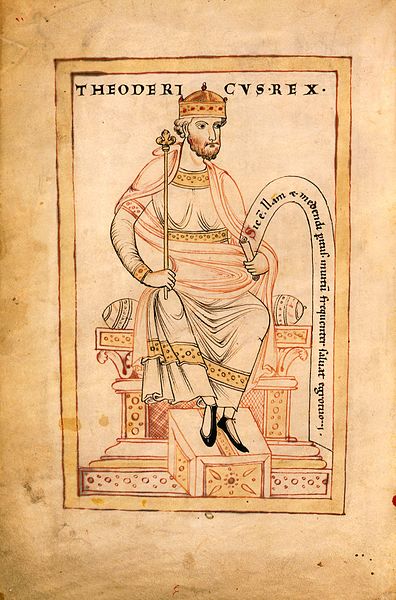
By 476, the Western Roman emperors had lost control over their domains. That year, the barbarian king, Odoacer, deposed the last Roman emperor, the 16-year-old Romulus Augustulus. By 493, the entire Italian peninsula was conquered by Theoderic the Great, king of the Ostrogoths. He went on to seize other former Roman lands, including the northern Balkans, and in Spain where he put his grandson Amalric on the throne. As the most powerful of the Germanic kings, the Burgundians and Vandals were also forced to accept Theoderic's overlordship.
Germanic kingdoms
In the 6th century, the old Western Roman Empire was divided up into Germanic kingdoms. The Franks, under Childeric I, established their kingdom, called Francia, in northern Gaul. Childeric's son Clovis I (481–511) founded the Merovingian dynasty and expanded the Frankish kingdom, converting its people to Christianity.
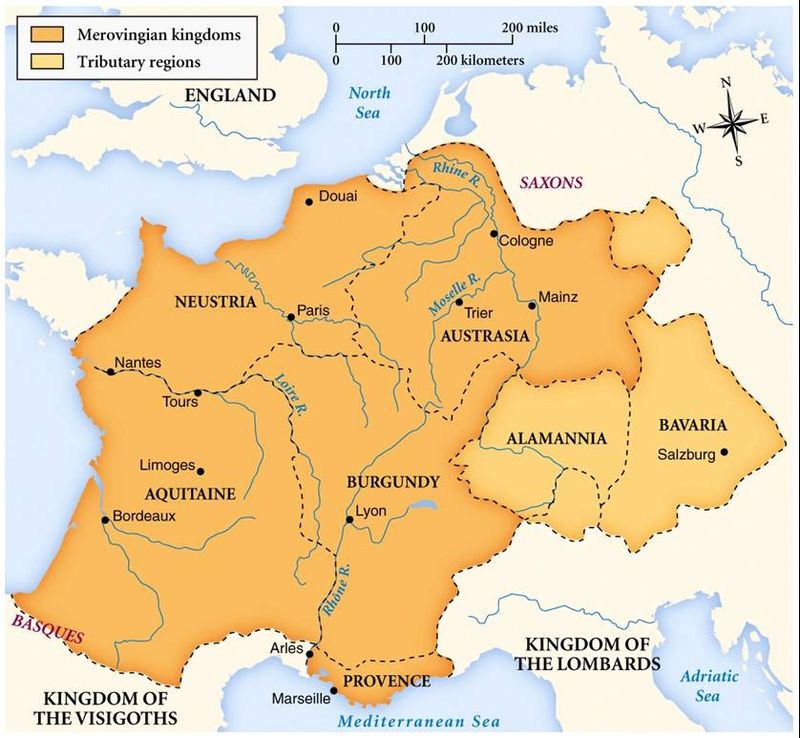
The Visigoths and Suebi founded kingdoms on the Iberian Peninsula (present-day Spain and Portugal), while the Vandals ruled North Africa and the western Mediterranean islands. Northern Italy, which had been captured from the Ostrogoths by the Byzantine Empire in 553, was invaded by the Lombards in 568.
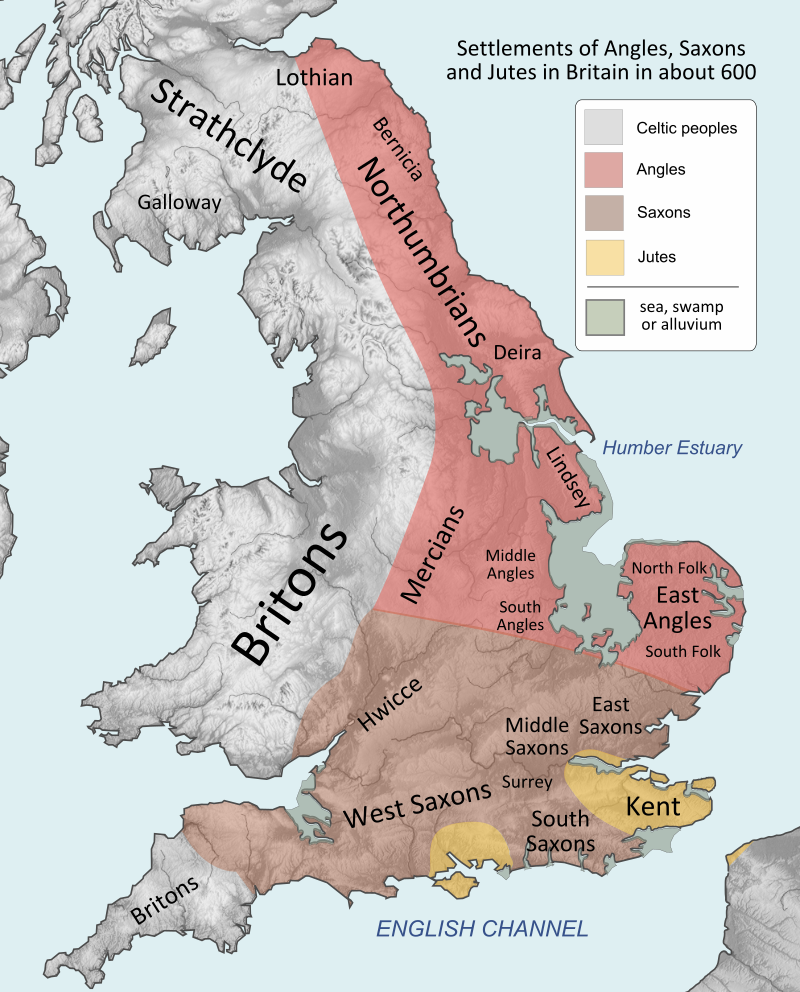
Some native Britons fled the Anglo-Saxon invasions of Great Britain and settled in northwest France, the land now known as Brittany. Much of the island they left behind was, by the year 600, dominated by the Anglo-Saxon kingdoms of Northumbria, Mercia, Wessex and East Anglia. The smaller kingdoms in Wales and Scotland were still ruled by Britons and Picts. Ireland was divided into scores of small tribal kingdoms.
Slav expansion
Meanwhile, the Slavs began to expand out of their homeland in Eastern Europe and into those lands abandoned by Germanic tribes migrating westwards. Spreading across Central Europe and the Balkan Peninsula, the Slavs reached the border with the Byzantine Empire during the 6th century.
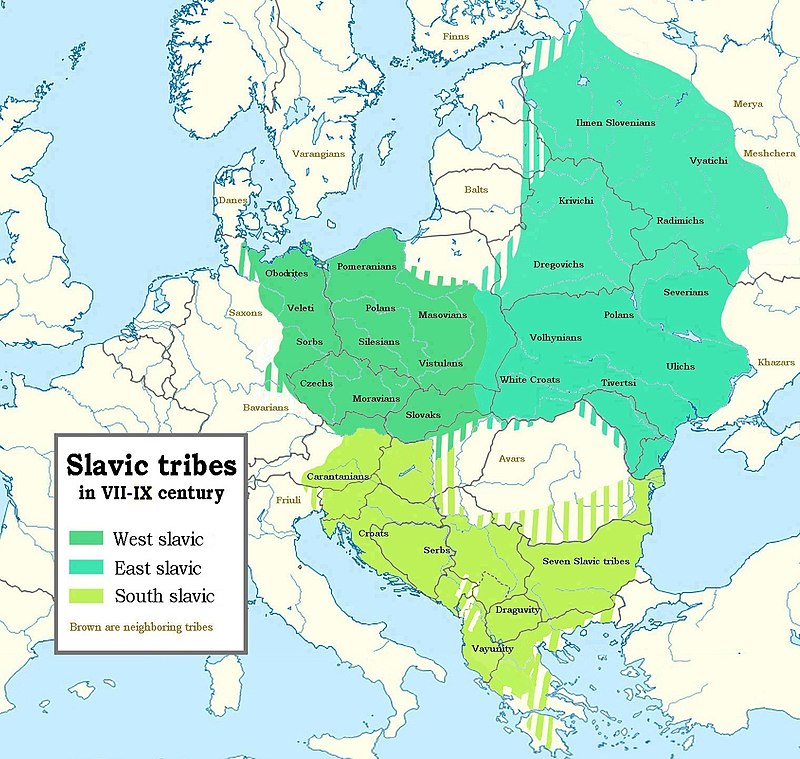
Latin, the language of the Western Roman Empire, was gradually replaced by local languages which evolved from it, known as Romance languages (Italian, French, Spanish, Portuguese and Romanian). Greek remained the language of the Byzantine Empire, while the Slavs brought Slavic languages with them to Central, Eastern and southeastern Europe.

Byzantine Empire
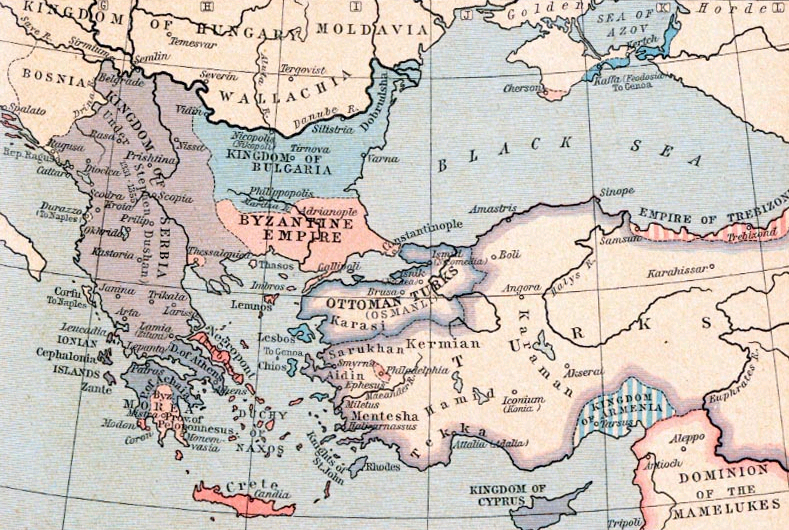
The Eastern Roman Empire, or Byzantine Empire, survived after the collapse of the Western Empire. Although reduced in strength, it stayed on as an important power in the Eastern Mediterranean. Under Emperor Justinian (527–65), the Byzantines successfully reconquered North Africa from the Vandals and, for a time, Italy from the Ostrogoths. A deadly outbreak of plague in 542 (which would, centuries later, return as the Black Death of the 14th century) halted Justinian's advances.
After Justinian's death, the Slavs began to expand into the Byzantine Empire from the north, even raiding the great Byzantine city of Thessaloniki in 586. Another people, the Pannonian Avars, also began to spread out from their lands to the north of the Danube in the 560s. They remained a menace to the Byzantines until the end of the 8th century.
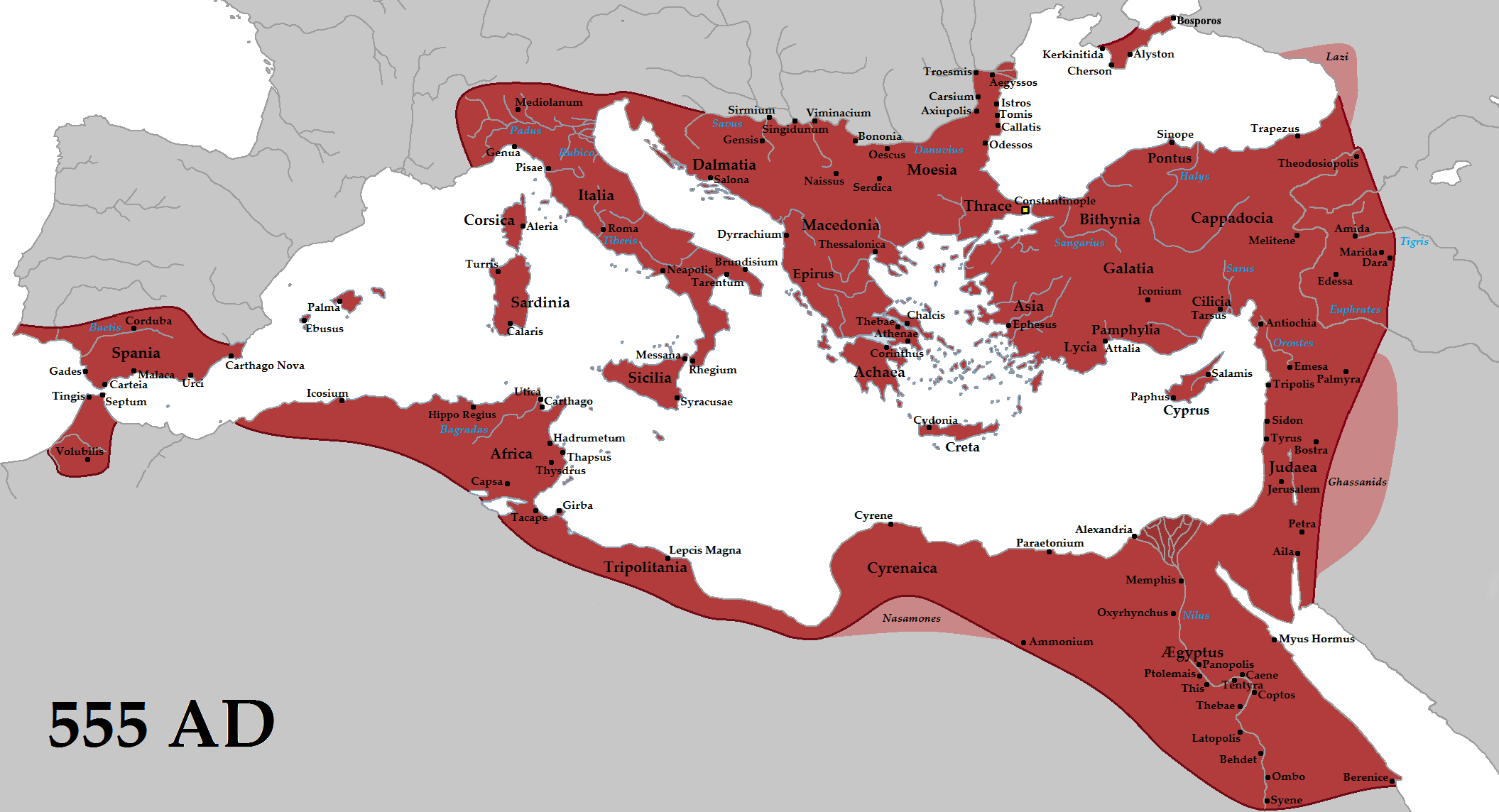
The Byzantine Empire saw a revival under Basil I (867–86) and his successors of the Macedonian dynasty. Its frontiers expanded once more. The empire, a Christian state since the 4th century, also benefitted from the conversion to Christianity of many the peoples on its northern borders.
The Bulgarian Empire, which was founded in around 680, expanded to control large areas of southeastern Europe. During the late 9th and early 10th centuries, Simeon I scored several victories over the Byzantines, laying siege to Constantinople in the 920s. The Byzantines recovered, and, in 1014, under Basil II "the Bulgar Slayer", defeated the Bulgarians at the Battle of Kleidion.
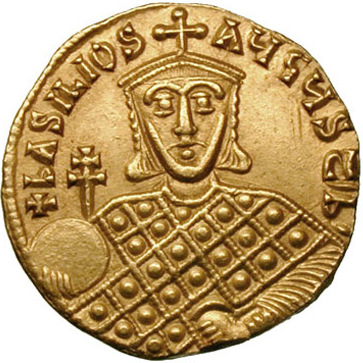
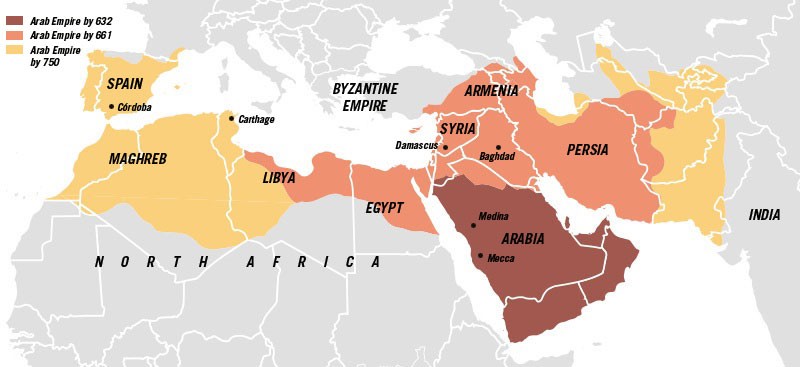
From the 7th century onwards, the greatest threat to the Byzantine Empire in the Middle East and North Africa came not from Christian Europe but from the rising Islamic Arab Empire.
Rise of Islam
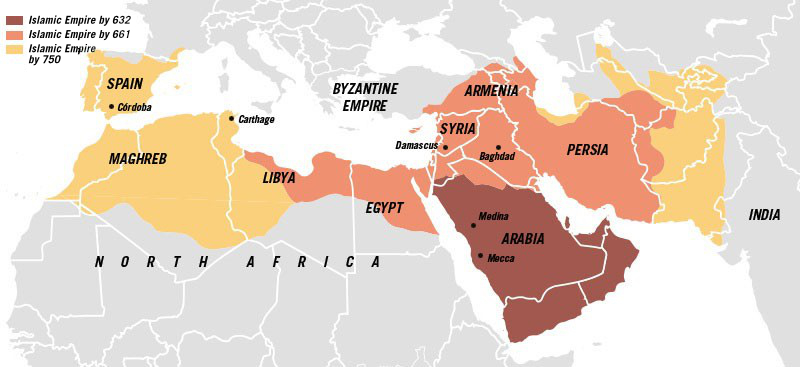
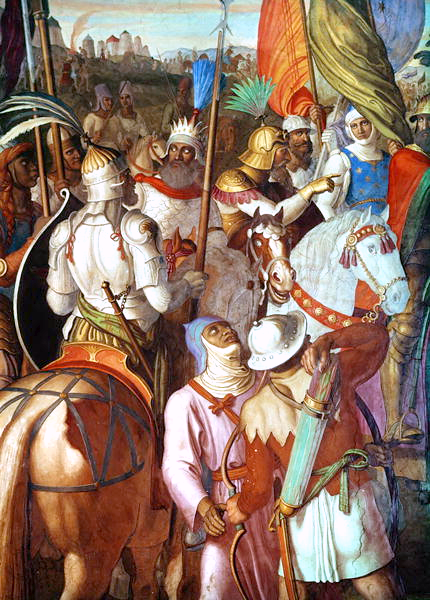
By 714, the Arabs had conquered much of the Iberian Peninsula and remained a threat to the rest of Western Europe until the mid-8th century. The Franks under Charles Martel defeated them at the Battle of Tours (also called the Battle of Poitiers or, by the Arabs, the Battle of the Highway of the Martyrs) in 732, preventing the Arabs from advancing into France. The expansion of Islam into Europe was halted not by military defeat, however, but because the Abbasid Caliphate, which had ousted the Umayyad Caliphate, switched their attentions to the Middle East.
Christian Spain, previously confined to the north of the Iberian Peninsula, gradually expanded the territory under its rule southwards during the 9th and 10th centuries, establishing the kingdoms of Asturias and León.
Monks and missionaries
The Early Middle Ages in the West saw the rise of monasticism—a way of life in which monks and nuns devoted themselves to following the teachings of Christ. Most lived in abbeys, convents, monasteries or priories, isolating themselves from the secular (non-religious) world.
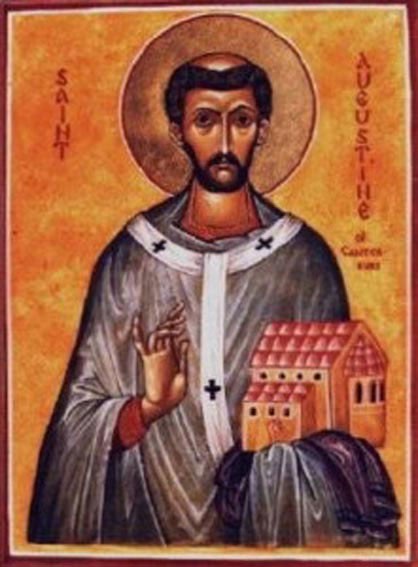
Some monks, however, lived among the community carrying out missionary work. They played an important role in converting pagan (non-Christian) Europe to Christianity. The Irish monk Columba spread Christianity to Scotland in the 560s and founded the abbey on Iona. Augustine was chosen by Pope Gregory in 595 to lead a mission to Britain to convert the Anglo-Saxon kings and their subjects to Christianity.

Often the only educated, literate people in their community, monks copied many of the surviving Latin manuscripts and wrote new works, setting down their knowledge of ideas and history with the aim of encouraging learning. Among them was Bede the Venerable (died 735), a Benedictine monk who lived and worked at a monastery in the Anglo-Saxon kingdom of Northumbria.
Carolingian Europe
After the death of Clovis I in the early 6th century, the Frankish kingdom in northern Gaul split into three Merovingian kingdoms—Austrasia, Neustria and Burgundy—each ruled by a descendant of Clovis. After a period of warfare between Austrasia and Neustria in the 7th and 8th centuries, the two kingdoms united under the rule of Pepin the Short in 751. He became the first king of the Carolingian dynasty (descendants of the Frankish prince Charles Martel).

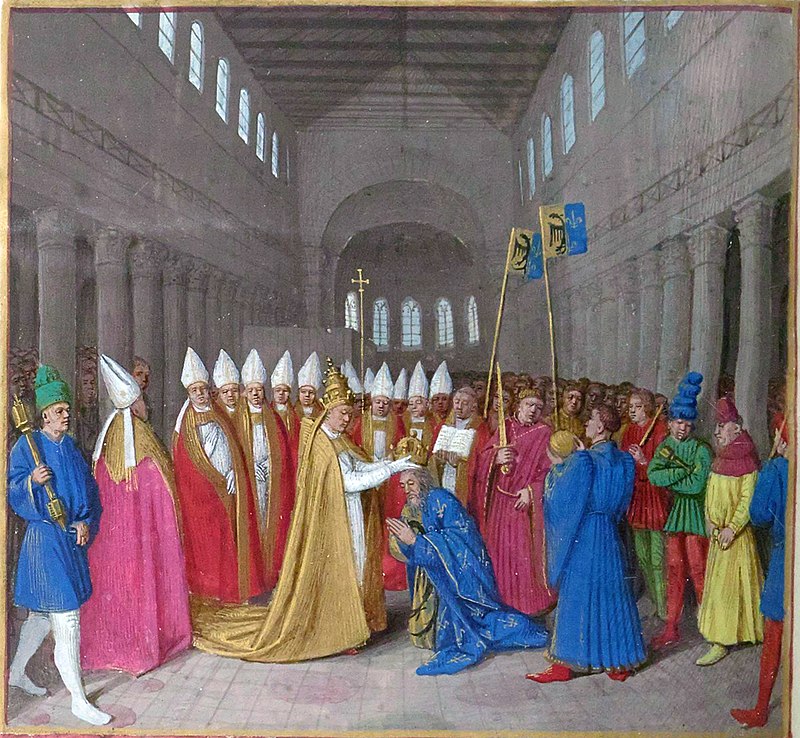
On his death in 768, Pepin left his kingdom to his two sons, Charles and Carloman. Within three years, following the death of his brother, Charles became sole ruler. Charles the Great—or Charlemagne as he has become known—then greatly expanded Carolingian lands, eventually conquering the whole of present-day France, northern Italy, the Low Countries, Switzerland and much of Germany. Charlemagne was crowned as emperor of a revived Western Roman Empire (later known as the Holy Roman Empire) by Pope Leo III on Christmas Day 800. Charlemagne ruled his great empire from his court in Aachen until his death in 814.

Following Charlemagne's death, civil war broke out between his descendants. Over the course of the first half of the 9th century, the power struggles between the emperor Lothair I and his brothers Pepin I of Aquitaine and Louis (or Ludwig) the German, and their half-brother Charles the Bald, led to the break-up of the Carolingian Empire.
By the Treaty of Verdun of 843, the empire was divided into West Francia (much of modern France), Middle Francia (the low Countries, Burgundy, western Switzerland and Lombardy in northern Italy) and East Francia (much of modern Germany, eastern Switzerland, Austria and Carinthia—roughly present-day Slovenia). The Carolingian dynasty was eventually replaced by the Capetian dynasty with the crowning of Hugh Capet as king of West Francia in 987.

The Vikings
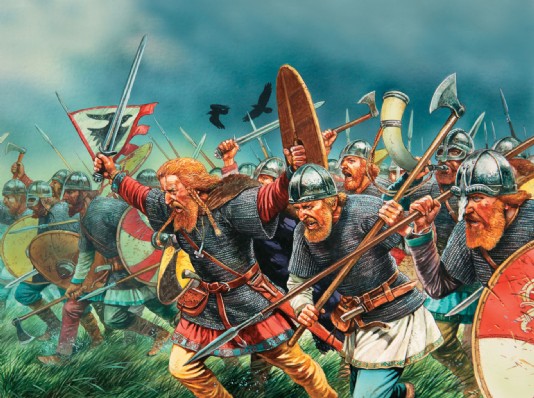
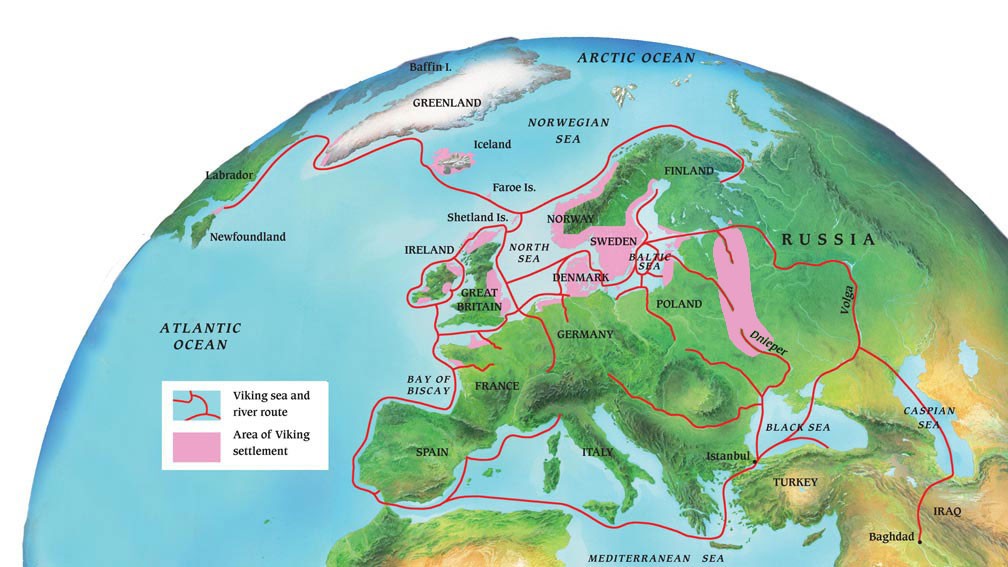
By this time, the Atlantic and the northern shores of West Francia were coming under attack by the Vikings, seafaring pirates from southern Scandinavia. The Vikings also raided the British Isles and later settled both there and Iceland. In 911, following his victory at the Siege of Chartres during a Viking raid, King Charles the Simple (898–922) of West Francia made peace with the Viking chieftain Rollo, granting Norse settlers lands in northern France, in what became Normandy.
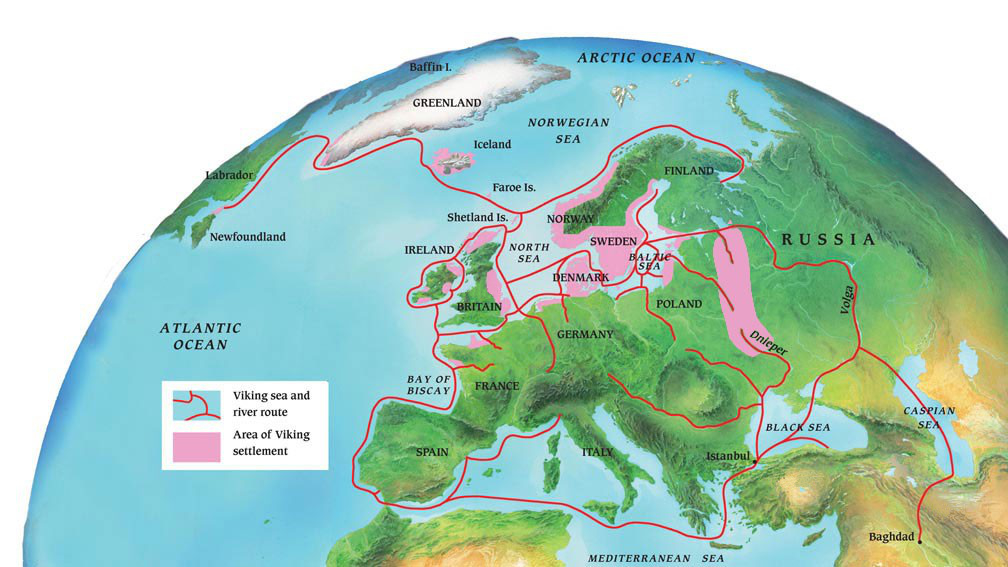
The Vikings also spread into what is now Russia and Ukraine, after traders from Sweden travelled down the Volga, Dnieper and Dniester rivers. Viking forces even attempted to capture Constantinople, the Byzantine capital, in 860, 907 and 941.
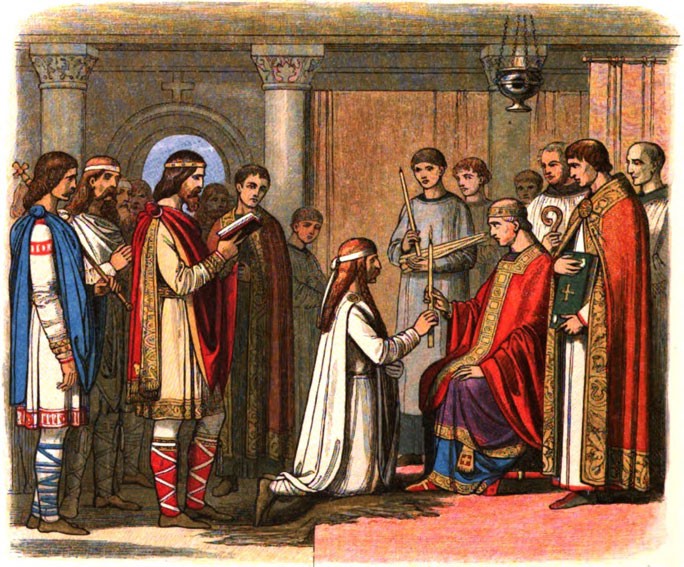
In Anglo-Saxon England, King Alfred the Great (871–899), also negotiated peace with the Vikings, allowing Danish settlement of Northumbria, Mercia and parts of East Anglia. By the middle of the 10th century, Alfred's successors had re-conquered Northumbria and established Anglo-Saxon control once more over the southern part of Great Britain. In the north, Kenneth MacAlpin (died 860) united the Picts and the Scots into what became the kingdom of Alba (present-day Scotland).
The Magyars
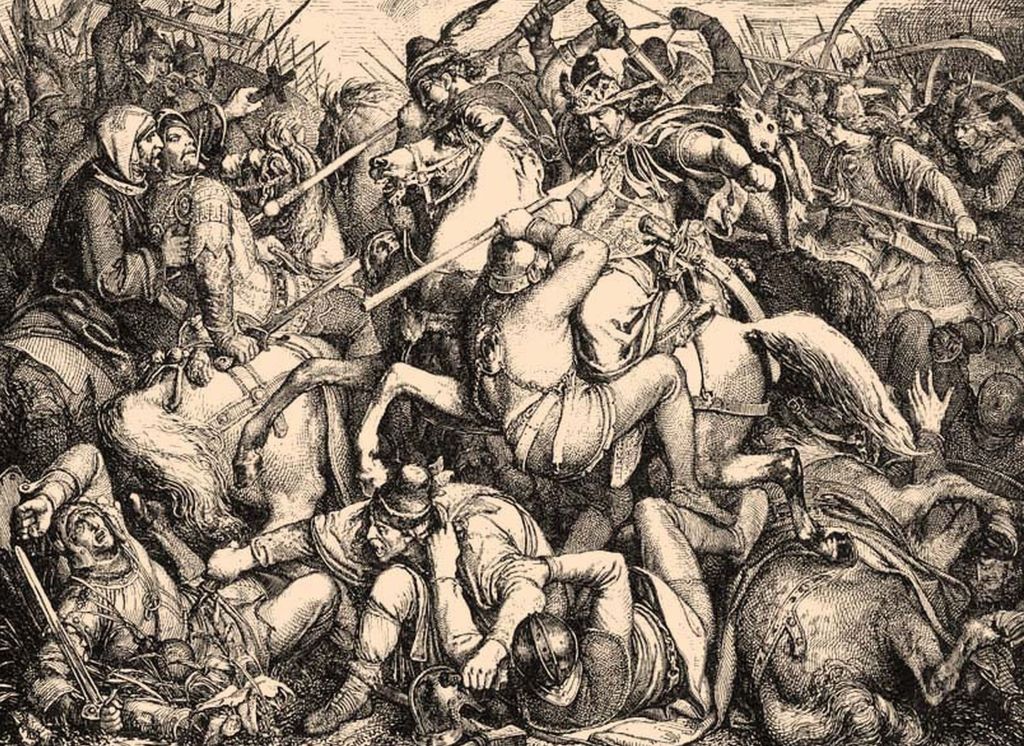
At the end of the 9th century, Middle and East Francia were invaded by forces of the Magyars (Hungarians). Under their leader, Arpad, the Magyar people had migrated to and settled on the Pannonian Plain. This is a lowland region of Central Europe lying between the the Carpathian Mountains and the Alps. At that time it was only thinly populated by Slavs. There, in 896, the Magyars established the Principality of Hungary. Having crushed a Bavarian army at the Battle of Pressburg in 907, they mounted raids on Frankish lands further west.
In East Francia, the Saxon king Otto (later known as Otto the Great) unified all the German tribes into a single kingdom in his bid to drive back the Magyars. This he did successfully at the Battle of Lechfeld in 955. A few years later, in 962, Otto was crowned Holy Roman Emperor. Hungary later became a kingdom with the coronation of St Stephen I, a descendant of Arpad, at Esztergom on Christmas Day 1000.

Consultant: Philip Parker
pics

Without in any way limiting Q-files Ltd’s exclusive rights under copyright, any use of this publication to “train” generative artificial intelligence (AI) technologies to generate text is expressly prohibited. Q-files Ltd reserves all rights to license use of this work for generative AI training and development of machine learning language models.