
Vikings

CITE
We have made every effort to follow citation style rules, but there may be some minor differences. If in doubt, please refer to the appropriate citation style manual.
Viking raiders. (2022). In Q-files Encyclopedia, History, Vikings. Retrieved from
https://www.q-files.com/history/vikings/viking-raiders
"Viking raiders." History, Vikings, Q-files Encyclopedia, 10 Feb. 2022.
https://www.q-files.com/history/vikings/viking-raiders.
Accessed 21 Sep. 2026.
Viking raiders 2022. History, Vikings. Retrieved 21 September 2026, from
https://www.q-files.com/history/vikings/viking-raiders
History, Vikings, s.v. "Viking raiders," accessed September 21, 2026.
https://www.q-files.com/history/vikings/viking-raiders


Viking raiders
Fierce warriors, the Vikings carried out raids across much of Europe, from England to Italy, Russia to Spain. But what made the Vikings sail across the seas to attack towns and villages? One reason may have been an increase in population in the Vikings' homelands which led to overcrowding and a shortage of farmland. Another reason is that local kings were trying to increase their power, and those who opposed this chose to go overseas to look for new land elsewhere—even if they had to fight for it. A further reason was that the Vikings were naturally adventurous, and many young warriors saw raiding as a way of gaining wealth and honour.

Lords of the sea
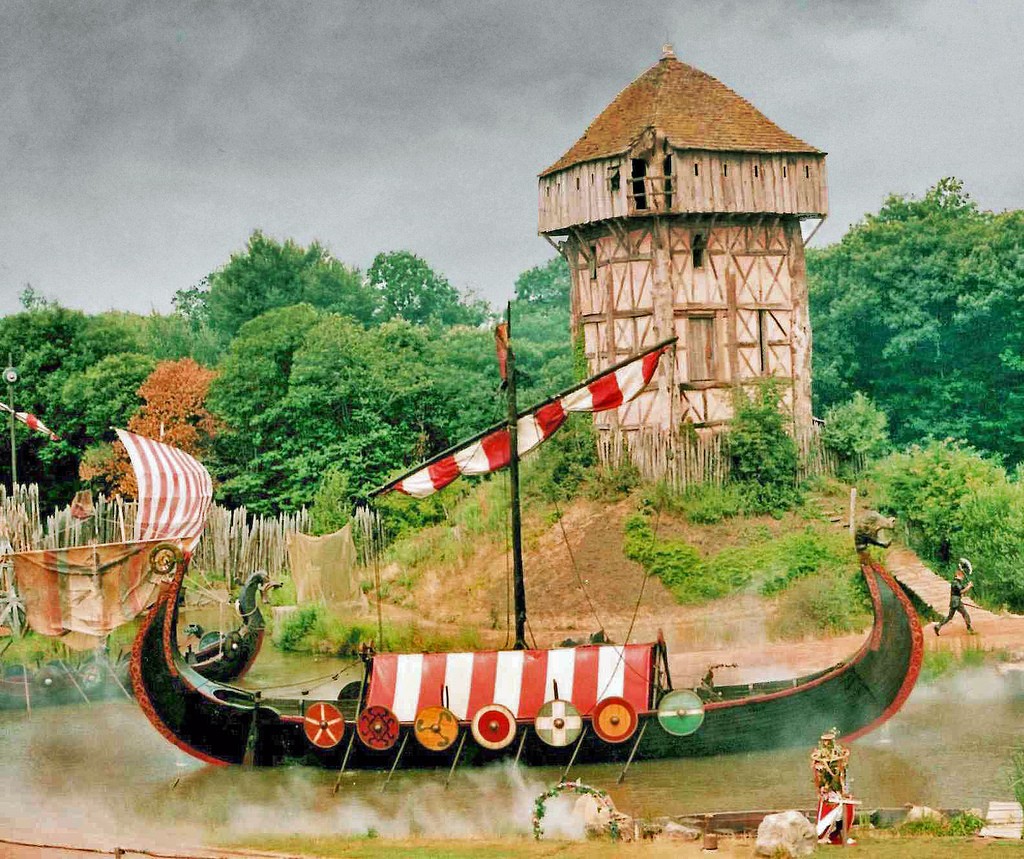
Between the 8th and 11th centuries, the Vikings were lords of the sea—no other European people had such fast and strong ships. Not afraid to lose sight of land, Viking sailors would navigate using the sun and the stars. Believing they were protected by their gods—Odin, god of war, Thor, god of thunder, and Freyr, god of fertility—the Vikings sailed round the coasts of Europe, across the North Atlantic Ocean and eastwards into Russia.

Destinations
The Norwegian Vikings travelled west to the northern islands of Scotland, the Faroe Islands, Ireland, Iceland, Greenland and North America, while the Danish Vikings sailed to England, Normandy and southern Europe. A force of 62 Danish ships sailed around Spain and Portugal to North Africa. They looted towns and set up trading posts, before going on to southern France and Italy. The Swedish Vikings travelled east, into Russia and beyond, but they concentrated on trading as much as they did raiding.
Surprise attacks
For 200 years the Vikings were a threat to many people in Europe. When Viking longships approached foreign shores, the local inhabitants were filled with fear. The sight of the fast-moving ships with their carved, serpent-like bows and warriors aboard waving their axes and swords was truly terrifying. In the shallow coastal waters the Viking raiders quickly waded on to land, pulling their ships up on to the beach with ease.
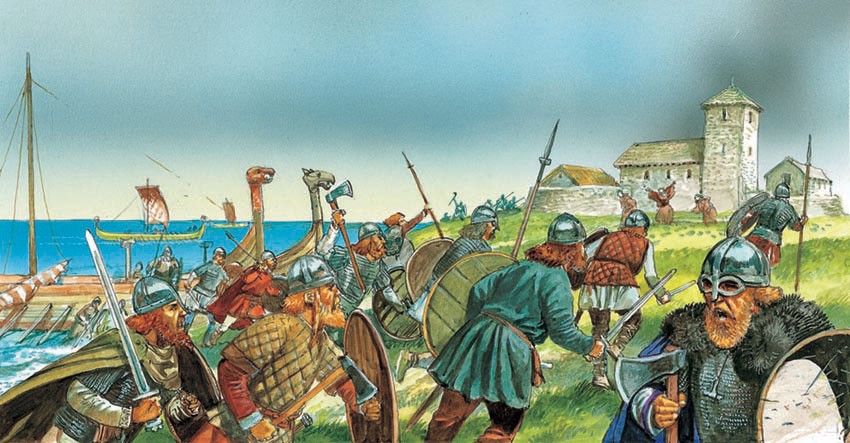
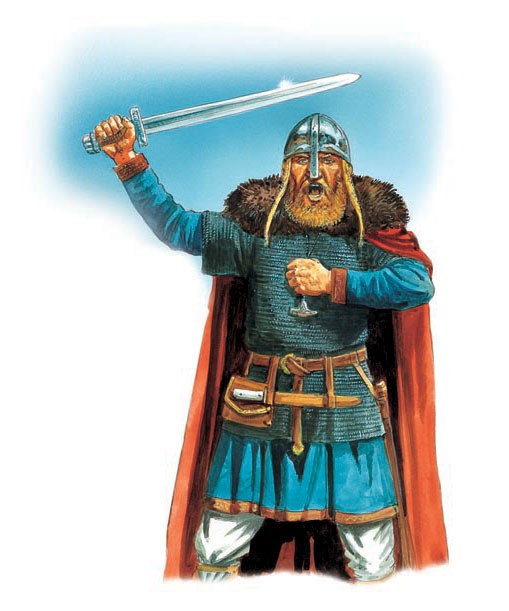
The Vikings frequently made surprise attacks on towns, villages, churches and monasteries. Monasteries were perfect targets for the Vikings because they were often poorly defended and filled with treasures. They stole everything of value, set fire to buildings and wounded or killed anyone who stood in their path.
In the face of a defending army, the Vikings would stand together behind a wall of shields. Then they would launch an attack by firing arrows and throwing spears. Hand-to-hand battle with swords and axes would follow.
Consultant: Philip Parker
pics
Without in any way limiting Q-files Ltd’s exclusive rights under copyright, any use of this publication to “train” generative artificial intelligence (AI) technologies to generate text is expressly prohibited. Q-files Ltd reserves all rights to license use of this work for generative AI training and development of machine learning language models.