
Europe

CITE
We have made every effort to follow citation style rules, but there may be some minor differences. If in doubt, please refer to the appropriate citation style manual.
Renaissance Europe. (2022). In Q-files Encyclopedia, History, Europe. Retrieved from
https://www.q-files.com/history/europe/renaissance-europe
"Renaissance Europe." History, Europe, Q-files Encyclopedia, 22 Feb. 2022.
https://www.q-files.com/history/europe/renaissance-europe.
Accessed 6 Aug. 2026.
Renaissance Europe 2022. History, Europe. Retrieved 6 August 2026, from
https://www.q-files.com/history/europe/renaissance-europe
History, Europe, s.v. "Renaissance Europe," accessed August 6, 2026.
https://www.q-files.com/history/europe/renaissance-europe


Renaissance Europe
The word Renaissance means “rebirth” and it describes a time when the arts and learning of ancient Greece and Rome were rediscovered by people in Europe. The Renaissance started in the 14th century in Italy, and spread across Europe during the 15th century. Many historians use the term Renaissance to mark the end of the Middle Ages in Europe. It was a time when people started to think about themselves, and the world around them, in a new way.

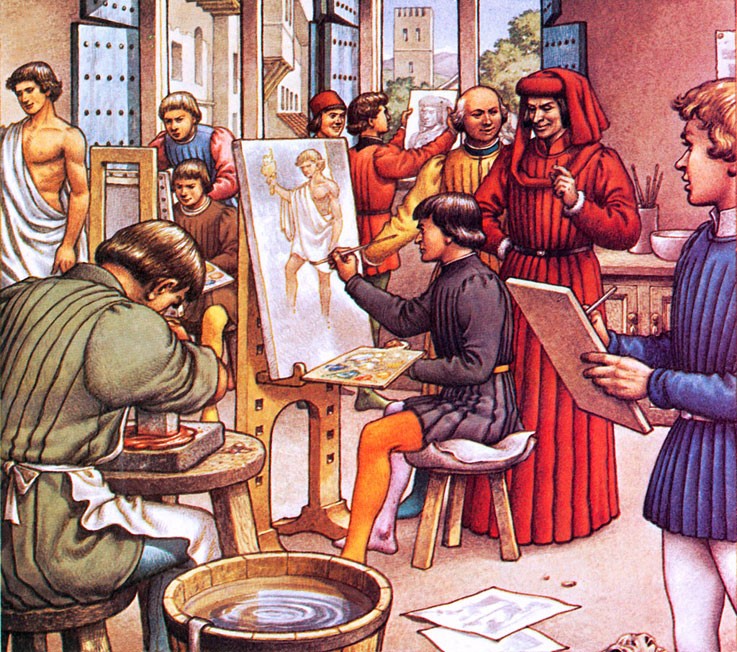
Italian city-states
Italy in the 1300s was not the unified country that it is today. It was made up of many city-states which were controlled by powerful families, such as the Gonzaga family in Mantua. The Renaissance was sparked here by these wealthy families, who employed architects to design grand buildings to echo the classical designs of ancient Greece and Rome, and artists to decorate them. They also started to encourage scholars to study the works of ancient Greek and Roman writers.
During the 1400s, the Medici family rose to power in Florence and made the city an important centre for the Renaissance. Venice became another leading centre.

Humanism
Renaissance scholars were interested in the study of human nature. This was known as humanism. They read texts about the great civilizations of Greece and Rome that had long lain forgotten. The study of humanism was boosted when many scholars fled west from Constantinople (Istanbul in modern-day Turkey), which was captured by the Ottoman Turks in 1453, bringing with them many precious books.

Writers and artists


In literature, some of the first writers to use humanism in their work were the Italian poets Dante (c.1265–1321) and Petrarch (1304–1374). Humanism also had a major influence on styles of painting. In the Middle Ages, artists painted in a flat, decorative style. They were not concerned with making their figures look natural. The Florentine painter Giotto (1266/7–1337) became the first European artist since the fall of the Roman Empire to try to portray figures in a lifelike way.
Later in the Renaissance, artists such as Sandro Botticelli (1445–1510), Leonardo da Vinci (1452–1519), Michelangelo (1475–1564), Raphael (1483–1520) and Titian (1488–1576) worked for rich patrons in Florence, Rome, Venice or elsewhere.

Architects

The first stone of St Peter’s in Rome was laid by Pope Julius II in 1506. Some of the greatest architects of the Renaissance played a part in its design. They included Bramante, Michelangelo and Bernini, who designed the magnificent baldacchino (canopy) that towers over the main altar. Michelangelo designed the huge 132-metre (433-feet) high dome, although it was not completed until after his death.
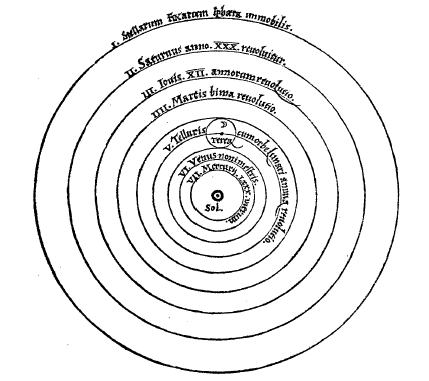
Scientific discovery
As well as being a period of new ideas in the arts, the Renaissance was a time for new inventions and discoveries. During the 1400s, European sailors discovered lands previously unknown to Europeans. In astronomy, Nicolaus Copernicus (1473–1543), a Polish astronomer, put forward the idea that the Earth orbited the Sun (and not the other way round as previously thought). The arrival in Europe of inventions such as the sailor’s compass, gunpowder and printing also revolutionized life for many people.
Consultant: Philip Parker
pics
Without in any way limiting Q-files Ltd’s exclusive rights under copyright, any use of this publication to “train” generative artificial intelligence (AI) technologies to generate text is expressly prohibited. Q-files Ltd reserves all rights to license use of this work for generative AI training and development of machine learning language models.