
Europe

CITE
We have made every effort to follow citation style rules, but there may be some minor differences. If in doubt, please refer to the appropriate citation style manual.
Medieval town life. (2022). In Q-files Encyclopedia, History, Europe. Retrieved from
https://www.q-files.com/history/europe/medieval-town-life
"Medieval town life." History, Europe, Q-files Encyclopedia, 10 Feb. 2022.
https://www.q-files.com/history/europe/medieval-town-life.
Accessed 2 Sep. 2026.
Medieval town life 2022. History, Europe. Retrieved 2 September 2026, from
https://www.q-files.com/history/europe/medieval-town-life
History, Europe, s.v. "Medieval town life," accessed September 2, 2026.
https://www.q-files.com/history/europe/medieval-town-life


Medieval town life
The time in history lasting from around AD 600 to 1500 is called the Middle Ages, or medieval times. Most people lived and worked farming the land—but, particularly after AD 1000, towns grew larger and more important. They were places where markets were regularly held and where craftsmen lived and worked. Some of the finer buildings in the town, such as a rich merchant’s house, were built of expensive stone. The poorer houses were made from cheaper timber with walls of sticks and plaster, called wattle and daub.

Buildings
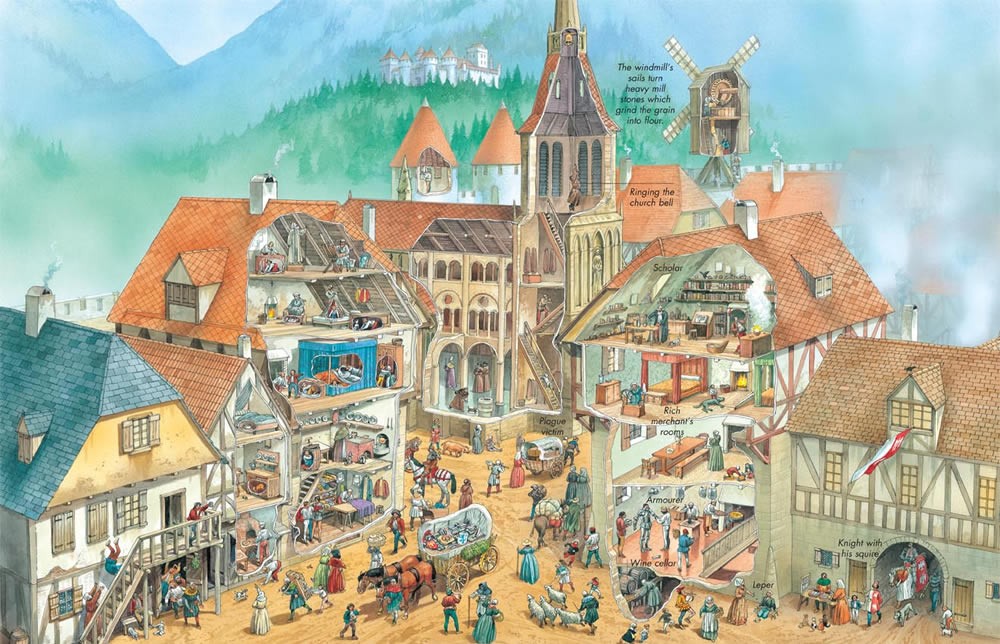
The grandest building in the town was the stone-built church at its centre. This was built to show the world how prosperous the town and its lord were. The town’s buildings contained shops and workshops on the ground floor with living areas above. Inns were not only places where people gathered to drink. They also provided food and lodging, as well as stabling and fodder for the travellers’ horses.
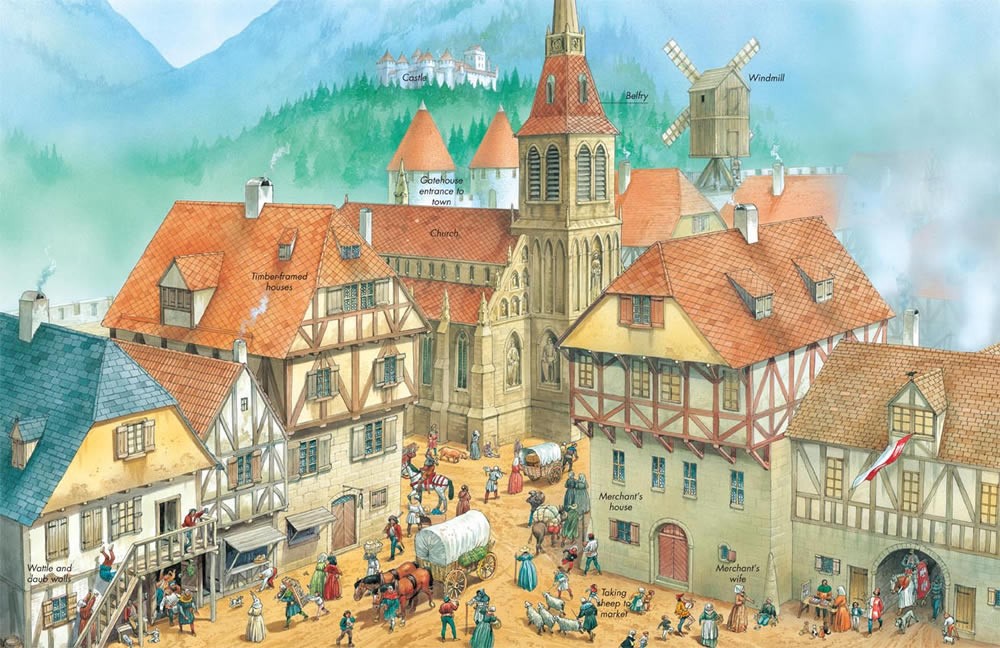
Most townsfolk struggled to make a living, but some merchants became very wealthy. They lived in grand houses in the centre of the town and employed servants and entertainers. The merchant owned the whole house, but might rent a small room at the top of the house for a poor family to live in.
Craftsmen
Many different craftsmen lived and worked in medieval towns. They included bakers, butchers, blacksmiths, carpenters, fletchers (arrow makers), bowyers (bow makers), dyers, potters and many others. A craftsman’s workshop, shop, storeroom and home were all found in the same building. Craftsmen took on apprentices to help them. They lodged with the craftsman and his family. If, after several years’ training, the apprentices proved themselves, they, too, could become master craftsmen and set up their own shops.
Blacksmith's forge
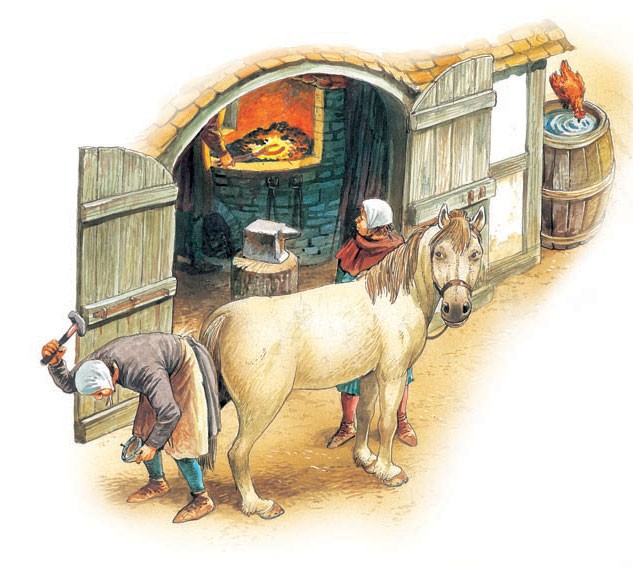
Every medieval town had a blacksmith’s forge. Here, a blacksmith would hammer, bend or cut iron to make tools, weapons, armour, horseshoes and other metal goods. The brick-built forge contained a fire of burning charcoal. It was kept blazing hot by blasts of air from bellows. The metal was softened by heating it over the fire until it glowed red, then beaten or bent into shape on an anvil, a metal block. To fit a shoe on a horse, the old one was removed, untidy bits of hoof trimmed with a rasp, and the new shoe nailed firmly into place.
Guilds
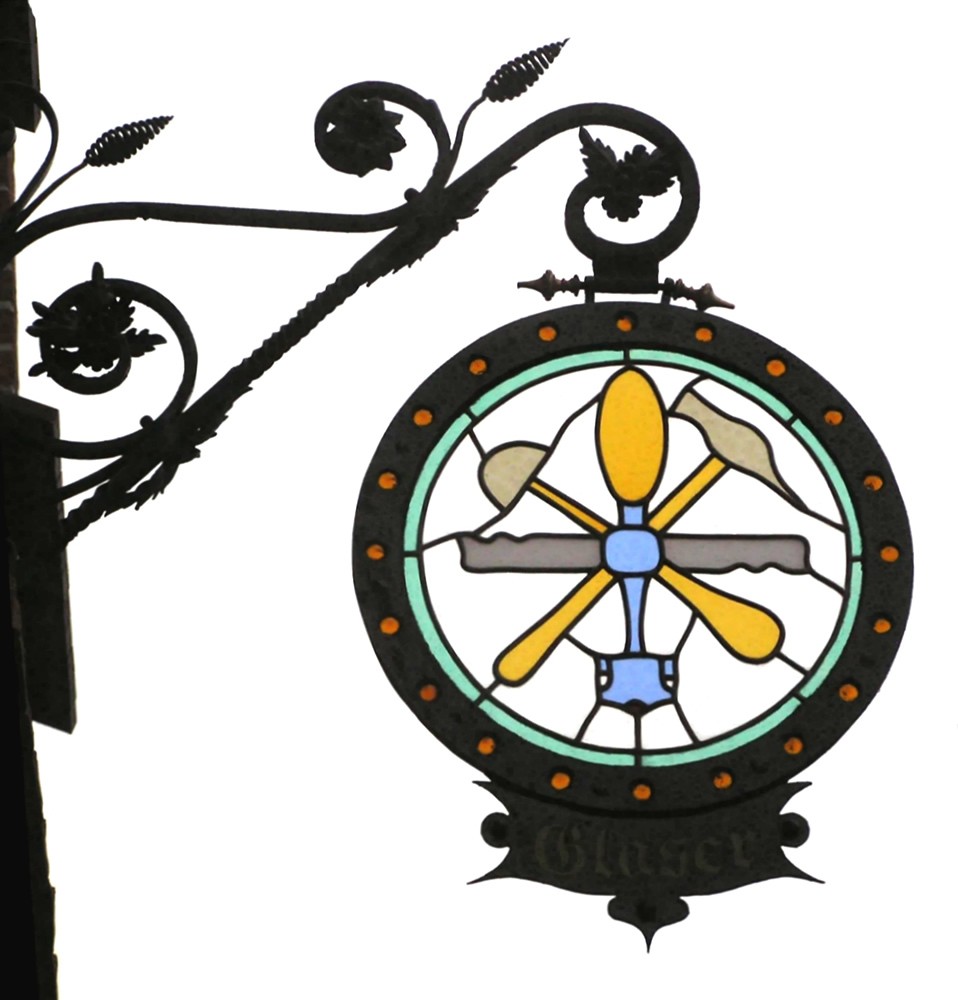
In the Middle Ages, all craftsmen were members of guilds. These groups of senior craftsmen controlled the working hours and conditions of work of their members. They also checked the quality of their wares, to make sure they were up
to standard.
Merchants also belonged to guilds. These were separate from craftsmen’s guilds. They controlled local trade, by making rules about prices, quality, weights and measures, and general business practices.
Market day
Market day was the busiest day of the week in a medieval town. Local farmers came to town to sell their meat and vegetables using horse-drawn, two-wheeled carts, while merchants came from farther afield to sell their fine cloth and other wares. Pedlars sold all kinds of goods. Tinkers would repair pots and pans.
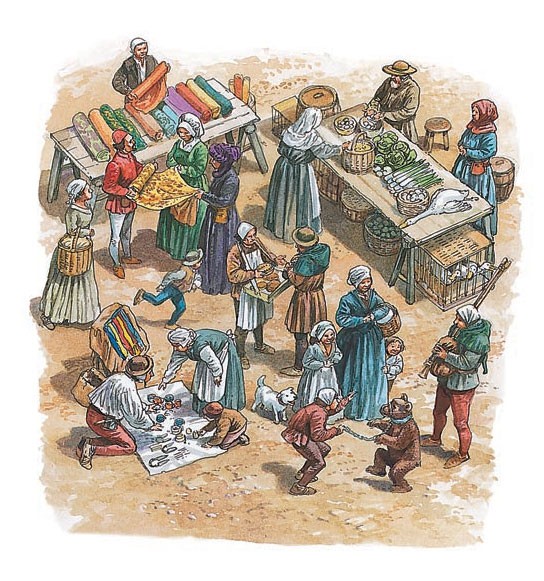
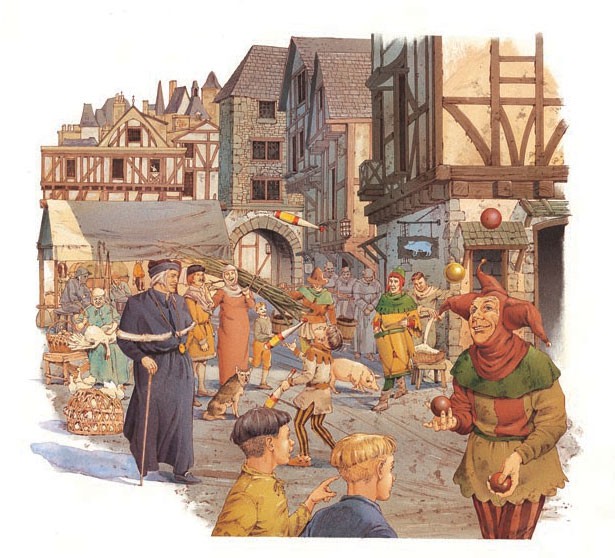
The marketplace was alive with noises and smells on the morning of market day. Pigs were a nuisance, however. Most townspeople kept them as they were cheap and a good source of food. But they were often let out into the streets to forage. The streets of a medieval town were dirty and smelly. Open drain channels ran along the sides or down the middle of the streets. People often threw dirty water out of their windows. The streets were also lively places—particularly on market days. Jugglers, jesters and even dancing bears entertained the crowds.
Punishment
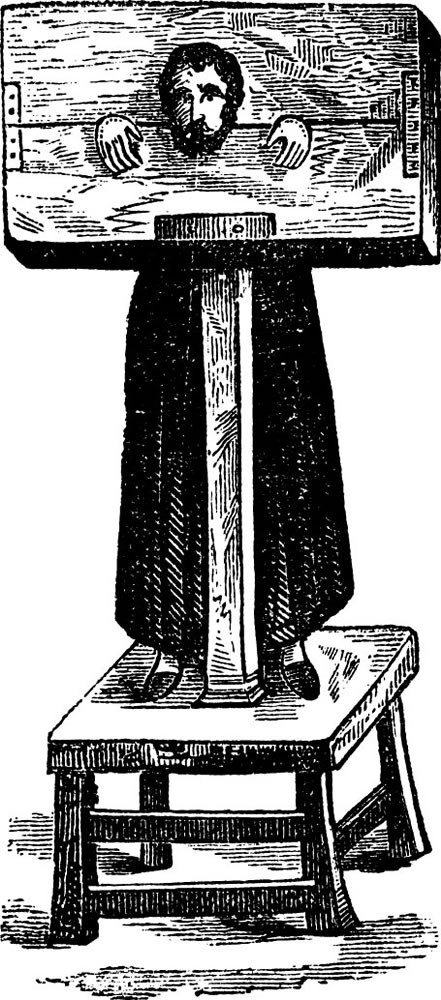
As punishment for petty thefts, stocks and pillories were used for public humiliation. The offender was locked in wooden boards and subjected to abuse. He or she was frequently pelted by rotten fruit. In the stocks, an offender sat with their feet locked in place. In the pillory, they stood locked by the neck and wrists.
Black Death
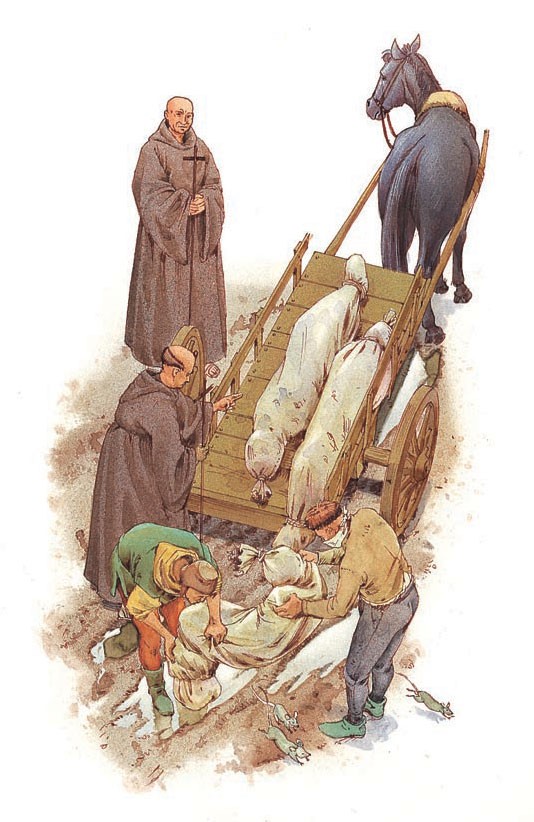
Between 1347 and 1349, a terrible disease called the bubonic plague swept in from Asia and spread across Europe, killing tens of millions of people. It was known as the Black Death. Diseases were common in medieval towns. People lived crowded together and there was no running water to wash away waste or dirt. The commonest symptom was the appearance of buboes, large swellings, in the groin, neck and armpits, which oozed pus and bled when opened. The disease was carried by bacteria in fleas that lived on black rats—although no one knew that at the time. People fled from infected towns and villages—spreading the disease as they went. There was no cure and many people died. The dead bodies were collected on carts in the night. The population of whole towns and villages dropped rapidly.
Consultant: Philip Parker
pics
Without in any way limiting Q-files Ltd’s exclusive rights under copyright, any use of this publication to “train” generative artificial intelligence (AI) technologies to generate text is expressly prohibited. Q-files Ltd reserves all rights to license use of this work for generative AI training and development of machine learning language models.