
Exploration

CITE
We have made every effort to follow citation style rules, but there may be some minor differences. If in doubt, please refer to the appropriate citation style manual.
Christopher Columbus. (2022). In Q-files Encyclopedia, History, Exploration. Retrieved from
https://www.q-files.com/history/exploration/christopher-columbus
"Christopher Columbus." History, Exploration, Q-files Encyclopedia, 13 Sep. 2022.
https://www.q-files.com/history/exploration/christopher-columbus.
Accessed 22 Sep. 2026.
Christopher Columbus 2022. History, Exploration. Retrieved 22 September 2026, from
https://www.q-files.com/history/exploration/christopher-columbus
History, Exploration, s.v. "Christopher Columbus," accessed September 22, 2026.
https://www.q-files.com/history/exploration/christopher-columbus


Christopher Columbus
In 1492 Christopher Columbus (1451–1506) sailed west across the Atlantic Ocean. His aim was to find a sea route to the rich lands of East Asia—the lands of spices and silks. These lands were known to Europeans as the Indies. When Columbus set foot on one of the Caribbean islands he was convinced that he had found the Indies. He called the local people that he met “Indians”. To this day, the Caribbean islands are sometimes called the West Indies. Columbus's four voyages across the Atlantic Ocean made Europeans aware of the existence of the Americas.


Early life
Christopher Columbus was born in the Republic of Genoa in 1451. In those days, Genoa was an independent state with its own language (he was known locally as Christoffa Corombo). Before he was 20, Columbus went to sea, sailing aboard a Genoese warship fighting the Kingdom of Naples. He later travelled to England, and, possibly, Iceland, before moving to work as a trader in Lisbon, Portugal. He married a Portuguese woman called Filipa Moniz Perestrelo.
An ambitious man, Columbus taught himself Latin, Portuguese and Castilian Spanish. He read widely about astronomy, geography and history, including the works of Claudius Ptolemy and the travels of Marco Polo.
Between 1482 and 1485, Columbus sailed along the coast of West Africa, reaching present-day Ghana. While he was away, Filipa died. Columbus returned to Portugal and took his son Diego with him to Spain. His African expedition had inspired him to make plans for a great new voyage.
Sailing west

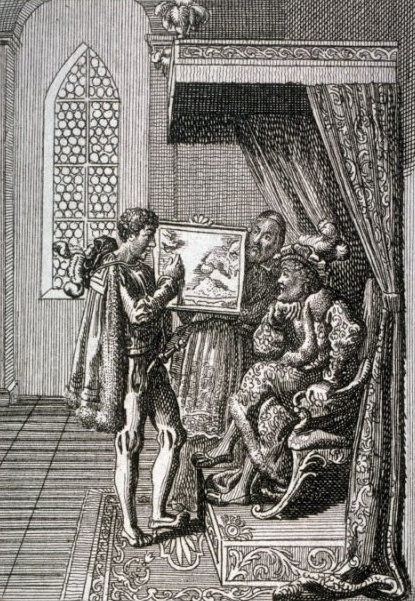
With the fall of Constantinople to the Ottoman Turks in 1453, the land route to Asia had become much more difficult and dangerous. Cut off from the source of valuable goods such as silk and spices, Portuguese navigators looked to find a way to Asia by sea instead.
By the late 15th century, most educated people agreed that the Earth was spherical. In 1470, the Florentine astronomer Paolo Toscanelli suggested to King Afonso V of Portugal that sailing west would be a quicker way to reach Cathay (China), Cipangu (Japan) and the Spice Islands than a route around Africa. Columbus picked up on Toscanelli's suggestion and proposed a plan to reach the Indies by sailing west across the "Ocean Sea", the Atlantic Ocean. It would be quicker and easier than taking the long and hazardous route eastwards.
But the calculations made by Toscanelli and Columbus of the distance from the Canary Islands to Japan—about 3700 kilometres (2300 miles)—was vastly less than the true distance: about 20,000 kilometres (12,000 miles). No ship in the 15th century could have carried enough food and fresh water for such a long voyage.
The Vikings had been the first Europeans to reach the Americas, in the 11th century—but their discovery had long been forgotten. No one in Europe knew of the existence of the Americas, and Columbus had no idea that his voyage westward would lead him to a new continent.
Columbus initially asked King John II of Portugal to sponsor his expedition. However, the king thought that Columbus had miscalculated the size of the Atlantic Ocean, so he refused to give him money. Columbus then turned to King Ferdinand and Queen Isabella of Spain. Eager to compete with other European countries for trade with the Indies, Ferdinand and Isabella believed Columbus's project—although far-fetched—held great promise. They agreed to finance his voyage.

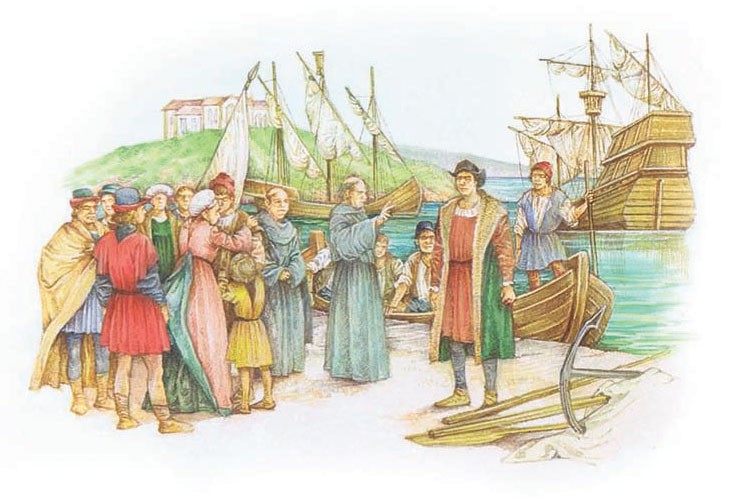
First voyage
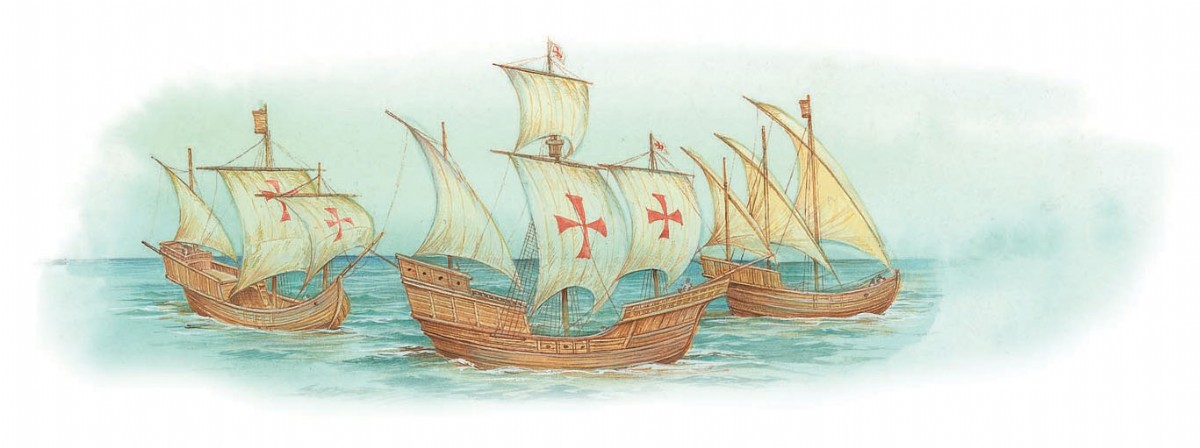
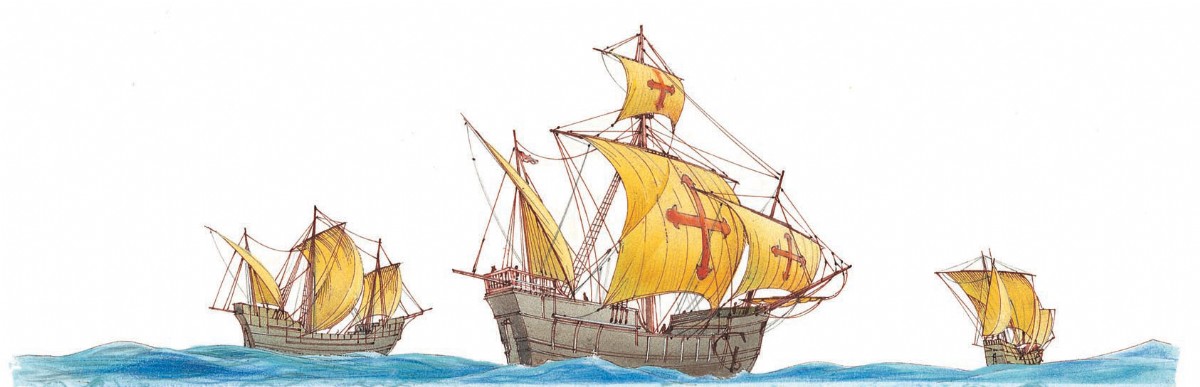
Columbus's fleet sailed from Palos, Spain, 3rd August 1492 with three ships under his command: the flagship Santa María and the smaller caravels (ships with lateen, or triangular, sails), Niña and Pinta. To reassure his restless crew during the voyage, Columbus kept a false log, which indicated that they were not as far from Spain as they really were.
After several false alarms, land was sighted in October. The crew landed on a tiny island which they named San Salvador (“Holy Saviour”). Here they met friendly natives. Thinking he had arrived in the East Indies, Columbus called them “Indians”. He was disappointed, however, not to find the busy Chinese ports he had expected. In fact, Columbus was in what we today call the Bahamas, in the Caribbean Sea. He had reached the Americas.
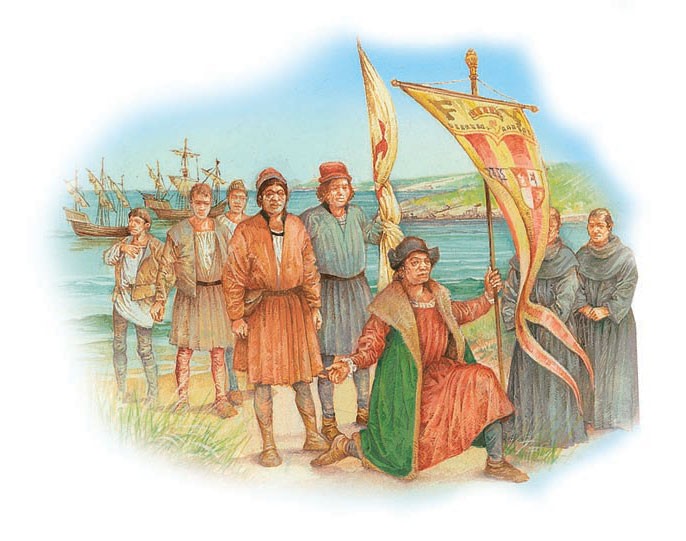

Cuba and Hispaniola
Hoping to find the rich Asian cities they had expected, the crew sailed on to Cuba, which was inhabited by the friendly Taino people. The Europeans were amazed to discover that they slept in hanging beds called hammocks and smoked tobacco leaves.
In November, the crew of the Pinta deserted the expedition, disappointed that no treasure had been found.
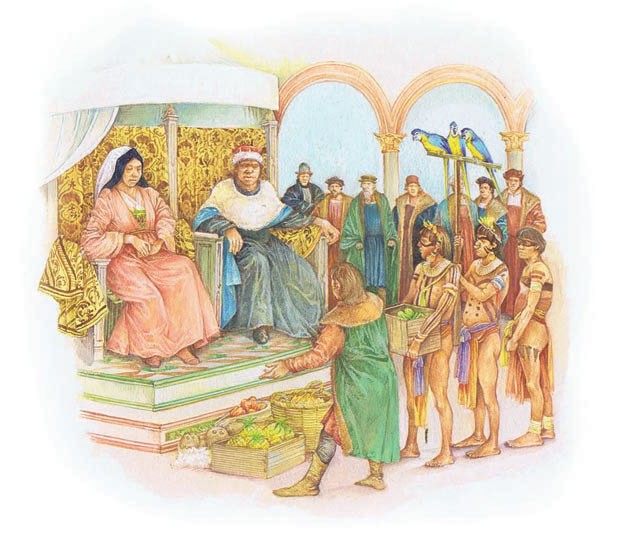
In December, the Santa María was wrecked off the island of Hispaniola (today the Dominican Republic and Haiti), which Columbus had claimed for Spain. He ordered his men to build a fort on the island and left 39 of them behind when he headed back to Spain aboard the Niña. On his return to the Spanish court, word of the new lands he had found soon spread across Europe.
Second voyage
Following his triumphant return to Spain, King Ferdinand and Queen Isabella made Columbus the governor of the islands he had discovered. Six months later, in September 1493, he set out for Hispaniola with a fleet of 17 ships and a crew of over 1000 men.
On arrival, Columbus discovered that the Taino people had destroyed the fort that had been built before he left. They had also killed all of his men. Work soon began on a new settlement, which Columbus named Isabella in honour of the Spanish queen. Angered by the arrival of more Spaniards, the Tainos rebelled. Many were killed in the battles that followed. Still more perished from diseases brought to the islands from Europe.

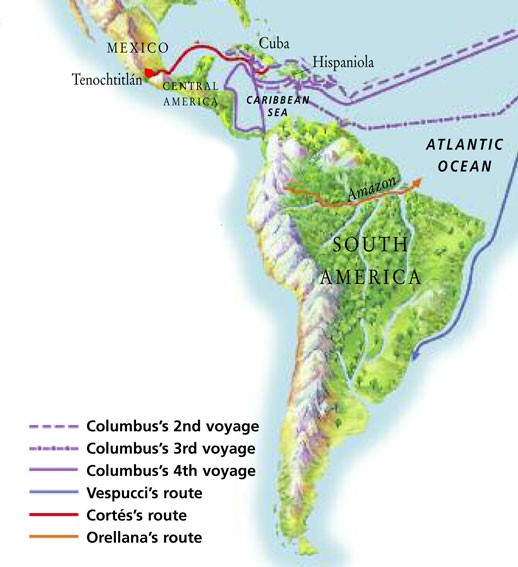
In April 1494, Columbus explored the south coast of Cuba and reached Jamaica. During this second voyage he also sighted and named several Caribbean islands, including Antigua (after a church in Seville, Spain), Montserrat (after the monastery of Montserrat, Spain) and Redonda (from the Spanish for "round", after the island's shape). He sailed back to Spain in 1496.

Third and fourth voyages
Two years later, in 1498, Columbus made a third voyage to the Caribbean. Leaving his brothers, Bartolomé and Diego, in charge of the settlement on Hispaniola, he set out once again to find the longed-for sea route to the Far East. During his voyage, he chanced upon the coastline of mainland South America. However, he was unable to explore it further because more trouble had broken out on Hispaniola. This time, the Spanish settlers had turned on Columbus’s brothers. Learning of the chaos, King Ferdinand and Queen Isabella ordered Columbus to be brought home in chains to explain the situation.
Despite Columbus's disgrace, in 1502 the Spanish monarchs allowed him to make a fourth and final journey to the Caribbean. He reached the coast of Central America, but was unable to find a passage through to Asia. Tired and disappointed, Columbus returned to Spain in 1504. He died on 20th May 1506.
Consultant: Philip Parker
pics

Without in any way limiting Q-files Ltd’s exclusive rights under copyright, any use of this publication to “train” generative artificial intelligence (AI) technologies to generate text is expressly prohibited. Q-files Ltd reserves all rights to license use of this work for generative AI training and development of machine learning language models.