
Exploration

CITE
We have made every effort to follow citation style rules, but there may be some minor differences. If in doubt, please refer to the appropriate citation style manual.
Race for the South Pole. (2024). In Q-files Encyclopedia, History, Exploration. Retrieved from
https://www.q-files.com/history/exploration/race-for-the-south-pole
"Race for the South Pole." History, Exploration, Q-files Encyclopedia, 12 Jan. 2024.
https://www.q-files.com/history/exploration/race-for-the-south-pole.
Accessed 13 Sep. 2026.
Race for the South Pole 2024. History, Exploration. Retrieved 13 September 2026, from
https://www.q-files.com/history/exploration/race-for-the-south-pole
History, Exploration, s.v. "Race for the South Pole," accessed September 13, 2026.
https://www.q-files.com/history/exploration/race-for-the-south-pole


Race for the South Pole
Ernest Shackleton was one of the first to make an attempt on the South Pole. But bad weather in Antarctica forced him to turn back only 157 kilometres (97.5 miles) from the Pole in January 1908. Two expeditions set out in 1911. Robert Falcon Scott (1868–1912) led the British expedition, while Roald Amundsen (1872–1928) led the Norwegian attempt. Scott’s men hauled their own sledges and were held up by blizzards. Carrying no heavy equipment and assisted by a team of dogs to pull their sledges, Amundsen’s better-prepared team succeeded in reaching the Pole 34 or 35 days ahead of Scott in December 1911.

First discovery of Antarctica

No human being had set eyes on Antarctica until Russian Admiral von Bellingshausen made the first reported sighting in 1820. Over the next 80 years, a number of explorers and scientists charted Antarctica’s coastline. In 1895 an Australian team led by Henrik Johan Bull probably became the first to set foot on the icy continent.

Roald Amundsen
Norwegian explorer Roald Amundsen wanted to be the first man to reach the North Pole. When he heard that Robert Peary had got there first, in 1909, he switched his attentions to reaching the South Pole.
Amundsen's ship, the Fram, specially built for polar voyages, carried his expedition to the Bay of Whales, Antarctica. In October 1911 he set out for the Pole with four men and four sledges, pulled by 52 dogs.
Amundsen's expedition

Amundsen was intent on reaching the South Pole as quickly as possible. Unlike Scott, he carried no heavy scientific equipment, so he needed only a team of dogs to pull his sledges across the ice. The first stage was across the Ross Ice Shelf. They made good progress across the flat ice, stopping for supplies already placed along part of the route by an advance party. Next came the climb up the rough ice of the Axel Heiberg Glacier. Terrible cold (–50°C / –58°F), gales and blizzards, hidden cracks in the ice—dangers loomed at all times. Some of the dogs were killed for food.
Reaching the Pole
On 14th December 1911, Amundsen and his team reached the South Pole and raised the Norwegian flag. He measured the sun’s position to confirm his calculations that he had actually reached the Pole. By 25th January, he and his men were back at their ship.


Scott's expedition
The Norwegians were not the only men in Antarctica that summer. A British team, led by Captain Robert Falcon Scott, was also trying to reach the Pole. They followed a longer route and were also carrying heavy scientific equipment, which slowed them down.
On 17th January 1912, Scott and four companions found the Norwegian flag already flying at the Pole. Tired and sad, Scott’s men turned back. Two of his companions, Edgar Evans and Lawrence Oates, died on the return march.
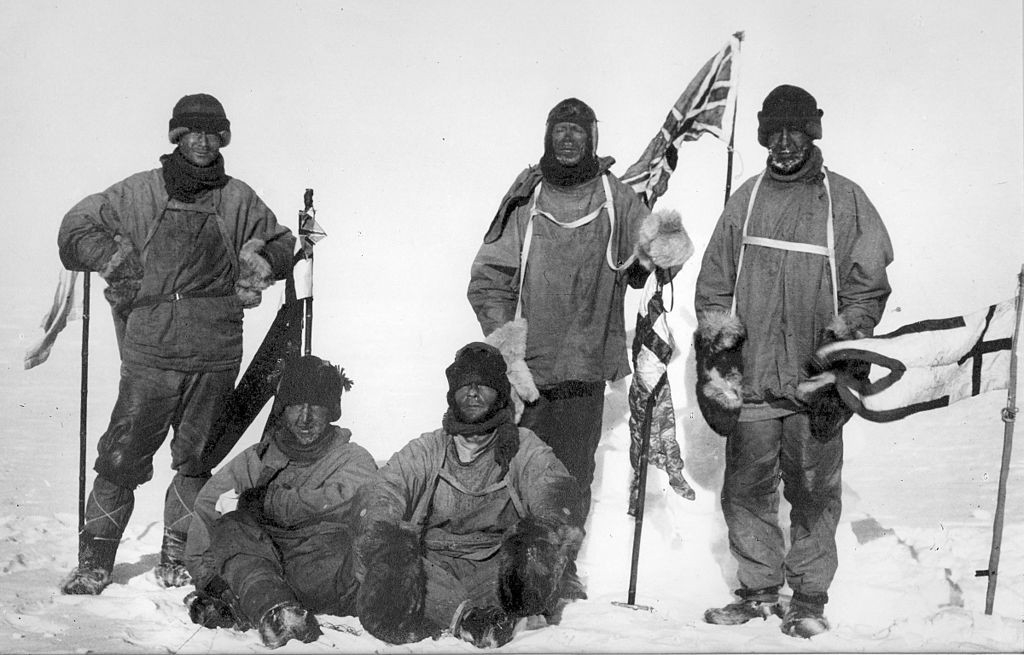
On the Ross Ice Shelf the remaining three—Scott, Edward Wilson and Henry Bowers—were caught in terrible blizzards, just 18 kilometres (11 miles) short of a supply depot. Unable to leave their tent as they waited for the blizzards to end, they watched their supplies dwindle. By 30th March 1912, all three were dead, from a combination of starvation, exhaustion and cold.
Consultant: Philip Parker
pics


Without in any way limiting Q-files Ltd’s exclusive rights under copyright, any use of this publication to “train” generative artificial intelligence (AI) technologies to generate text is expressly prohibited. Q-files Ltd reserves all rights to license use of this work for generative AI training and development of machine learning language models.