
Exploration

CITE
We have made every effort to follow citation style rules, but there may be some minor differences. If in doubt, please refer to the appropriate citation style manual.
South American exploration. (2026). In Q-files Encyclopedia, History, Exploration. Retrieved from
https://www.q-files.com/history/exploration/south-american-exploration
"South American exploration." History, Exploration, Q-files Encyclopedia, 30 Apr. 2026.
https://www.q-files.com/history/exploration/south-american-exploration.
Accessed 2 Nov. 2026.
South American exploration 2026. History, Exploration. Retrieved 2 November 2026, from
https://www.q-files.com/history/exploration/south-american-exploration
History, Exploration, s.v. "South American exploration," accessed November 2, 2026.
https://www.q-files.com/history/exploration/south-american-exploration


South American exploration
Once Europeans had discovered the existence of South America at the end of the 15th century, they set out to explore its coastline and interior. From the 16th century, Spanish and Portuguese adventurers, known as conquistadores, arrived on the continent, seeking gold, trade routes and new lands. The legend of El Dorado—a kingdom said to be rich in gold—enticed European explorers to the Amazon Basin in search of riches. No trace of it was ever found, but while searching, explorers made some of the first maps of the region and its rivers. In the 19th century Alexander von Humboldt (1769–1859) and Charles Darwin (1809–1882) made important scientific discoveries in South America while exploring the natural world. The early 20th century saw explorers such as Percy Fawcett (1867–1925) and Hiram Bingham (1875–1956) venture deep into the continent's rainforests in search of lost worlds.
First expeditions
South America lay unknown to Europeans until 1498, when Christopher Columbus caught sight of its coast on his third voyage to the Americas. Columbus sailed into the Gulf of Paria (modern-day Venezuela) and was amazed by the quantity of fresh water pouring into the ocean from the River Orinoco. He guessed that such a huge volume of water must come from a land the size of a continent.
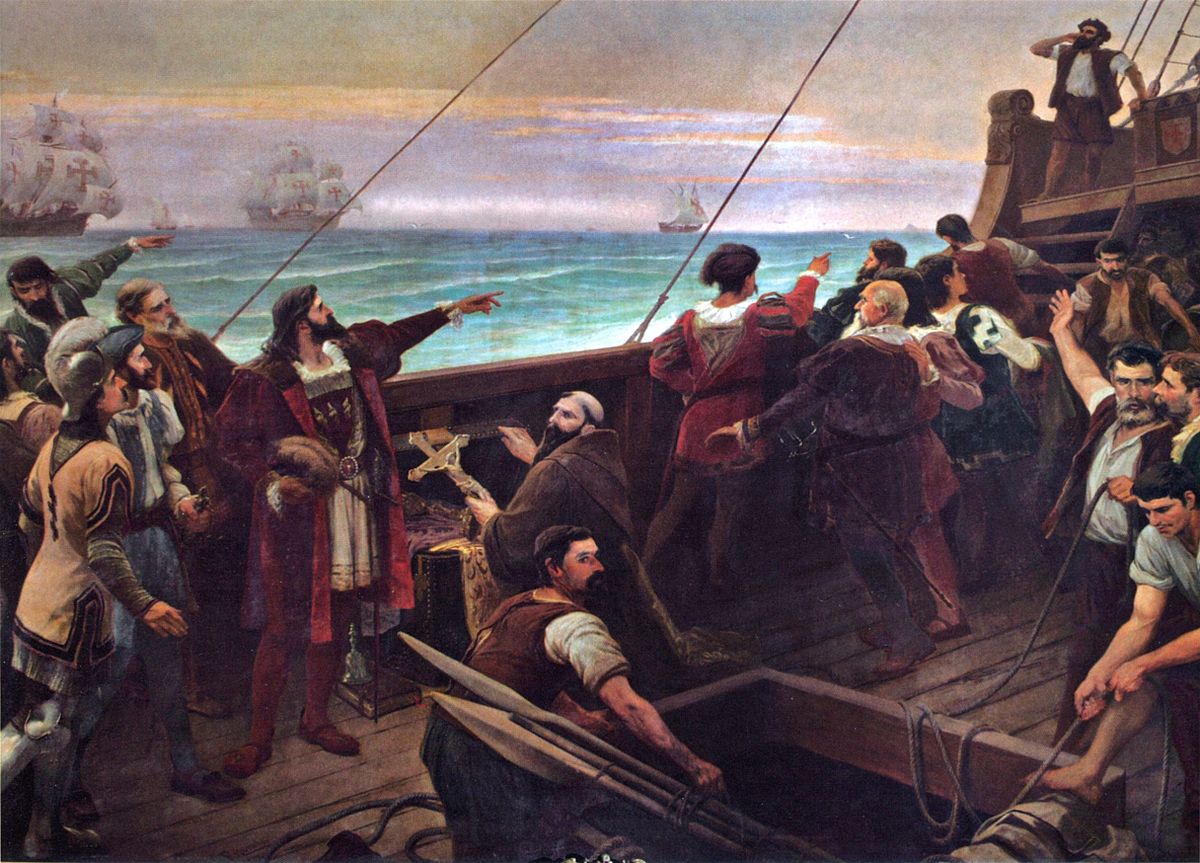
Two years later, in 1500, a Portuguese navigator named Pedro Cabral (c.1468–1520) became the first European to explore this land, which he thought at first to be a large island. Cabral was attempting to follow Vasco da Gama's sea route to India when he sailed too far west and accidentally reached the northeast coast of South America. As the land lay within the Portuguese sphere according to the Treaty of Tordesillas, Cabral claimed it for Portugal.
Cabral made contact with the native people, the Tupiniquim, who were friendly. To confirm his claim, he erected a large wooden cross, and named the newly discovered land the Island of the True Cross. It would later come to be known as Brazil.
In 1501 the King of Portugal, Manuel I, sent an expedition to explore further the land Cabral had found. It was headed by the Italian explorer Amerigo Vespucci (1451–1512). When Vespucci and his ships arrived on the northeast coast they faced a hostile reception from the native people and were forced to sail onwards. They travelled south, charting the coastline as they went. On New Year’s Day 1502 they reached a large bay, which Vespucci named Rio de Janeiro (“River of January”). On his return to Portugal Vespucci wrote to the King with an account of his expedition. He confirmed that the land they had explored was part of a new continent, which he called the New World. It was later named America after him.

Juan Díaz de Solís

In 1515 the Spanish navigator Juan Díaz de Solís (1470–1516) set out to explore the coast of South America for Spain and find a route through to the Pacific Ocean. He and his men arrived at the point where the Uruguay and Paraná rivers flow into the sea, and named the estuary Mar Dulce (“Freshwater Sea”).

Still looking for a passage, the ships sailed up the River Uruguay until they reached an island. Díaz de Solís and around eight of his men went ashore, but the group were immediately attacked and killed by the people who lived there (probably the Guaraní). The rest of the crew fled in horror.
Only the ship's boy survived the attack. He lived among the islanders for ten years, until the arrival of another Spanish expedition led by the Venetian navigator Sebastian Cabot (c.1474–1557). Cabot explored more of the estuary in 1526, sailing up the River Paraná as far as the site of the present-day city of Asunción. Here, the Guaraní people traded silver objects with him, which inspired him to name the area Rio de la Plata (“River of Silver”).
A new sea passage
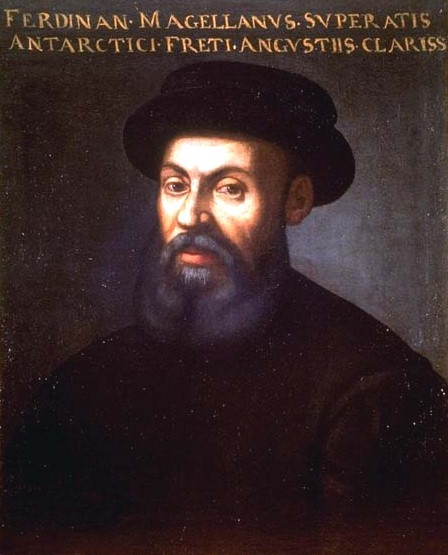
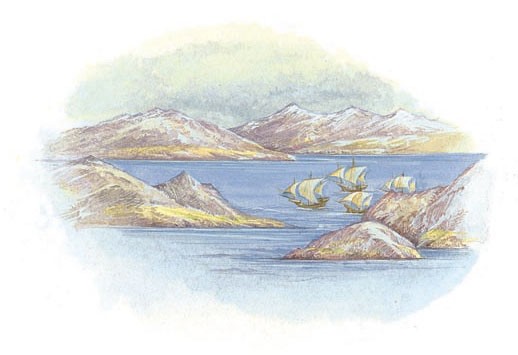
Shortly after Díaz de Solís's journey, King Charles I of Spain sent another expedition to look for a passage to Asia. It was headed by the Portuguese navigator Ferdinand Magellan. Magellan's ships reached South America in 1519 and followed its coastline southwards. Nearing the treacherous southern waters, they came across an inlet in the coast which Magellan hoped would lead through to another ocean. The ships sailed through the snaking 600-kilometre (370-mile) channel, which did indeed open into the Pacific Ocean on the other side of the continent. Magellan called the passage he had discovered Estrecho de Todos los Santos (“All Saints' Channel”) after the date they entered the channel: 1st November 1520, All Saints' Day. It was later renamed the Strait of Magellan.

Search for El Dorado
By the 1530s the Spanish had begun their conquest of the Inca civilization. Spanish soldiers, the conquistadores, set out on expeditions in search of riches to plunder. They had heard legends about the rich chief of the Muisca people, who covered his body with gold dust and poured gold into a lake as an offering to the gods. Over time, the story became ever more fanciful: the golden king turned into a golden city, and then a whole empire of gold named El Dorado. The empire was said to be in the Lake Guatavita region near present-day Bogotá, Colombia.

Spanish conquistador Gonzalo Pizarro (1510–48) and his men searched the area in the early 1540s but found no trace of the legendary kingdom. Others, such as the English adventurer Sir Walter Raleigh (c.1554–1618), spent years scouring other parts of South America for evidence of rumoured cities of gold, but none were ever found. Local people often claimed that El Dorado lay somewhere far away, so that the Europeans would leave them alone.
Silver mountain
The conquistadores failed to find gold, but in 1545 they discovered the richest silver mine to date: Potosí, in the Andes Mountains in present-day Bolivia. The silver came from rich ores inside the Cerro Rico (“Rich Mountain”). The mining town of Potosí grew up in the neighbourhood and soon became one of the largest cities in the Americas. Around 45,000 tonnes of silver were mined between 1546 and the end of the 17th century, mostly by local people and then by imported African slaves. Many of these people died from the harsh conditions in which they were forced to work.


Francisco de Orellana
The first European to navigate the entire length of the River Amazon was the Spanish conquistador Francisco de Orellana (1511–46). In 1541 he took part in an expedition searching for El Dorado along the River Coca in Ecuador. When the group ran out of food, Orellana took a boat and sailed ahead with a party of 60 men to look for supplies. But when the crew eventually found food, they realised the current was too strong for them to return. Instead they decided to build a new boat and follow the water's course. They soon found themselves sailing down a gigantic river.

On their way they encountered fierce women warriors who reminded Orellana of the Amazons, mythical female warriors of ancient Greece. The women attacked the Spanish boats from the banks of the river. One Spaniard wrote that the arrows came down so thickly that “we could not see each other”. Orellana later named the river after the "Amazons".
As they sailed through the warriors’ kingdom, the Spanish explorers passed what they later described as glittering white villages, cities and temples. When they came ashore, their wealthy hosts supplied them with fruit and turtle meat. Further downriver, however, the Spaniards were shot at with poisoned arrows.
A year and a half after beginning his voyage, Orellana’s boat eventually reached the mouth of the great Amazon. He sailed on to Trinidad and then homewards, eventually reaching Spain. Orellana returned to explore the Amazon in 1546, but the expedition was a disaster—many ships and nearly all his men were lost before they even reached South America. As the remaining ships neared the mouth of the Amazon, Orellana’s own ship was wrecked, and he died soon afterwards.

Juan Ladrillero

Having taken possession of what is today Chile, Spanish governors sent an expedition to explore its rugged coastline. Two ships set out from Valdivia: one headed by captain Juan Ladrillero (1490–1559), the other by Francisco de Cortés Hojea, a mapmaker. They sailed southwards, and had almost reached the mouth of the Strait of Magellan when the two ships were separated; Cortés Hojea’s ship was badly damaged. After repairs, he and his men failed to find the strait's entrance and sailed home, deciding that it must have been blocked by a new island or landfall. Meanwhile, Ladrillero had found his way through to the strait and was sailing through it west–east, the first European to do so. He made detailed measurements of the strait, its bays and harbours. When he emerged into the South Atlantic Ocean at the other end, he claimed the entire region he had explored for Spain.

European rule
By 1700, most of South America was ruled by Spain and Portugal. Only a tiny northern portion (today's French Guiana) was ruled by France. The Peruvian capital Lima was the continent's most important city, standing as it did at the centre of the Spanish silver trade. In the 1680s a wall was built around Lima to protect it from pirate attacks. Europeans who came to live in South America settled in coastal cities such as Lima, Santiago, Chile and Buenos Aires, Argentina, while the indigenous peoples lived in rural and upland areas. Vast areas of South America's interior remained unexplored and uncharted—including most of the Amazon rainforest.
La Condamine
Between 1736–43, the French scientist Charles-Marie de la Condamine (1701–74) led a research expedition to Quito, Ecuador (then part of Peru). The scientists planned to take measurements at the equator to test Isaac Newton’s theory that the Earth was a sphere that bulged at the equator and was flattened at the poles. The French group secretly also had another mission: they wanted to explore Peru, which was always closely-guarded by its Spanish rulers, and which the rest of the world knew little about.

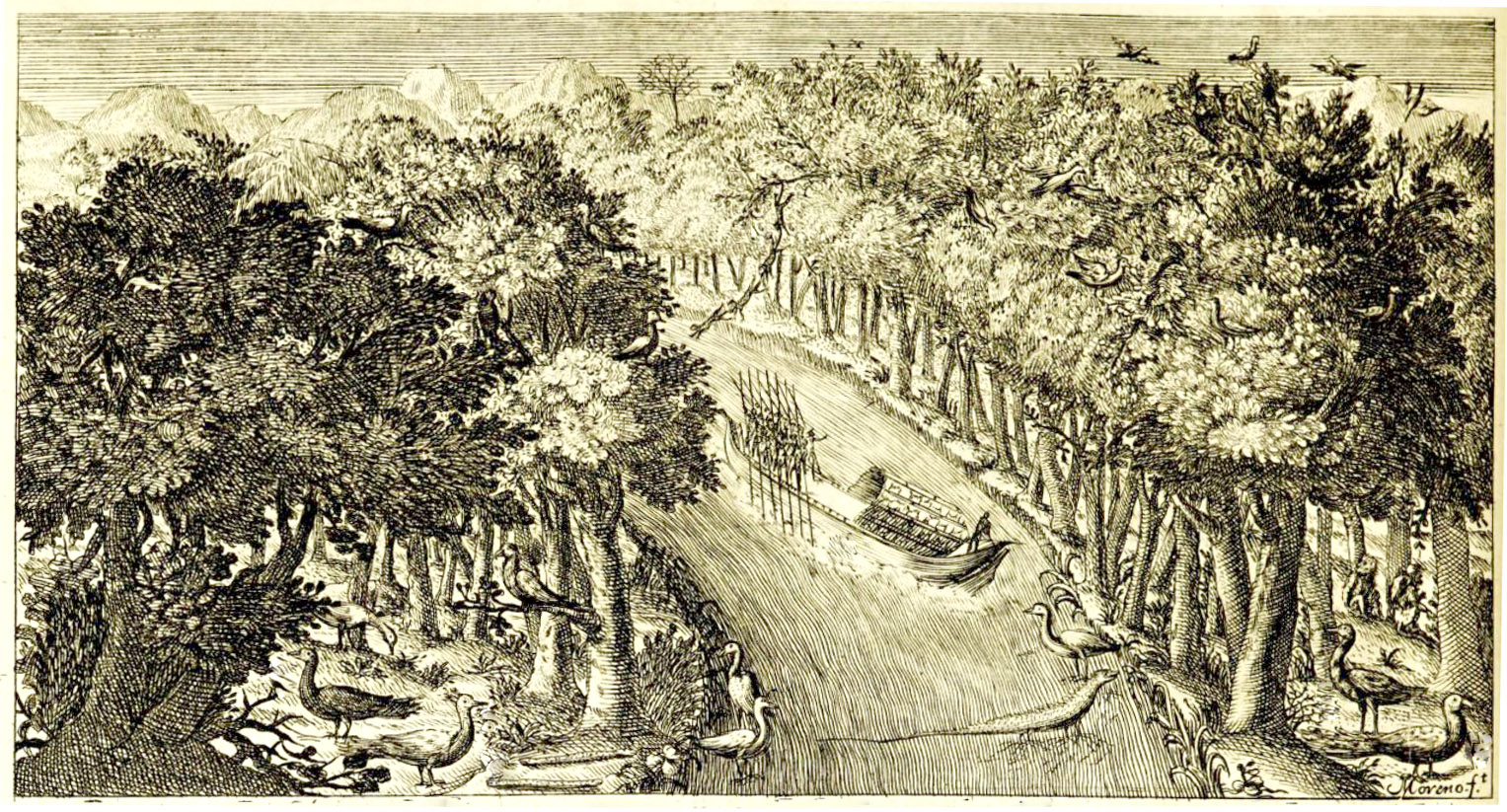
The scientists were granted permission to travel to Peru by the Spanish king, Philip V. They sailed across the Atlantic to the French Caribbean island of Martinique and then on to the port of Manta on the Pacific coast, arriving in March 1736. From there, they journeyed inland to Quito. The lowland paths were waterlogged, and the group were plagued by mosquitoes and other insects.
High in the Andes Mountains, they crossed swaying bridges made from vines and rode their horses along the steep sides of canyons, even skirting a path round Mount Chimborazo, an active volcano. One year after setting out, the group finally arrived in Quito with their scientific equipment, ready to begin their work.

In 1743, once the expedition was over, its members returned to France separately. La Condamine chose to travel home down the River Amazon in a dugout canoe. He made a detailed map of the river’s course as he travelled and took notes on the wildlife and plants he observed. As the river widened, he noted: “I found myself in a new world... surrounded by a maze of lakes, rivers and canals... in every direction the gloom of an immense forest”. La Condamine eventually arrived back in France in 1745, more than a decade after he had left.
Isabel Godin des Odonais
Isabel Godin des Odonais (1728–92) became famous during her lifetime for her epic journey across the Amazon Basin in 1769. Born Isabel Gramesón into a wealthy Spanish family, Isabel grew up in Quito, which was at that time part of Peru. She married Jean Godin des Odonais, a scientist taking part in La Condamine's expedition, but the pair became separated when Godin travelled to French Guiana and Spanish authorities prevented him from returning to Peru. Isabel waited for 20 years for her husband to return before eventually setting out to find him in October 1769. Together with a group of 42 servants, porters and family members she journeyed from Quito to Cayenne, at the mouth of the Amazon, a six-month voyage that would cover 5000 kilometres (3000 miles). At the time, it was extremely unusual for a woman to make such a journey.

One by one, the members of her expedition fled, died from diseases or drowned. Eventually Isabel was left to make the rest of the journey alone. For nine days, she walked alone through the rainforest, starving and plagued by insects, until she found help from local indigenous people. They nursed her back to health, and took her by canoe to Cayenne. Here, in July 1770, she was reunited with her husband. Together they moved to France, where they lived for the rest of their lives.
Alexander von Humboldt
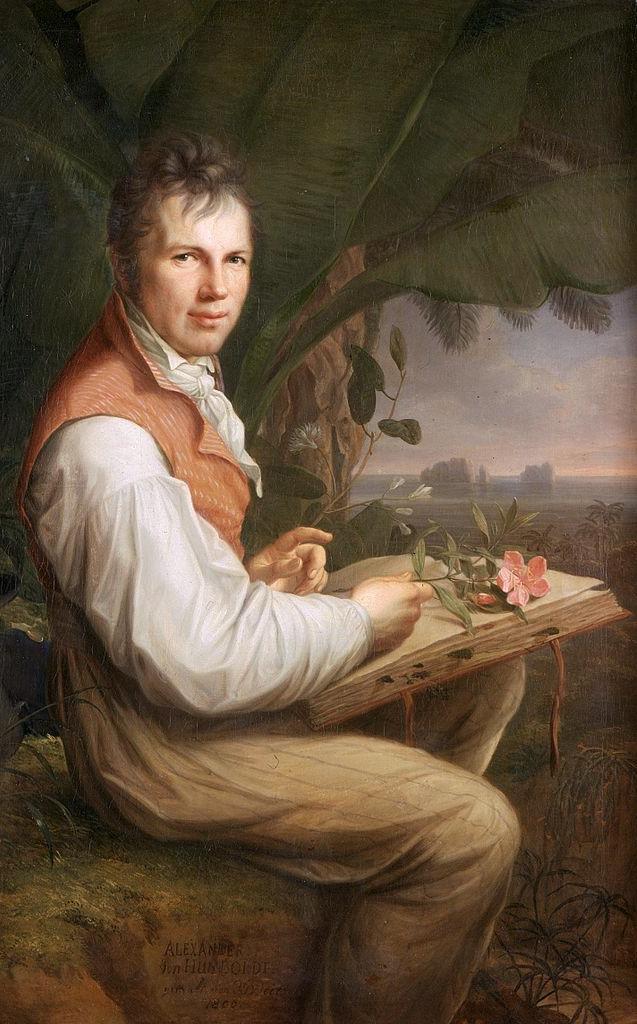
The German scientist Alexander von Humboldt (1769–1859) made a five-year expedition to South America in 1799, travelling with botanist Aimé Bonpland. Humboldt wanted to investigate the way that things in the natural world connected with one another, such as the relationship between creatures and their habitats. His ideas would come to influence Darwin's theory of evolution.
Humboldt and Bonpland began their expedition in Venezuela, where they travelled 2250 kilometres (1400 miles) along the River Orinoco in canoes steered by locals, living on a diet of rice and ants. Along the way, Bonpland collected flower specimens, while Humboldt took measurements of the river. In November, the two scientists set sail for Cuba. Here, Humboldt saw slaves working on plantations. Appalled by the practice, he declared slavery to be the “greatest of all evils.”

Their next stop was Ecuador, where they climbed high into the Andes to measure volcanoes, and shimmied along ledges to peer into their craters. In 1802 they set out to climb Mount Chimborazo, then believed to be the world’s highest mountain. Recording every plant and creature they saw, they noticed fewer and fewer signs of life as they travelled higher up. Near the summit, local guides left Humboldt and Bonpland to complete their ascent alone.
The pair climbed upwards through heavy fog until it cleared and they saw an enormous ravine in front of them, blocking their way to the top of the mountain. Forced to retrace their steps, the pair had nevertheless climbed higher than anyone on Earth had been known to climb before. Travelling onwards to Peru, Humboldt observed a cool ocean current moving up the Peruvian coast of the Pacific Ocean. This important discovery would come to bear his name: the Humboldt Current.


Charles Darwin
In 1832 the young British naturalist Charles Darwin (1809–82) arrived in South America on board the British Royal Navy’s survey ship, HMS Beagle. The ship docked in Salvador, Brazil, where Darwin saw tropical rainforest for the first time. He wrote in his journal about this experience: “I never experienced such intense delight.”
While the ship carried out its mission to map the coastline, Darwin went ashore to make observations and collect specimens in Brazil, Argentina, Chile and the remote Galápagos Islands. Overall, he collected more than 1500 specimens, including both fossils and plants, to send back to England. Most of the plants had never been seen before in Europe.
Darwin was also interested in geology—the study of rocks and the formation of the Earth. In Chile, he noticed petrified (fossilized) trees along the coast. He climbed high into the Andes Mountains, where he found remains of similar petrified trees. He wondered if the mountains had been pushed up from sea level by a series of earthquakes.
Cândido Rondon
Towards the end of the 19th century, the Brazilian government wanted to improve communications and transport links across Brazil. In 1890, a young Brazilian soldier named Cândido Rondon (1865–1958) was given the task of building a telegraph line across the state of Mato Grosso, one of Brazil’s remotest regions.
Later, Rondon built a road connecting Brazil’s interior with the Atlantic coast for the first time, as well as an even longer telegraph line—this time stretching across the whole of the country. Rondon’s work took him to places that had never been explored before. He built good relationships with the indigenous Bororo people who lived there. Once they got to know him, some Bororo villagers helped Rondon with his work.
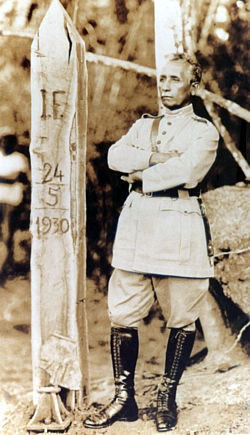

In 1909 Rondon led an eight-month expedition from Mato Grosso to the River Madeira. During this trip Rondon discovered an unknown Brazilian river that had never been mapped before. He named it the River of Doubt, and returned to map it with former US president Theodore Roosevelt in 1914. A tributary of the Aripuanã, it is now known as the Roosevelt River.

Harriet Chalmers Adams
American explorer, writer and photographer Harriet Chalmers Adams (1875–1937) set off on a South American expedition in 1904 with her husband Franklin. Together they travelled 64,000 kilometres (40,000 miles)—mostly on horseback, on foot and by canoe—through both the Andes and the Amazon rainforest. As they travelled, Adams spoke to local people, took photographs and recorded notes on her experiences in a diary and a scientific logbook. She sent detailed reports of her travels to the National Geographic magazine. When her writing was published, it quickly made her name as an expert on South America.
In 1925 Harriet Adams was made the first president of the Society of Women Geographers, a club set up for women explorers, who were banned from the all-male Explorers Club. Speaking about her life as a female explorer, Adams told a newspaper in 1920, “If a woman be fond of travel, if she has love of the strange, the mysterious and the lost, there is nothing that will keep her at home ...”
Machu Picchu
American-born Hiram Bingham (1875–1956) was the first Westerner to come across the ruins of Machu Picchu in 1911. Bingham originally set out in search of the Inca capital city of Vilcabamba, lost to Spanish conquistadores in 1572. On his way, he found the ruins of Vitcos, an Inca palace. Local farmers then led him to the overgrown ruins of Machu Picchu. For the rest of his life, Bingham believed that Machu Picchu was the lost city of Vilcabamba, but after his death another of the cities he discovered, Espíritu Pampa, was proved to have been a more likely site.


Percy Fawcett
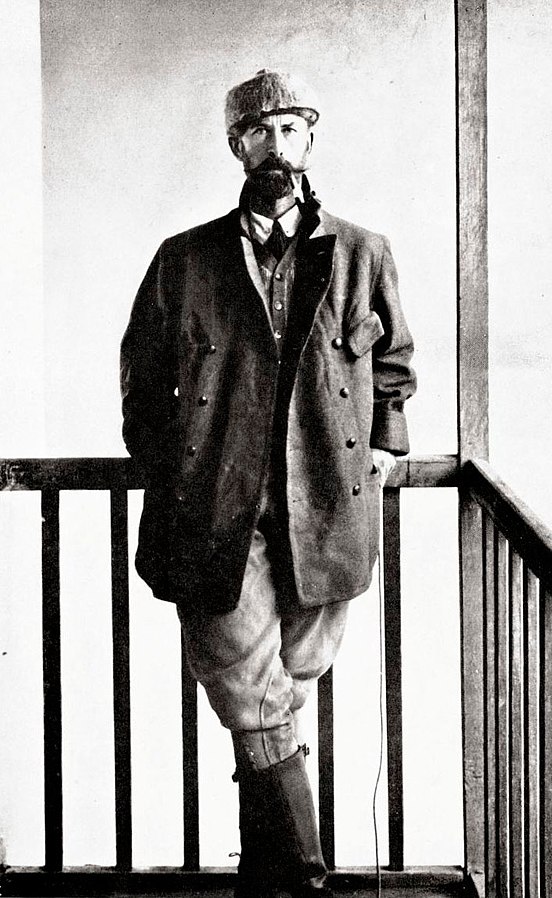
Percy Fawcett (1867–1925) was a British army officer who first went to South America in around 1906 to map the border between Bolivia and Brazil. He then surveyed the Rio Verde river in eastern Bolivia, and traced the river to its source. His 310-kilometre (193-mile) journey took him through a region that had never been mapped before.
In 1925 Fawcett led an expedition from Cuiabá in central Brazil, to find what he called the lost city of “Z”, the remains of a great civilization with statues and temples. He had read 18th-century reports of a magnificent city hidden deep in the Amazon and become convinced that a large, sophisticated civilization had existed there. Five years earlier, he had even made a solo attempt to find it. This time aged 57, he set out once more to look for Z in the unexplored Mato Grosso region of Brazil. But the 1925 expedition ended in disaster: Fawcett, along with his son Jack and Jack’s friend Raleigh vanished in the rainforest and were never found.
People have continued to try and solve the mystery of Percy Fawcett’s disappearance since 1925. It is thought that around 100 people have died in the Amazon while trying to discover what happened to him.
Modern exploration
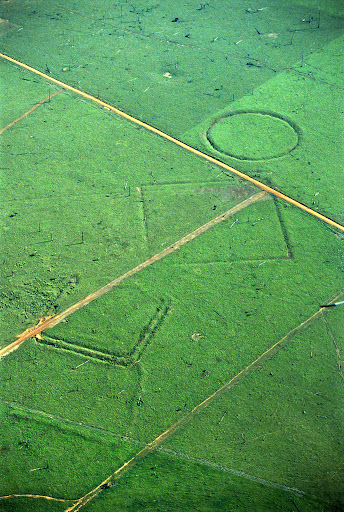
Exploring the Amazon with satellite technology in 2009, archaeologists have discovered the remains of an ancient civilization in the Amazon rainforest. They found a network of earthworks stretching over an area of 250 kilometres (155 miles), suggesting that roads, houses and other buildings were buried under the ground. Ten years later, a team of archaeologists dated the settlements to between 1200 and 1500 AD
Their discovery makes it likely that there really was a lost city of “Z”, as Percy Fawcett and others believed. It is likely that this civilization—probably the one witnessed by Orellana on his journey down the Amazon in 1542—was wiped out by smallpox and other diseases from Europe, to which its people had no immunity.
Consultant:Philip Parker
pics


Without in any way limiting Q-files Ltd’s exclusive rights under copyright, any use of this publication to “train” generative artificial intelligence (AI) technologies to generate text is expressly prohibited. Q-files Ltd reserves all rights to license use of this work for generative AI training and development of machine learning language models.