
Exploration

CITE
We have made every effort to follow citation style rules, but there may be some minor differences. If in doubt, please refer to the appropriate citation style manual.
Robert Peary. (2025). In Q-files Encyclopedia, History, Exploration. Retrieved from
https://www.q-files.com/history/exploration/robert-peary
"Robert Peary." History, Exploration, Q-files Encyclopedia, 10 Jun. 2025.
https://www.q-files.com/history/exploration/robert-peary.
Accessed 13 Sep. 2026.
Robert Peary 2025. History, Exploration. Retrieved 13 September 2026, from
https://www.q-files.com/history/exploration/robert-peary
History, Exploration, s.v. "Robert Peary," accessed September 13, 2026.
https://www.q-files.com/history/exploration/robert-peary


Robert Peary
American explorer Robert Peary (1856–1920), along with Matthew Henson (1866–1955) and others, made several Arctic expeditions from 1886 onwards. His early journeys gave him experience of Arctic conditions, but all attempts on the North Pole itself were beaten back by the weather, starvation and frostbite. Peary claimed that he and Henson finally made it to the Pole in April 1909, but his claims have never been wholly accepted.

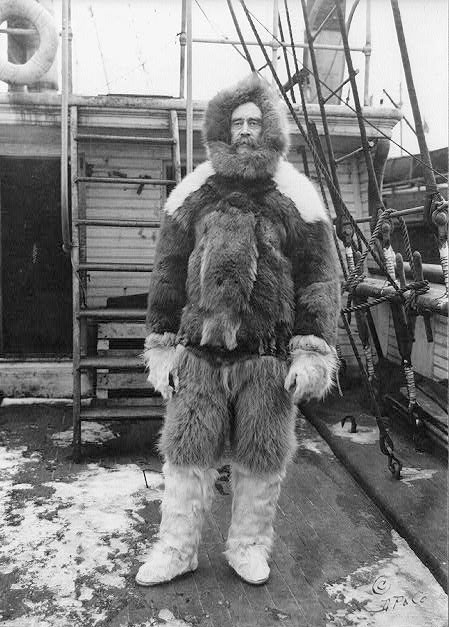
Peary's expedition
In 1909 Robert Peary began his eighth Arctic expedition. He was 52 and he had already lost eight of his toes through frostbite, but he was determined to reach the North Pole. Nothing else in his life mattered so much. From his base on Cape Columbia in Canada, he set out with 19 dog sledges across the shifting ice of the Arctic Ocean. Though often held up by stretches of open water, called leads, he advanced at a brisk rate of 24 kilometres (15 miles) a day. Other members of the expedition had gone ahead to leave supplies of fuel and food before turning back.
Dash for the Pole
Peary made the final dash to the Pole with his friend Matthew Henson and four Inuit. On 6th April 1909, they finally reached it. Ill and exhausted, Peary himself had travelled on a dog sledge, and had sent Henson on ahead as scout. Henson later recalled that his footprints were first at the spot they identified as the North Pole. He planted the US flag there.

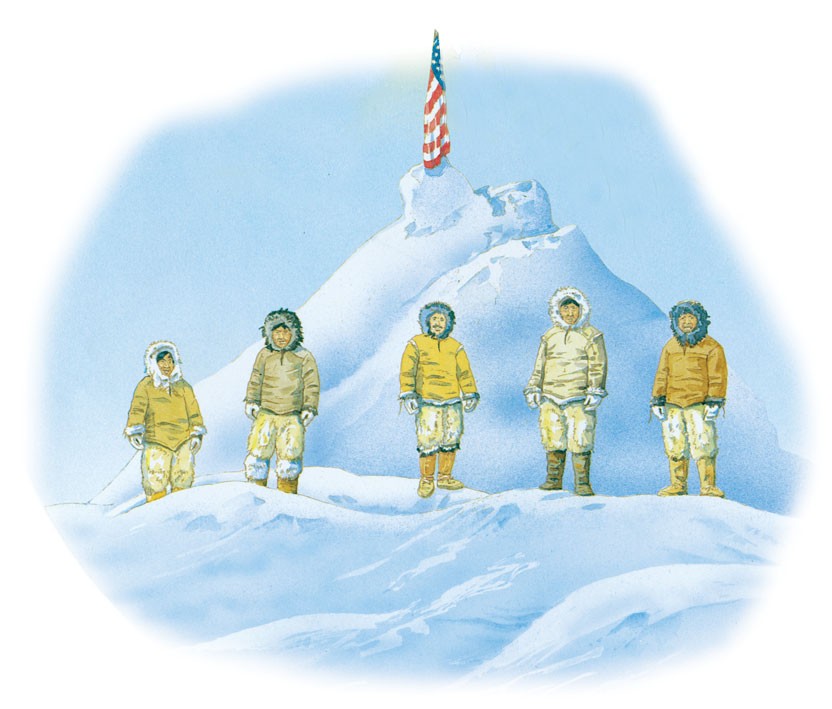
No one had ever travelled so fast across the Arctic ice. In that final dash, Peary and his companions covered more than 300 kilometres (190 miles) in four days. Doubts over his incredible speed have made some people think that Peary never reached the Pole at all.
Consultant: Philip Parker
Timeline of polar exploration
1576–78
Englishman Martin Frobisher searches for Northwest Passage between the Atlantic and Pacific Oceans.
1741
Danish explorer Vitus Bering discovers Alaska.
1773
Captain James Cook crosses the Antarctic Circle.
1893
Norwegian explorer Fridtjof Nansen sets sail for the North Pole in the Fram, a ship specially designed to resist the pressure of the ice in the Arctic Ocean. Nansen walks on the pack ice to within 380 km (240 miles) of the North Pole before turning back.
1909
Peary possibly reaches the North Pole.
1911–12
Amundsen and Scott both reach the South Pole.
1914–16
Shackleton’s Antarctic expedition.
1926
Italian Umberto Nobile flies across the North Pole in the airship Norge, with Amundsen aboard.
1968
British explorer Wally Herbert makes the first dog-sledge journey across the Arctic Ocean via the North Pole.
1992–93
Britons Ranulph Fiennes and Mike Stroud make the first unsupported crossing of Antarctica.
1994
Norwegian Liv Arnesen is the first woman to ski solo to the South Pole.
pics
Without in any way limiting Q-files Ltd’s exclusive rights under copyright, any use of this publication to “train” generative artificial intelligence (AI) technologies to generate text is expressly prohibited. Q-files Ltd reserves all rights to license use of this work for generative AI training and development of machine learning language models.