
Ships and boats

CITE
We have made every effort to follow citation style rules, but there may be some minor differences. If in doubt, please refer to the appropriate citation style manual.
History of sailing ships. (2026). In Q-files Encyclopedia, Technology, Ships and boats. Retrieved from
https://www.q-files.com/technology/ships-and-boats/history-of-sailing-ships
"History of sailing ships." Technology, Ships and boats, Q-files Encyclopedia, 13 Mar. 2026.
https://www.q-files.com/technology/ships-and-boats/history-of-sailing-ships.
Accessed 13 Oct. 2026.
History of sailing ships 2026. Technology, Ships and boats. Retrieved 13 October 2026, from
https://www.q-files.com/technology/ships-and-boats/history-of-sailing-ships
Technology, Ships and boats, s.v. "History of sailing ships," accessed October 13, 2026.
https://www.q-files.com/technology/ships-and-boats/history-of-sailing-ships


History of sailing ships
The first sailing boats had single masts with square sails fixed to them. Over the centuries, boatbuilders arranged their boats' sails, called the rig, in various ways designed to catch the wind more efficiently. A square rig consists of sails hung on a spar across the boat. The fore-and-aft rig, with a triangular sail hanging from a spar parallel with the boat’s sides, is more effective at making the best use of wind blowing from side on. By the 15th century, many ships had a mixture of rigs: square-rigged sails on some masts and fore-and-aft sails on others. Ships (large vessels) could now sail across the oceans.
The first boats
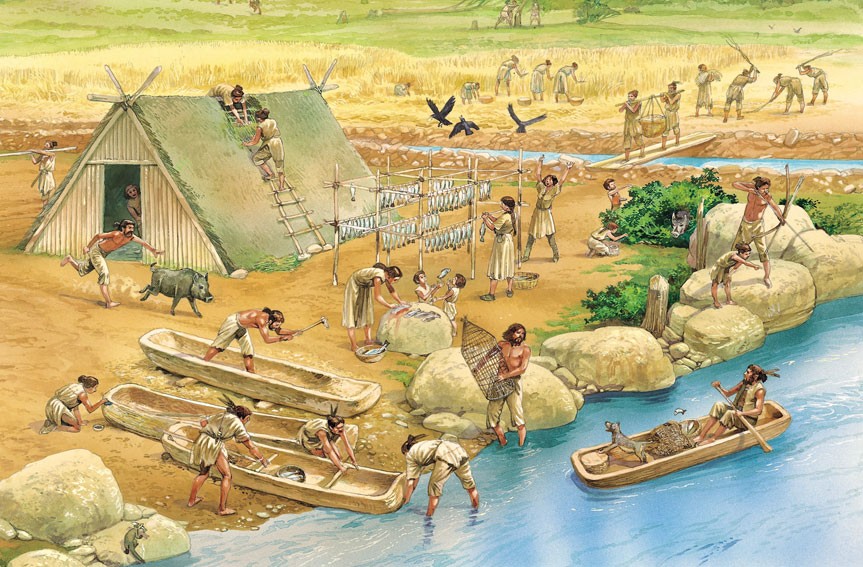
The first water craft, dating back thousands of years, must have been logs, used as buoyancy aids. Later, people tied logs together to make rafts, or hollowed them out to make canoes. Where there were no big trees, they made boats from locally available materials, such as reeds or animal skins. These early craft were propelled by simple paddles, or poles pushed into the river bed.
Ancient Egypt
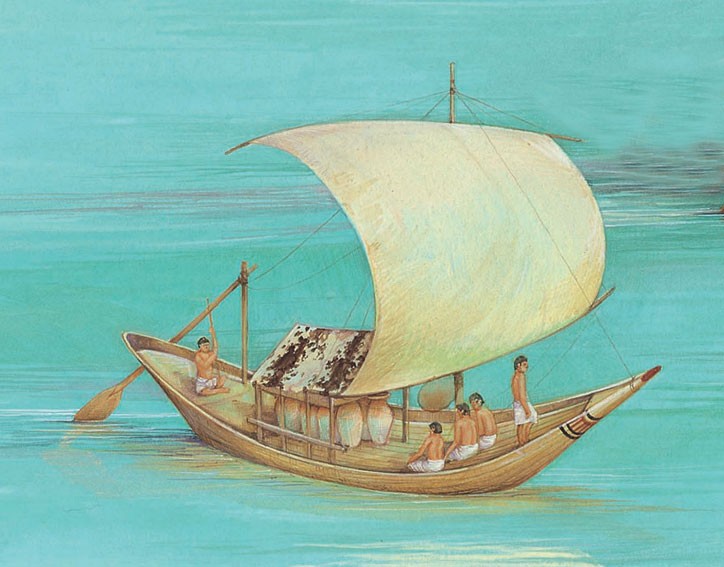
By about 3400 BC, the first sailing ships were in use on the River Nile in Egypt. The hulls of the earliest ships were made of papyrus reeds bundled together. Later, wood from acacia or sycamore trees was used, although only short lengths could be cut from these timbers. They had a single mast with a square sail, which was used in addition to oars when the wind was blowing in a favourable direction. The crew steered with long oars hanging over the stern.
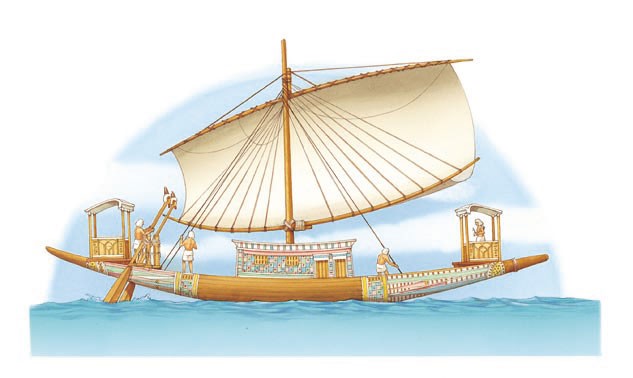
From 2900 BC, Egyptian merchants began to import cedar, a wood from which much longer planks could be sawn. Later Egyptian vessels were built with keels and a ribbed frame, copying the designs of merchant ships from Minoan Crete. Warships of this construction sailed under the command of Pharaoh Ramesses III in about 1400 BC.
Ancient Greek trireme
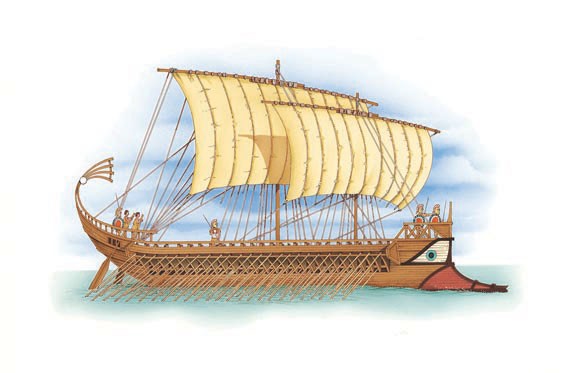
While sails were the best way to power cargo ships, warships needed oars as well as sails to provide extra speed and manoeuvrability. Oared ships, called galleys, were used by the ancient Greeks in war. Rowed by three banks of oarsman, and fitted with a ram and steering oar, Greek triremes triumphed over the mighty Persian fleet in the naval battle of Salamis in 480 BC.
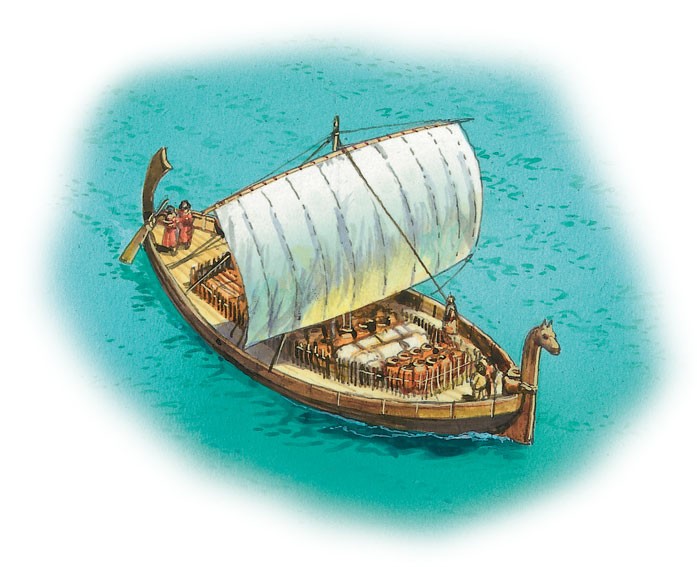
Phoenician hippo
Active between 1500 and 1000 BC, the Phoenicians founded the coastal cities of Sidon and Tyre on the eastern shores of the Mediterranean Sea. They traded their manufactures, including glassware and dyes, for linen, oil, ivory and other goods with cities around the Mediterranean coast. The Phoenicians relied on their sturdy seagoing cargo ships, called hippoi, and their own expert seamanship.
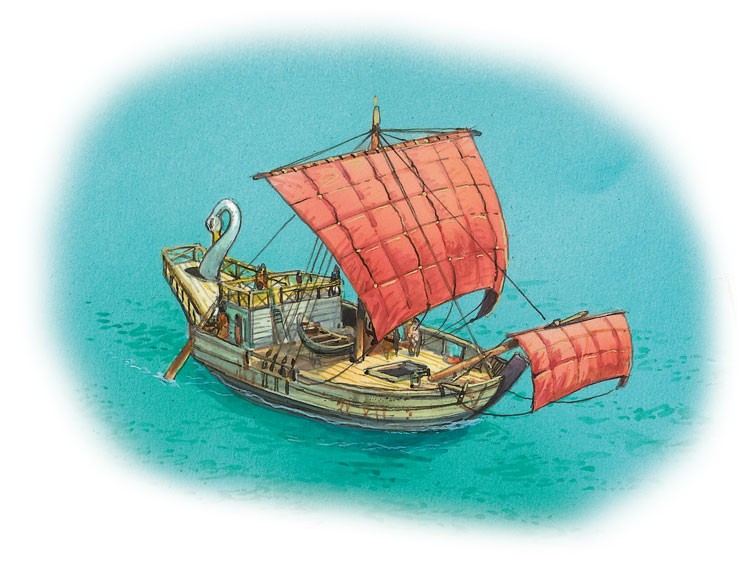
Roman cargo ship
Greek power in the Mediterranean was later challenged by Carthage, a Phoenician colony in North Africa. Carthaginian galleys, called quinqueremes, outclassed the Greek triremes until they were themselves defeated by Roman galleys of a similar design during the Punic Wars (264–241 BC). Roman cargo ships also borrowed some features from Phoenician vessels. The Romans added high sterns, improved rigging and a small sail at the bow to improve manoeuvrability.
Viking longship
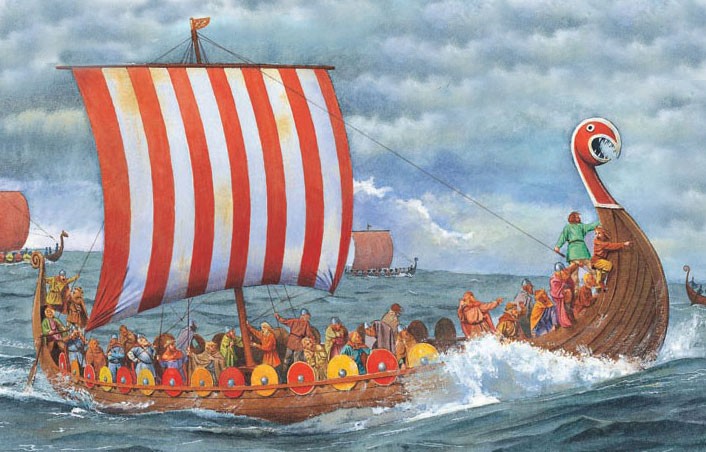
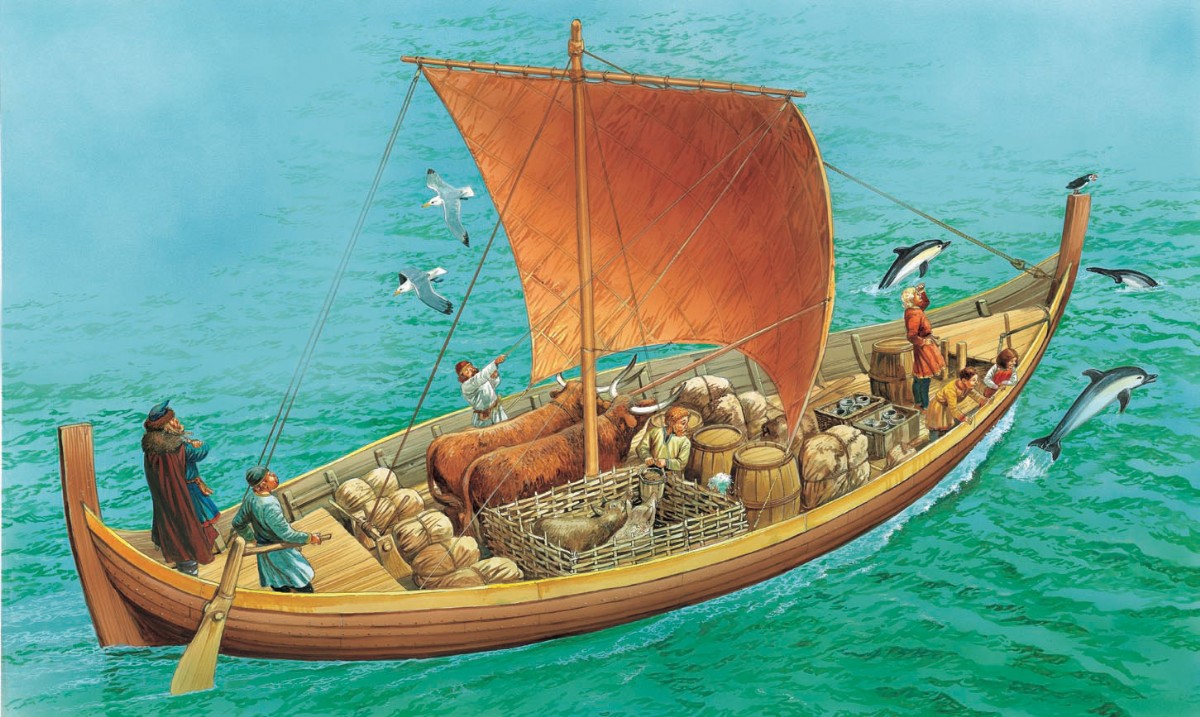
From about AD 800, Norseman from Scandinavia, the Vikings, began to make voyages across the North Sea to raid coastal areas of Britain and Ireland. They also sailed round the coasts of France and Spain to reach the Mediterranean. The hulls of their longships, built from overlapping planks (“clinker-built”) rivetted to frames, were strong and flexible enough for long sea journeys. The ships were also slender and shallow in shape—ideal for making journeys up inlets under oar.
Viking cargo ships, called knarrs, had wider hulls. Viking explorers and settlers travelled in them to Iceland and Greenland, eventually reaching North America in about 1000 AD.
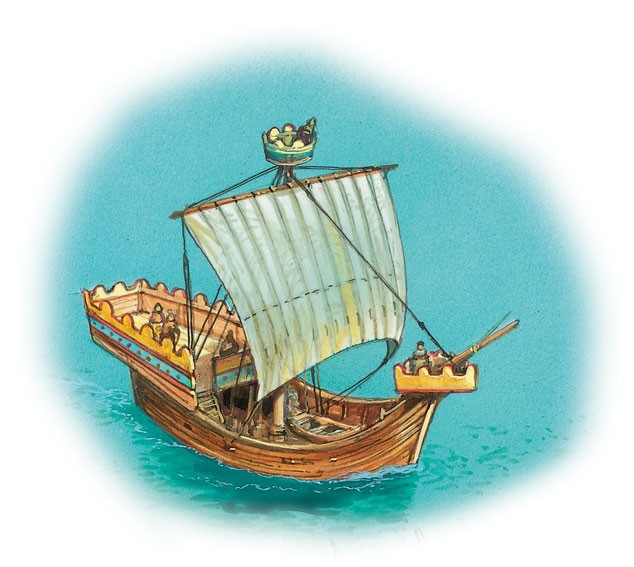
Cog
For several centuries, shipbuilders from northern Europe followed the clinker-built, single square sail design of the Viking longship. Thirteenth century ships had raised platforms at both ends, known as fore and aft “castles”, from where archers could shoot arrows. Trading ships had deep hulls for cargo, so the rudder was fixed to the stern end. These cogs, as they were called, were commonly used by members of the Hanseatic League, trading ports of the Baltic Sea and North Sea, from about 1200 onwards.
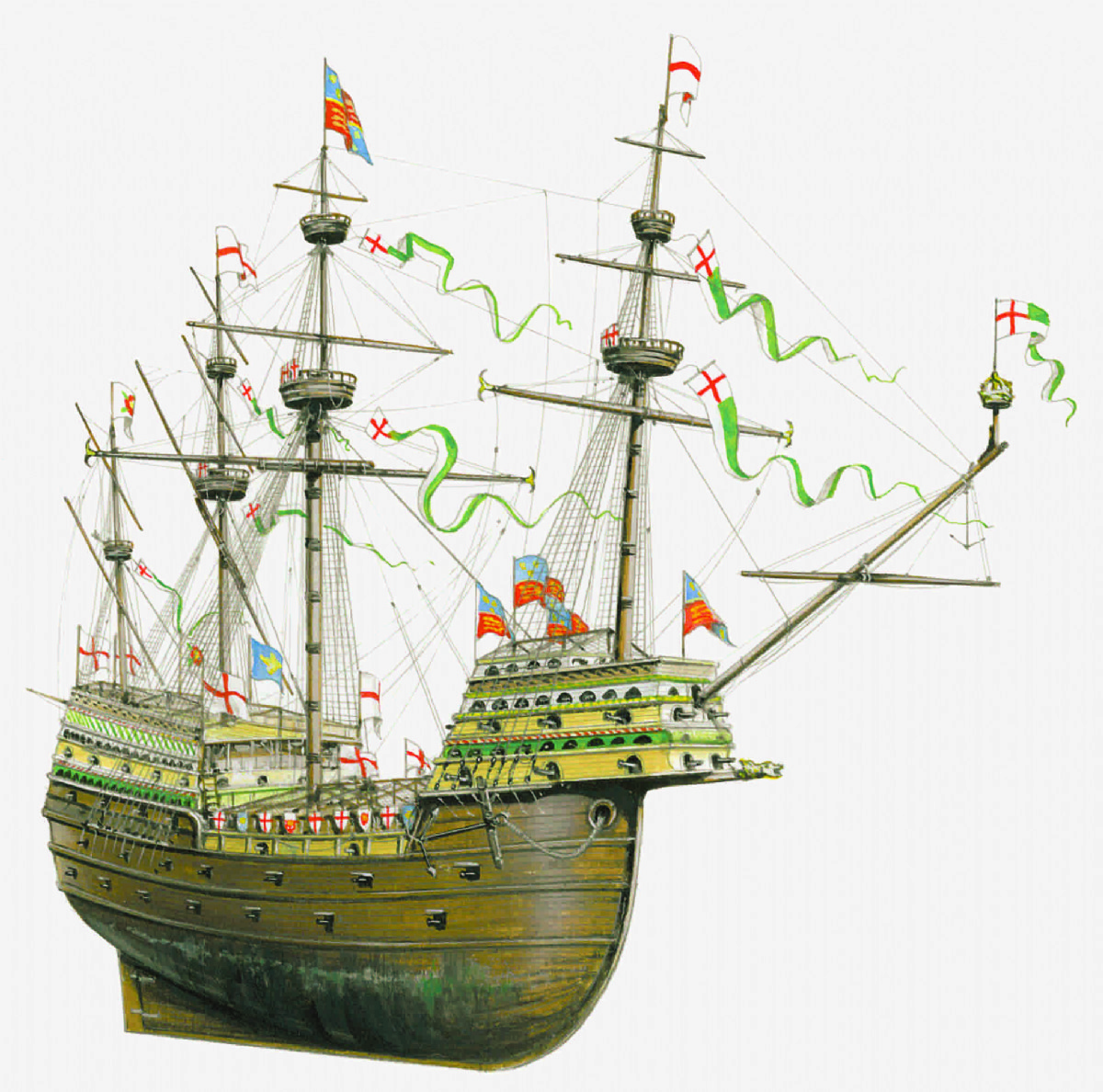
Carrack
As trade between northern and southern Europe expanded, so the designers of ships began to exchange ideas and methods. Instead of clinker-built hulls, northern builders now began to adopt the southern “carvel” method, in which planks were fitted edge to edge on to a frame. This allowed them to construct larger hulls. They also added extra masts and lateen, or triangular, sails, enabling their ships to make better use of the wind. The deep hull, high fore- and aftcastles, and stern-mounted rudder were all kept. The result was the first full-rigged sailing ship: the carrack.
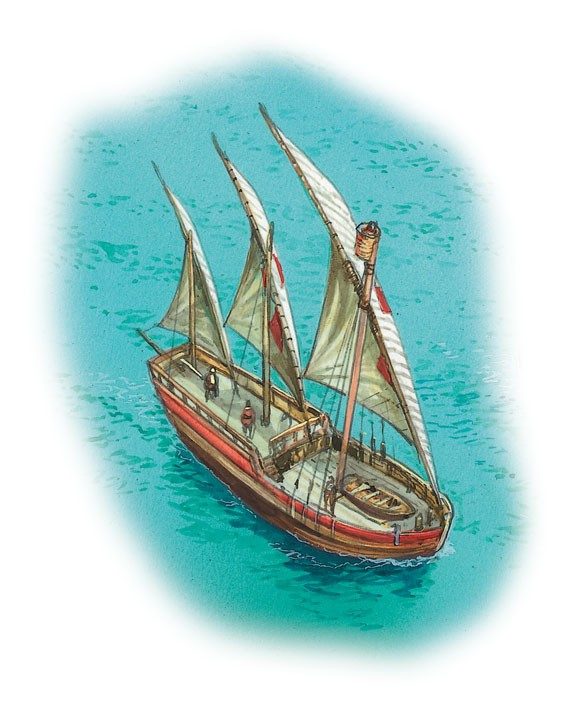
Caravel
In southern Europe, larger ships were needed to trade with the north, so carracks were built there too; they were known as naos. These ships were too bulky and slow for long-distance voyages, so when Portuguese seafarers began to explore the coast of Africa they chose lateen-sailed caravels—smaller, more streamlined vessels based on the design of Arab fishing boats called dhows. By the end of the 15th century, European sailing ships were capable of long ocean crossings. With the aid of compasses to stop them accidentally sailing in circles, sailors set out from European ports to explore the world and to try to find new sea routes to the Spice Islands of Asia.
Chinese junk

A junk is a wooden Chinese sailing ship, first developed in the 2nd century AD and still used by some fishermen today. Between 1405 and 1433 a fleet of junks made seven expeditions across the Indian Ocean from China. The massive, nine-masted flagship, said to be 150 metres (500 feet) in length, was under the command of Zheng He, a trusted servant of the Ming emperor of China. Wall-like internal partitions called bulkheads added great strength to the hull. Their sails were stiffened by thick bamboo poles, and they had a single sternpost rudder for steering.
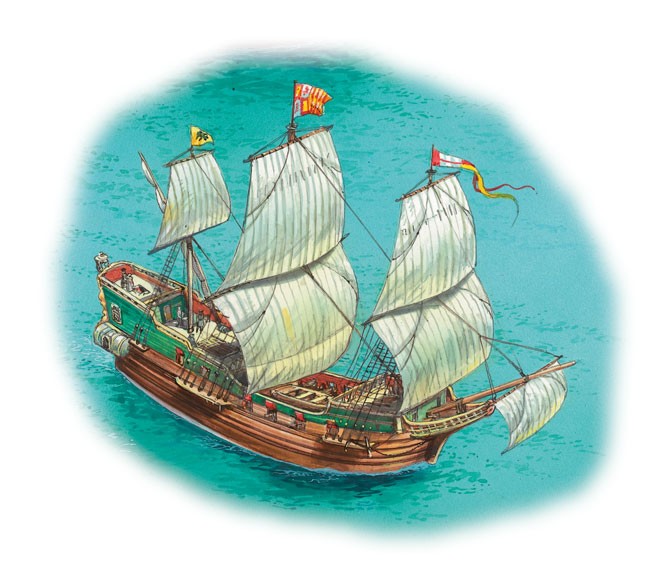
Galleon
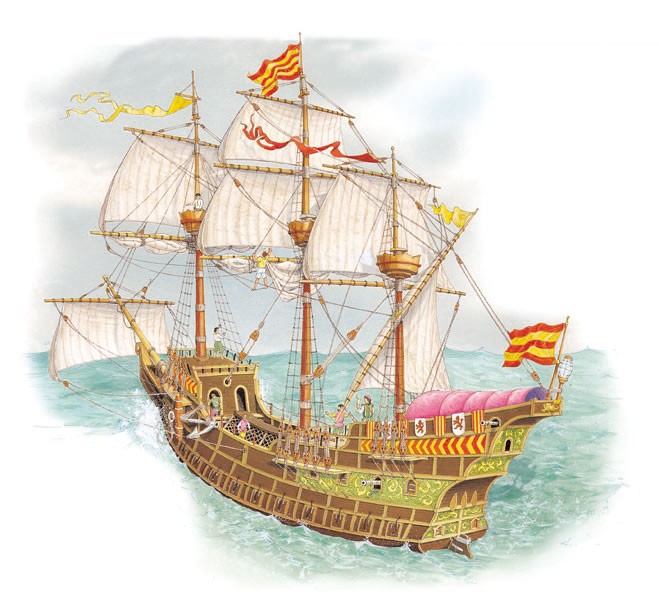
In the early 16th century, Spain needed a new kind of warship to protect its vessels bringing back treasures from its American territories. It would combine the size, sailing rig and design of the nao with the speed and manoeuvrability of the caravel. The Spanish war galleons were large, three-masted ships armed with cannon. They had thick sides and a richly decorated stern. The huge sails had to be pulled up by sailors hauling on heavy ropes. Galleons were used in the battle between the English fleet and the Spanish Armada in 1588.
The Age of Sail
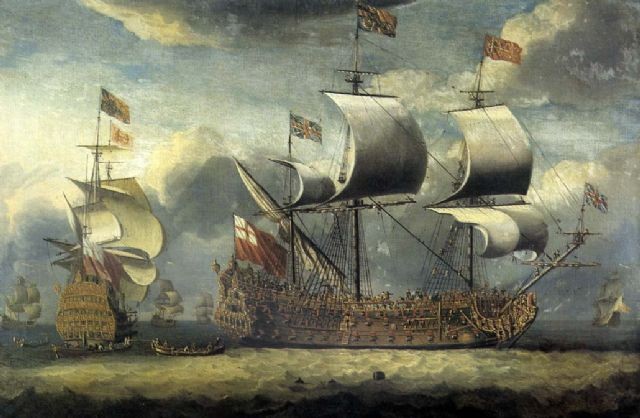
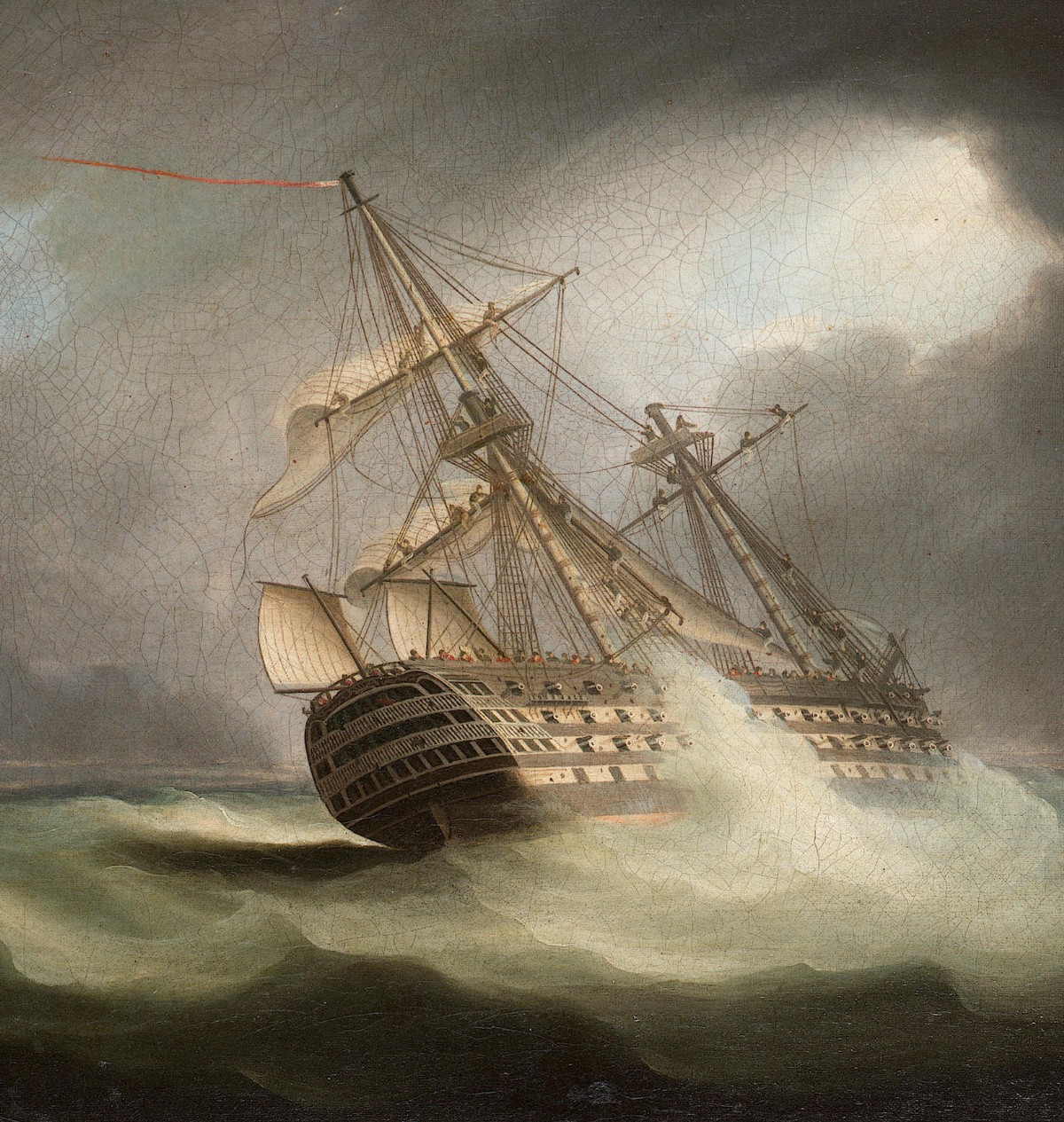
The Age of Sail was the period in which sailing ships dominated trade routes and warfare at sea. It lasted from the 16th to the mid-19th century. During this time, square-rigged sailing ships carried European explorers and settlers to many parts of the world. The man-o'-war was a large, three-masted warship, or frigate, up to 60 metres (200 feet) long, with up to three cannon decks. Sailing vessels, such as clippers and barques, reached their peak in speed and efficiency during the second half of the 19th century, at which point steam-powered ships started to dominate the seas.
Clippers
About 150 years ago, large sailing ships called clippers vied with each other to be the quickest on the high seas. Loaded with tea and powered only by the wind, the clippers raced non-stop from China to Europe—more than halfway around the world—in about 100 days. They owed their speed to a huge sail area, designed to take advantage of light winds, and streamlined hulls.

When the Suez Canal was opened in 1869, the tea trade collapsed for clippers: they could never be as fast as steam vessels, which could now use the canal to cut off the long route round the Cape of Good Hope. Clippers, such as the British ship Cutty Sark, newly built in 1869, focused on the wool trade and the carrying of immigrants between England and Australia and New Zealand instead, although that, too, soon fell to steamships.
Barque
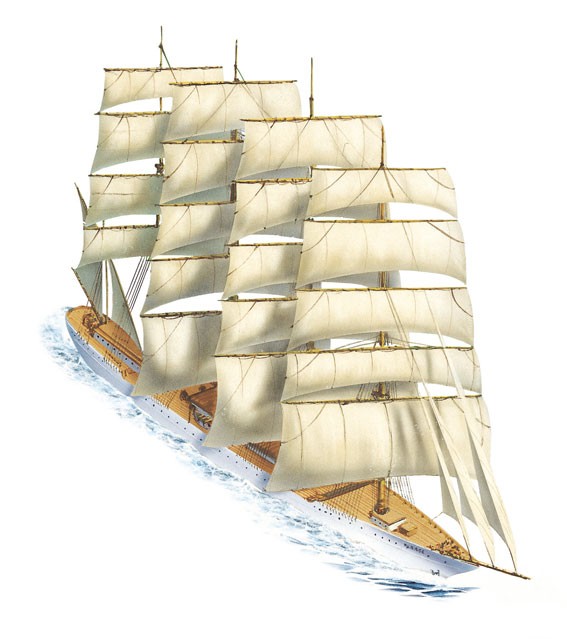
Barques were high-capacity, multi-masted sailing ships that carried bulk cargoes such as grain between Europe, South America and Australia. A small crew could operate the barque’s simple rig.
Consultant: Chris Oxlade
pics


Without in any way limiting Q-files Ltd’s exclusive rights under copyright, any use of this publication to “train” generative artificial intelligence (AI) technologies to generate text is expressly prohibited. Q-files Ltd reserves all rights to license use of this work for generative AI training and development of machine learning language models.