
Castles & knights

CITE
We have made every effort to follow citation style rules, but there may be some minor differences. If in doubt, please refer to the appropriate citation style manual.
Medieval soldiers and weapons. (2022). In Q-files Encyclopedia, History, Castles & knights. Retrieved from
https://www.q-files.com/history/castles-knights/medieval-soldiers-and-weapons
"Medieval soldiers and weapons." History, Castles & knights, Q-files Encyclopedia, 10 Feb. 2022.
https://www.q-files.com/history/castles-knights/medieval-soldiers-and-weapons.
Accessed 6 Aug. 2026.
Medieval soldiers and weapons 2022. History, Castles & knights. Retrieved 6 August 2026, from
https://www.q-files.com/history/castles-knights/medieval-soldiers-and-weapons
History, Castles & knights, s.v. "Medieval soldiers and weapons," accessed August 6, 2026.
https://www.q-files.com/history/castles-knights/medieval-soldiers-and-weapons


Medieval soldiers and weapons
Footsoldiers were a mixture of ordinary men, pressed into service as part of their rent to their lord, and mercenaries, who fought for money. They wore quilted tunics, helmets and chainmail, to protect them while fighting. Their weapons included axes, glaives, slingshots and maces. Castle guards were armed either with a halberd, a long pole with a blade fixed to the end of it, or a bow.


Mounted men-at-arms
Mounted men-at-arms were ranked below knights. They fought on horseback and used lances, bows, swords and maces. Knights invested in expensive metal armour to protect themselves—and sometimes their horses. The poorer men-at-arms could only afford chainmail and helmets for protection.
Weapons

A glaive was used for stabbing and slashing. It was a useful against mounted men-at-arms. Swords did the same job when fighting in close combat. A mace was heavy enough to smash helmets and body armour. With sharp, well-balanced blades and long shafts, axes were particularly effective weapons against armour.
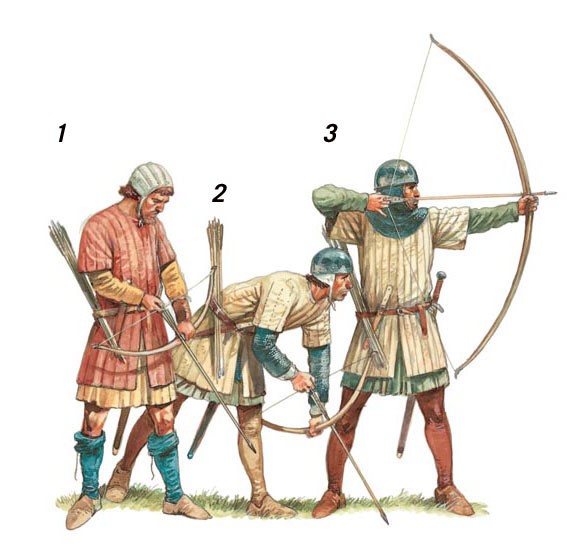
Longbows
Both castle garrison and besieging armies relied on their bowmen when fighting began. Longbows were as tall as men. With training, a good longbowman could shoot 12 arrows a minute, achieving a high degree of accuracy over long range—200 metres (1000 feet) or more.
To shoot an arrow with a longbow, the archer first “nocked” his arrow on to the bow string (1). He then drew back the string (2) and took aim, looking directly down the arrow shaft, before releasing the arrow (3). This process demanded great strength and accuracy.
Arrowheads
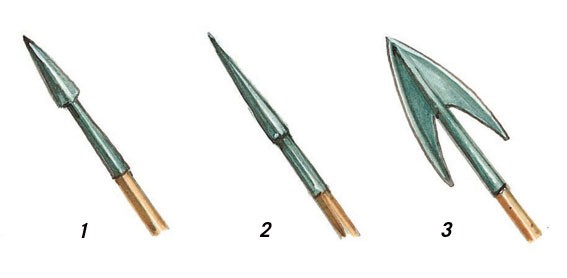
Different types of arrowheads were needed for different targets. A general arrowhead (1) could kill a man without armour. A needle-like bodkin (2) was sharp enough to pierce a mounted knight’s armour. A broadhead’s barbs (3) were difficult to pull out and were used to wound warhorses.

Crossbows
No special training was required to shoot with a crossbow, but they were slower to repeat-fire than longbows. Crossbows fired metal-tipped bolts rather than arrows. They could be left “cocked”: wound back with the bolt in place, ready to shoot instantly and with great power. This allowed the crossbowman to aim better, using sights to fix his target. the weapon was accurate and powerful at short range, and some could shoot as far as a longbow.
To shoot a bolt with a crossbow the bowstring had to be drawn back and locked in position by a trigger (1). A great amount of force was necessary to draw the bow, so in some designs a lever or winding device was used. The bolt was then placed in position (2). The crossbowman took aim before releasing the trigger (3).
Ballista

The ballista was a giant, frame-mounted crossbow. To operate it, the drawstring was winched back using a cranked wheel. It was then loaded with a massive arrow—more like a javelin—and fired by releasing the drawstring with a lever. Though not capable of destroying walls, the ballista was suitable for accurate aiming and for attacking specific targets.
Consultant: Philip Parker
pics

Without in any way limiting Q-files Ltd’s exclusive rights under copyright, any use of this publication to “train” generative artificial intelligence (AI) technologies to generate text is expressly prohibited. Q-files Ltd reserves all rights to license use of this work for generative AI training and development of machine learning language models.